 IMPLICATOR

Implicator PRO Briefing / Tuesday, 9 Jun 2026
Voice dictation has become the uncommon AI product that changed a habit rather than speeding one up. As the speech models underneath it turn into a commodity, the contest has moved to the layer above them, and that is where an open-source project run by one developer competes with venture-funded incumbents and with the operating systems closing in on all of them.
Marco Hillger speaks, and the words land where he needs them. Not in a separate dictation window but inside the GitHub comment he is writing, or the body of an email already open on screen. He works from a study south of Berlin, close enough to the city limit that the S-Bahn reaches him. The software running in front of him is his own. He calls it TypeWhisper.
Three years ago, Hillger said in an interview, a stroke impaired the right side of his body and ended his ability to type for any sustained stretch. He needed something to replace the keyboard. The best-funded app in the category at the time, a San Francisco product called Wispr Flow, lagged enough between his last syllable and the inserted text that a full workday with it became, by his account, close to unworkable. So he wrote his own, and he has kept writing it. A new version goes up on GitHub most days.
Key Takeaways
- Voice dictation crossed into behavior change. Wispr Flow reports its average user writes more than half their characters by voice after three months, a company figure.
- The speech recognizers (Whisper, Parakeet, Apple's SpeechAnalyzer) have commoditized, so the defensible value moved up to the editor that turns speech into finished prose.
- Wispr Flow leads on capital, with $81 million raised at a reported $700 million valuation, and carries a cloud-privacy record rivals exploit.
- TypeWhisper, free and open-source, built by a developer who cannot type, out-engineers the paid leaders on control, privacy, and cost, and trails them on polish.
- Apple, Microsoft, and Google hold every component but have not assembled a product, leaving the standalone apps a window of two to four years, not one.
AI-generated summary, reviewed by an editor. More on our AI guidelines.
That is the smaller of two stories about AI dictation in the spring of 2026, and the more instructive one. The larger story is the capital. Wispr Flow has raised $81 million in venture funding, including $30 million from Menlo Ventures in June 2025 and $25 million from Notable Capital in November 2025, and was valued at a reported $700 million after that last round, according to TechCrunch. Its chief executive, Tanay Kothari, describes the product not as a writing utility but as a "voice operating system." He has said he took the money because the threat he watches is Apple, Microsoft, and Google, each of which now ships a version of AI dictation inside the operating system itself.
Between those two poles, a free project maintained by one person and a company chasing a billion-dollar interface, sits the question that decides what an organization can actually put on its machines. Wispr reports that its average user writes more than half of their characters by voice rather than keyboard after three months, a figure the company states and no independent party has audited. Once that habit forms, the keyboard starts to feel slow on the way back. The fight now is over the layer that turns loose speech into finished prose, and over whether any standalone app can hold that ground before the platform owners take it.
This briefing maps the field for that decision. It covers the capitalized leader, the open-source challenger that prompted this piece, the configurable middle, the cloud speed specialists, and the three incumbents waiting in the second row. It treats the privacy divide as the axis that increasingly determines which app a regulated buyer can authorize at all. And it returns to the developer south of Berlin, because his project is the clearest evidence for where the durable value in this category now sits.
From speech recognition to a writing surface
The dictation that exists now is a different product from the one a decade ago. Older systems, built around Nuance's Dragon, turned speech into a literal transcript and left the cleanup to the user. The current generation does the cleanup itself. It removes the false starts, repairs the grammar, sets the punctuation, and adapts the register so that the same spoken sentence comes out terse in Slack and formal in an email. The category stopped being a speech-recognition problem and became a writing problem.
Under the hood, each of these apps is built from three parts. A recognizer turns the audio into raw text. A language model then rewrites that text into something a person would have been willing to type. A small piece of software inserts the finished sentence wherever the cursor happens to be. The first two parts get the marketing. The third, the least glamorous, often decides whether speaking feels like switching tools or simply like another way of typing.
Only a handful of companies still build the recognizer at scale. OpenAI's is called Whisper, Nvidia's is Parakeet, and Apple added its own, SpeechAnalyzer, in 2025. All three are available to anyone who wants to build on them, and the open variants run locally on a modern Mac. The polishing pass usually runs on a large model from one of the familiar cloud providers, though it can run on a smaller model on the user's own drive. The recognizer, in other words, has commoditized. The same shift that is collapsing the old three-model voice pipeline at the infrastructure level shows up here at the product level. The defensible work has moved up the stack, away from the recognizer and toward the part of the app that decides what to cut from a spoken sentence and how to make the rest read like the person who spoke it.
That migration is why a free app can compete. When the recognizer is a download and the polishing model is a metered API call, the thing left to differentiate is the surrounding loop: the per-application vocabulary, the prompt that does the rewriting, the privacy defaults, the latency, and the muscle memory of a single keystroke that works in every text box. An incumbent can be richer and still lose that loop to a developer who cares more about it.
It is also why the behavioral claim matters. Spoken sentences run longer and looser than typed ones, full of half-formed thoughts that a competent model smooths into prose. A poor model smooths them too, which is the more serious problem and the subject of a later section. But when the smoothing works, the bottleneck in writing stops being transcription, the labor of getting words down, and becomes composition, the harder labor of having something worth saying. Wispr's reported figure, more than half of characters by voice within three months, is the strongest evidence that the shift is real rather than a novelty. It is also company data, unaudited, and worth holding at arm's length until someone outside the company measures it.
I — THE LEADER
Wispr Flow and the voice-interface bet
Wispr Flow is the capitalized leader, and it did not start as a dictation app. Kothari and co-founder Sahaj Garg first pursued a neural wristband for silent speech, a hardware project, and built the software layer to test the device. The software turned out to have its own demand, and in the second half of 2024 the team pivoted to it. The pivot worked. The company now reports accounts at 270 of the Fortune 500 and growth that TechCrunch, citing the company, put at 50% month over month in mid-2025. It supports 104 languages, with German among the most-used non-English ones, and TechCrunch reported that 60% of dictations on the platform are in a language other than English.
The product runs in the cloud on Wispr's own models rather than on third-party Whisper. Kothari has told TechCrunch the team designed around how people actually speak rather than around word-error-rate benchmarks. The result is fast and, for casual use, very good: the company quotes text insertion in under 700 milliseconds, and the polishing layer handles tone matching and filler removal well enough that most users accept the output without editing. There is no offline mode. Every recording leaves the device.
That last fact is the company's exposure. In the autumn of 2025, a Reddit analysis of Wispr's network traffic reported that the app's "Context Awareness" feature, which reads the active window so the model knows whether it is drafting an email or a Slack message, also transmitted screenshots of that window. Garg apologized publicly. The company says training on user content is now off by default and offers a Privacy Mode with zero data retention, and it lists SOC 2 Type II and HIPAA compliance across its plans. The catch sits in the defaults. Context Awareness is on by default on the desktop, Privacy Mode is not, and enforcing the stricter setting across an organization requires an enterprise contract, per Wispr's own security documentation.
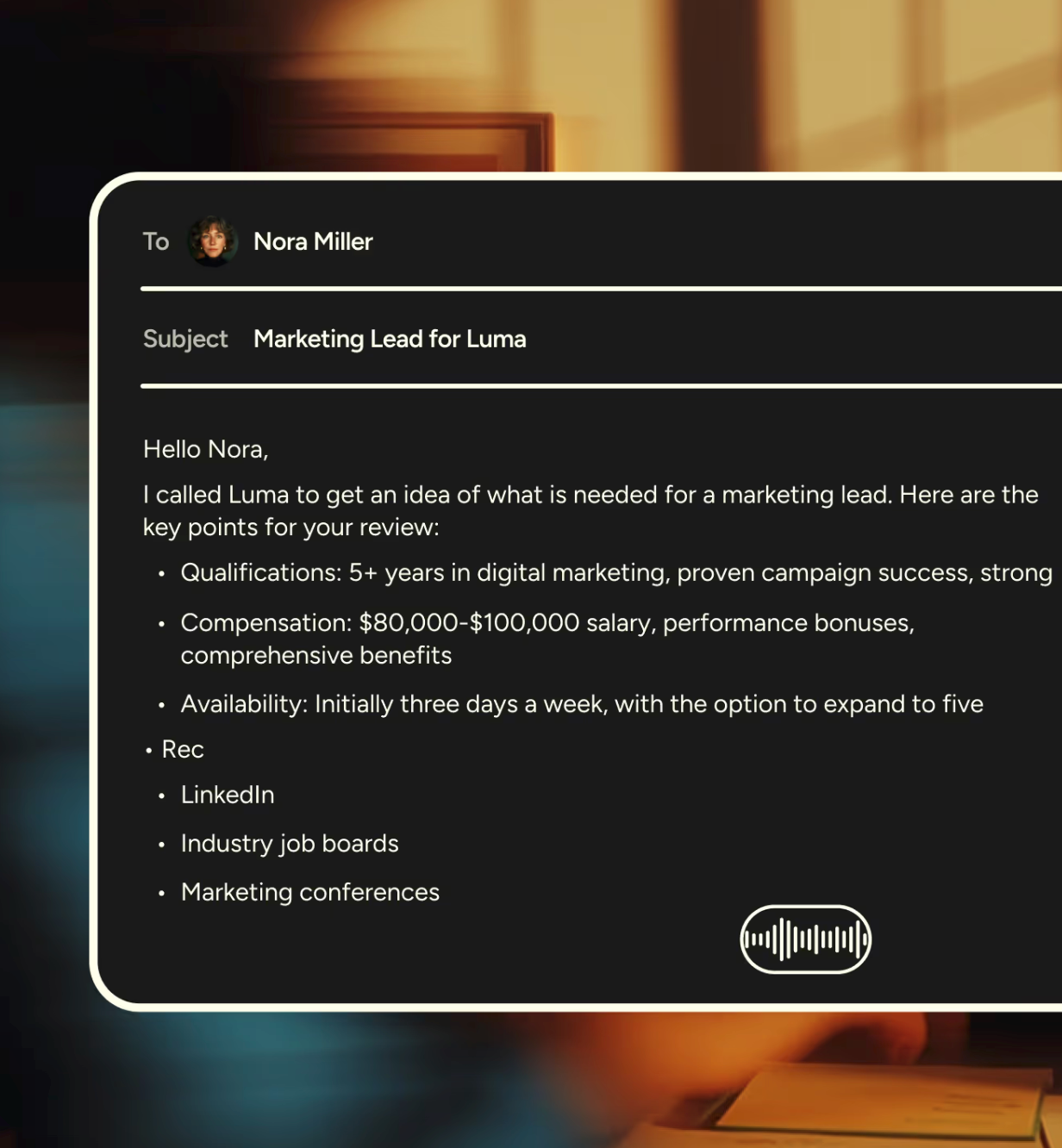
The funding only makes sense in that light. The $81 million it has raised is more capital than a productivity utility selling Pro seats at $15 a month can deploy. It buys a wager that the speech layer becomes the interface for the next class of devices, and that Wispr's models become the layer everyone else builds on. Kothari has been explicit that the platform owners' distribution is the risk that pushed him to raise rather than stay lean.
II — THE CHALLENGER
TypeWhisper, the open-source switchboard
Hillger is 41. He studied communication and information management and has worked in software for more than fifteen years, six of them as a developer at a financial firm where, he said, a two-person team grew to roughly 40 before he left to start his own company. None of that is the reason TypeWhisper exists. The reason is that after the stroke he could no longer rely on his hands, and the tool he needed was not on the market in the form he wanted. He built the tool for himself first. The business came after.
It is barely a business, by design. TypeWhisper is free and licensed under GPLv3 for personal use, with commercial licenses and support starting in the single-digit euros per month and team and enterprise tiers above that. By Hillger's account it began earning around 2,000 euros a month within two months of introducing the paid option, with no marketing behind it. "I'm not an influencer," he said when asked why he had not produced the kind of recommended-settings guide that would help newcomers. That reluctance is also the product's main weakness, which the next paragraph gets to. The point for now is the model: TypeWhisper sells trust, support, and deployment flexibility around an open core, not access to a hosted service. Distribution is word of mouth. The first calls from the United States came, Hillger said, after the YouTuber Quinn Nelson, who runs the Mac channel Snazzy Labs, praised the app.
"I'm not an influencer."
Marco Hillger, on why TypeWhisper ships without a setup guide
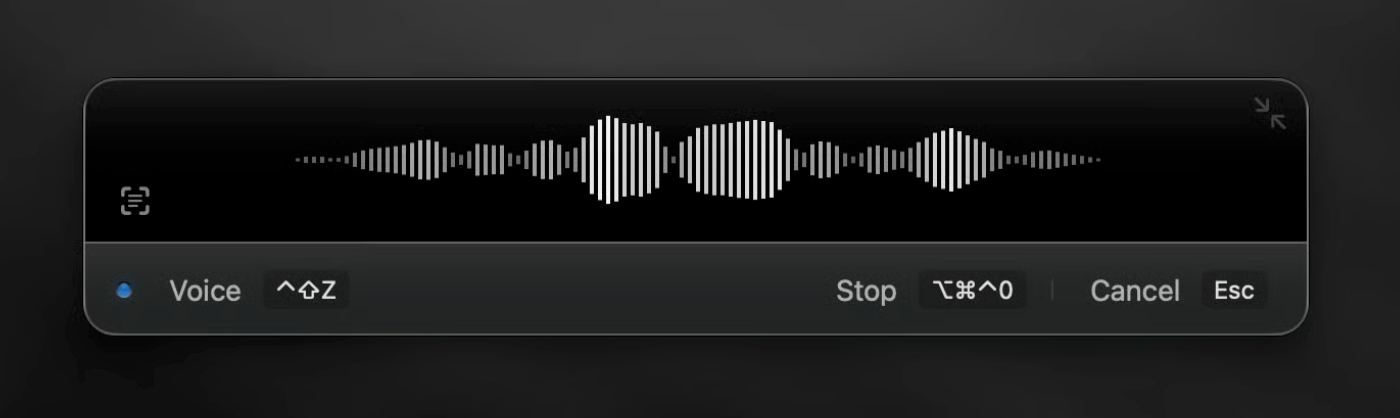
What makes it the most architecturally interesting product in the category is that it commits to nothing and connects to everything. The recognizer is the user's choice: Apple's SpeechAnalyzer on macOS 26, Nvidia's Parakeet for European languages, Apple's neural-engine WhisperKit for breadth, with add-ons for Qwen3 ASR, Groq's hosted Whisper, and OpenAI's. The polishing model is the user's choice too: Apple Intelligence on-device, Groq, OpenAI, Google's Gemini, or a local Gemma model. On top of that sits a workflow layer most paid apps do not expose at all: a dictionary, snippets, history, and profiles that can change the app's behavior per application and even per website, so the cleanup prompt in a code editor differs from the one in a mail client. There is a local REST endpoint and a command-line tool for scripting. If Apple's recognizer becomes the fastest local path, TypeWhisper integrates it rather than competing with it. The design is the same one that let Visual Studio Code win the editor market: an open shell that absorbs whatever component improves next.
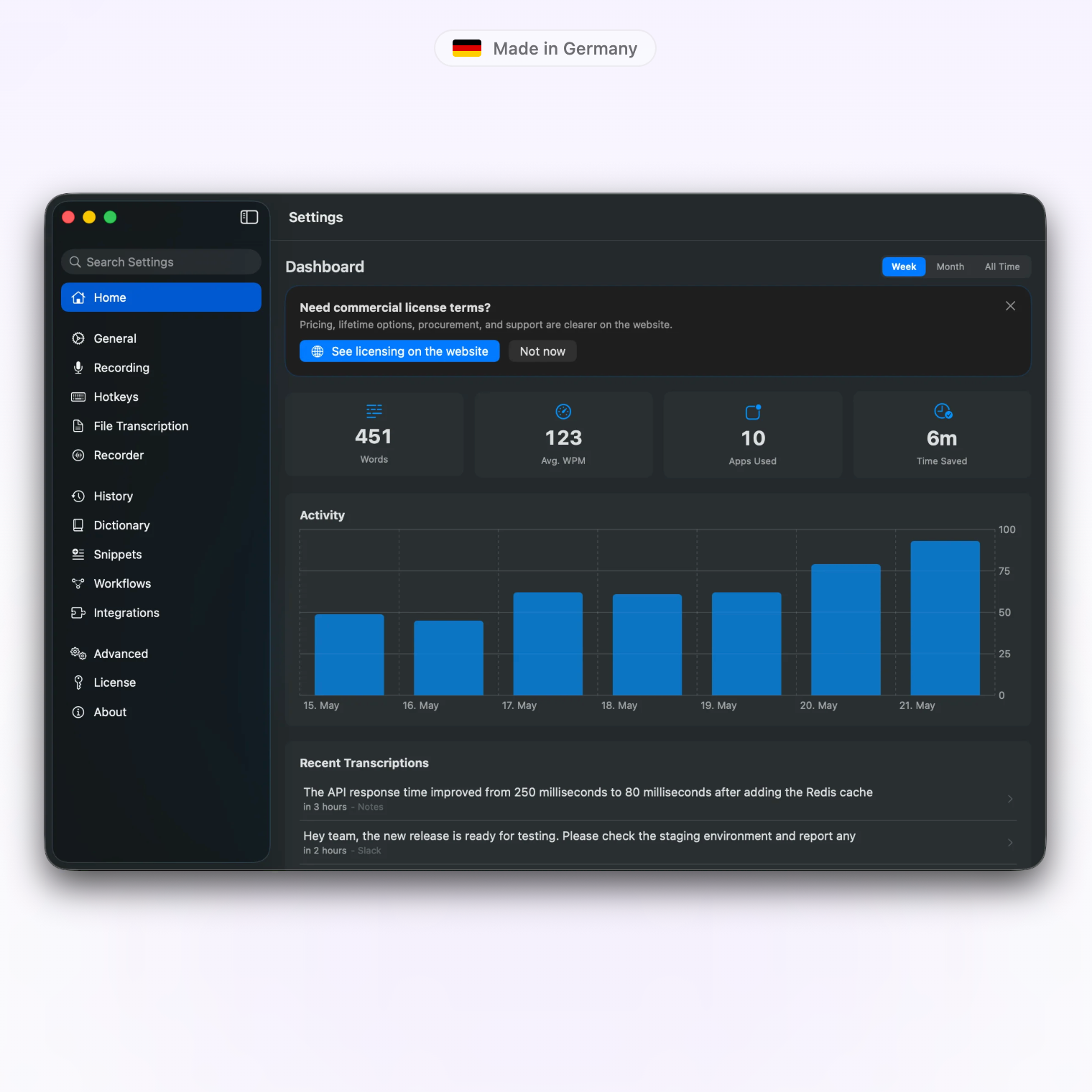
Hillger's own stack is a useful illustration of the control he is selling. He uses Parakeet for local transcription and Groq for the cloud cleanup pass, "not the Elon Musk Grok," he added, distinguishing the inference provider from the chatbot. He builds the app itself with an AI coding assistant, and in April 2026 he switched the model behind that work from Anthropic's Claude to OpenAI's Codex. The reason was consistency. "With Claude there were some days where it really wasn't good," he said; Codex ran more evenly day to day. The detail is worth noting because it is the kind of judgment a heavy daily user makes and a benchmark does not capture.
The honest assessment is that TypeWhisper out-engineers the paid incumbents on the axis that is becoming decisive, and trails them on the one buyers notice first. On control, privacy, configurability, and cost, nothing else in the category matches a free, local-first, engine-agnostic shell. On polish and platform maturity it is behind, and Hillger is the first to say so. He asked that the project not be described as equally finished everywhere: macOS is the stable path, Windows is in beta, and the iOS build is still an early preview. The configurability that power users prize is the same friction that sends a non-expert back to a product that simply works on first launch. That gap, between a tool that can be tuned and a tool that is already tuned, is the whole reason a paid market still exists above the free one.
III — THE MIDDLE
Superwhisper, the configurable middle
For users who find Hillger's approach too austere, Superwhisper is the nearest polished alternative. It runs local Whisper models and Parakeet, with optional cloud language models reached through the user's own API keys, and it wraps that flexibility in a more guided experience than TypeWhisper offers. The Globe and Mail, which profiled the bootstrapped shop behind it as a Toronto startup with no institutional funding, reported hundreds of thousands of weekly active users and named Meta, OpenAI, Coinbase, and Dropbox among its customers, all company-supplied figures. The same profile described an investment banker who dictates at 162 words a minute against a typing speed of 60.
Superwhisper's real product is its mode system. A user defines a separate set of instructions for each application: a polite register for Gmail, a terse one for Slack, an instruction to leave variable names untranslated in the Cursor code editor. That is more capable than Wispr's automatic tone detection and more demanding to set up; one reviewer compared the initial configuration to provisioning a server. Pricing runs about $8.49 a month, $84.99 a year, or $249.99 for a lifetime license, which makes it the most expensive on-device Mac option at the top tier and the obvious target for cheaper local tools and free ones underneath it. The strategic question for Superwhisper is the size of the market for a paid, highly configurable workflow when an open-source equivalent sits beside it and the operating system is climbing toward the same baseline.
Get the AI strategy brief
Strategic AI news from San Francisco. No hype, no "AI will change everything" throat clearing. Just what moved, who won, and why it matters. Daily at 6am PST.
No spam. Unsubscribe anytime.
IV — THE CLOUD
Aqua Voice and Willow, built for the cloud
Two newer entrants accept the cloud trade-off in exchange for speed and polish. Aqua Voice, based in San Francisco, runs a proprietary model it calls Avalon and markets very low latency, with figures around a 50-millisecond launch and text insertion as fast as 450 milliseconds, and strong handling of technical vocabulary. Its target is the developer dictating into Cursor, Linear, or Slack, where class names and identifiers have to survive the cleanup pass intact. Aqua publishes a model card with performance claims; no independent benchmark of the full app exists, and there is no offline mode. Pricing sits around $12.99 a month.
Willow Voice, backed by Y Combinator, belongs to the same cloud-first, venture-funded cohort as Wispr. It sends audio to the cloud, adds team management and writing-style memory, and takes compliance more seriously than most of its peers, listing HIPAA and SOC 2 by plan. Its blog claims 98% accuracy and 200-millisecond latency, both company figures and unverified. Willow is the alternative for a buyer who wants Wispr's convenience with stricter administrative controls. Like Aqua, it asks the customer to accept that the recording leaves the building.
| App | Engine | Local or cloud | Price floor | Best for |
|---|---|---|---|---|
| TypeWhisper | 10+ swappable: WhisperKit, Parakeet, SpeechAnalyzer, plus cloud add-onsBYOK polish model | Local-first | Free (GPLv3) | Privacy-sensitive power users who want to control every layer |
| Wispr Flow | Proprietary cloud models | Cloud only | $15/mofree tier | A fast cross-app default; enterprise teams |
| Superwhisper | Whisper + Parakeet, BYOK cloud LLMs | Local or cloud | $8.49/mo$249.99 lifetime | Per-app modes for Mac power users |
| Aqua Voice | Proprietary "Avalon" model | Cloud only | $12.99/mo | Low-latency dictation into code editors |
| Willow Voice | Proprietary cloud models | Cloud only | $15/mofree tier | Teams needing admin controls and compliance |
| Apple Dictation | SpeechAnalyzer, on-device | Local | Freein macOS 26 | Casual notes; cuts off after silence |
| Microsoft Fluid Dictation | On-device small language model | Local (Copilot+ only) | Freein Windows 11 | Accessibility on new Windows hardware |
| Google AI Edge Eloquent | Gemma on-device, Gemini cloud cleanup | Local or cloud | Free | Offline mobile dictation on iPhone |
| Dragon Professional 16 | Legacy Nuance recognizer, no LLM layer | Local | $699one-time | Regulated desktop vocabularies |
V — THE INCUMBENTS
What Apple, Microsoft, and Google ship today
The platform owners can take the bottom of this market whenever they choose to assemble what they already own. So far they have shipped the components and left them unassembled.
Apple is furthest along on the underlying technology while its consumer dictation stays among the most limited in the category. The SpeechAnalyzer framework it introduced at its June 2025 developer conference and shipped in macOS 26, code-named Tahoe, is fast: in a beta test the MacStories writer John Voorhees clocked it transcribing a 34-minute file in 45 seconds, around 55% quicker than MacWhisper running Whisper Large V3 Turbo on the same file, with no quality penalty he could hear in that single run. Apple Intelligence supplies the rewriting layer, and the framework is open to any developer. Yet Apple's own consumer dictation cuts off after about 30 seconds of silence, accepts no custom vocabulary, and offers no per-app control. The timeout is a policy choice, not a technical one, because the developer framework carries no such limit. The practical effect is that a third-party app, Hillger's included, can reach better Apple speech recognition than Apple gives its own users.
Microsoft's version, Fluid Dictation, runs inside Windows Voice Access and uses an on-device small language model to clean grammar, punctuation, and filler in real time. It is gated to Copilot+ PCs with a dedicated neural chip, a small slice of the installed base, and it is English-first. It also surfaces the category's central danger most clearly. Microsoft's own support forums carry complaints that Voice Typing rewrites what was dictated into a smoothed-over version of it. A recognizer that drops a word gets caught on review. A polishing layer that quietly turns a hedge into an assertion does not, and that failure mode matters more for a lawyer or a clinician than any latency number. Microsoft also owns Nuance, which it bought in 2022 for $19.7 billion, yet Dragon Professional 16 still sells for $699 as a one-time purchase with no modern language-model layer and no announced successor. The company's attention has gone to hospital dictation, where Dragon Copilot has a defensible position, while the desktop product stands still.
A recognizer that drops a word gets caught on review. A polishing layer that quietly turns a hedge into an assertion does not.
Google shipped the closest thing to a free standalone competitor. AI Edge Eloquent arrived on the iPhone in April 2026, runs a Gemma-based model on the device, works offline, and adds cloud cleanup modes through Gemini. An Android version is promised without a date. It is a real threat to paid mobile dictation and a poor fit for the desk, where a long report is the use case. Google's separate strength is Gboard, whose advanced voice typing detects languages automatically on recent Pixel phones and supports English, French, German, Italian, Japanese, and Spanish. That is the better mid-sentence multilingual story in the category, and it is mobile-first.
VI — PRIVACY
Where the recording goes
What increasingly decides which app a company can deploy is where the recording goes and what the editor is allowed to change. Accuracy matters less than either.
Audio is among the most sensitive material a knowledge worker handles, and the finished transcript usually is too. A physician dictating a finding, an attorney drafting privileged correspondence, an investigative reporter recording a source's name: in each case a recording that leaves the device for a cloud server the user does not control, or a transcript stored and used for training, is a problem before anyone weighs convenience. This is the point Hillger built his architecture around, and it is the one a buyer in a regulated function should weigh first. The cloud-first products, Wispr, Aqua, and Willow, ask the user to trade that exposure for polish and cross-platform sync, the same trade most people already make with email and chat assistants. The local-first products, TypeWhisper, Superwhisper, VoiceInk, and the operating-system recognizers, keep the audio on the machine by default.
The harder problem is the editor, not the channel. Because the polishing model rewrites rather than transcribes, it can change meaning while improving fluency. The Microsoft forum complaints are one symptom. The multilingual case is another: a speaker who shifts between German and English mid-sentence, common in a Frankfurt headquarters or a San Francisco startup, exposes the limits of every recognizer. Whisper switches languages but hesitates; Parakeet covers 25 European languages, though evidence on smooth mid-sentence switching between them is thin. The working fix is a profile that pairs Whisper as the recognizer with a large model as the final editor, the kind of arrangement only a configurable tool permits and a sealed consumer product forbids. The same gap shows up at the model level in Deepgram's mid-call language switching, and here it decides whether a bilingual team can use a given app at all.
| App | Audio leaves device | Default posture | What it captures | Compliance |
|---|---|---|---|---|
| Wispr Flow | Yes, to the cloud | Context Awareness on; Privacy Mode off | Audio, transcript, active-window context | Lists SOC 2 Type II, HIPAA |
| Aqua Voice | Yes, to the cloud | Cloud processing, no offline mode | Audio, transcript | Not independently audited |
| Willow Voice | Yes, to the cloud | Privacy Mode varies by plan | Audio, transcript, writing-style memory | HIPAA, SOC 2 by plan |
| Superwhisper | No by default | Local models offline; cloud optional | Local audio; text only if a cloud mode is on | Depends on chosen provider |
| TypeWhisper | No by default | Local-first, no forced telemetry | Stays on device unless a cloud add-on is chosen | Self-hosted, GPLv3 |
| Apple Dictation | No | On-device on Apple Silicon | On-device audio | Apple privacy terms |
| Microsoft Fluid Dictation | No, on Copilot+ PCs | On-device small model on NPU hardware | On-device on Copilot+ machines | Device-based processing |
The privacy divide also explains a structural advantage that the local-first camp has not fully pressed. As healthcare, legal, and financial buyers add data-residency requirements, a tool that processes on the device and exposes its own prompts and dictionaries can satisfy an auditor in ways a sealed cloud service cannot. That is the argument TypeWhisper, Superwhisper, and the open-source projects can make and the cloud incumbents must work to answer. It is also the argument that survives even if the operating systems win the casual market, because the operating systems do not yet expose the prompt-level control a compliance officer wants to inspect.
VII — ABSORPTION
How much the operating systems will absorb
The case that the whole category collapses into the operating system within a couple of years is easy to assemble and probably too fast. Apple has shown one of the fastest local recognizers in early testing and offers a free rewriting layer. Microsoft has on-device cleanup on new hardware. Google has an offline app and the best mobile multilingual support. All three have the recognizer, the polishing model, and the distribution. Kothari named that combination as the reason he raised $81 million rather than coast toward profitability.
The case against the quick collapse is the gap between owning the parts and shipping the product. Apple keeps a 30-second timeout on dictation it does not impose on developers. Microsoft's polish is locked to Copilot+ hardware and to English. Google's app is iPhone-only with Android unscheduled. Dragon, under the company that owns the most capable language-model infrastructure on the planet, has not had a meaningful update in years. None of the three has assembled a coordinated dictation product, and their efforts are scattered across separate teams with different limits.
The likely outcome is a split rather than a clearance. Baseline polished dictation becomes a free operating-system feature, good enough for casual notes and short messages, and the simple paid utilities that do nothing more than wrap Whisper get squeezed out. The standalone apps that survive move upmarket into the work the platforms cannot generalize: per-app prompts, team dictionaries, specialist medical and legal vocabularies, the option to bring your own model, local-first compliance, portability across Mac, Windows, and Linux, and the assurance that the invisible editor will not alter a sentence's meaning. The window for that move is real but not urgent. Two to four years, not one to two. The risk to the independents is less that Apple ships something better than that Apple ships something good enough and free, bundled where the user already lives, which for casual writing is already true.
China shows where the absorption story ends if it runs to completion. There the voice layer lives inside input methods, phones, and super-apps rather than standalone tools. iFlytek reports hundreds of millions of users for its voice products, and ByteDance's Doubao assistant passed 100 million daily users in late 2025, according to TechNode. Those companies do not compete for the Western desktop, but they model the end state: when voice input becomes a keyboard feature inside a dominant platform, the independent layer shrinks to the specialists. The West may reach the same place through Apple Dictation, Windows Voice Access, and Gboard.
VIII — THE VERDICT
What the choice of app actually decides
Strip the funding and the feature lists away and the decision in front of a buyer is narrow. Every product in this category does the same thing, turns speech into finished writing, so the choice is not really about whose recognizer is sharpest this quarter. It is about two questions the marketing rarely puts first. Where does the audio go, and how much can you see and control of the editor that rewrites your words. The cloud leaders answer the first question with convenience and the second with a closed box. The local-first tools answer the first with the device and the second with exposed prompts and dictionaries. An executive authorizing a deployment is choosing a position on both, whether the procurement form says so or not.
That is why the developer south of Berlin is the most useful figure in the category and not a footnote to the funding race. Hillger did not build TypeWhisper as a market opportunity. He built it because he could not type, which forced design decisions a venture-backed roadmap would not reach. The engine-agnostic core exists because no single recognizer works for every user, and a person who cannot fall back to the keyboard needs a second engine ready when the first one fails. The result beats an $81 million company on the controls a compliance officer checks, and trails it on the polish a first-time user feels in the first ten minutes. The right choice depends on which of those two people the deployment is for.
The behavioral shift underneath all of it will outlast any single app. People who dictate for a few weeks stop reaching for the keyboard, and their own typing starts to feel slow against the pace of speech. The recognizers that made that possible are now a commodity, downloadable or a metered call away, which is why the contest has moved to the judgment around them. What gets cut from a spoken sentence, where the recording travels, and whether the editor leaves the meaning intact are the questions that now separate one app from another. Hillger built his answer because a stroke left him no choice, and he was still shipping a new version most days. The companies with a hundred times his funding are building answers to the same question, and the operating systems are building theirs. Whoever a writer ends up trusting with it will have won something larger than a dictation app.
IX — SIGNALS
What to watch
Whether macOS 27 removes the 30-second silence timeout on consumer dictation and adds custom vocabulary. Doing both would pull the floor out from under the simplest paid Mac apps; keeping them signals Apple is content to leave the prosumer layer to others.
Whether the company makes Privacy Mode the default rather than an opt-in and simplifies org-wide enforcement, and whether any outside party verifies the "more than half of characters by voice" retention figure. Both would change how seriously regulated buyers can take it.
Whether the Windows and iOS builds reach the stability of the Mac version, and whether a contributor community forms around the plugin system. An open shell only out-engineers the incumbents at scale if other people maintain the engines.
Whether Fluid Dictation moves beyond Copilot+ hardware and English, and whether the "rewording" complaints get an answer. The meaning-change problem is the category's real liability, and Microsoft is the largest vendor publicly exhibiting it.
Whether compliance and data-residency requirements push regulated functions toward local-first tools, or whether the cloud leaders' SOC 2 and HIPAA claims prove sufficient. That answer decides how large the independent market stays once the operating systems take the casual one.
Frequently Asked Questions
What is the best AI dictation app in 2026?
It depends on the trade-off. For control, privacy, and cost, TypeWhisper leads because it is free, local-first, and engine-agnostic. For a polished cross-platform default, Wispr Flow is the most capitalized option. For casual notes, the built-in tools in macOS, Windows, and Android are now good enough and free.
Is Wispr Flow safe to use?
Wispr Flow is cloud-only. Its Context Awareness feature is on by default and its Privacy Mode is not. A 2025 analysis reported the app transmitted active-window screenshots; the company apologized, made training opt-in, and lists SOC 2 Type II and HIPAA compliance. For sensitive audio, a local-first tool avoids the question entirely.
Who built TypeWhisper?
Marco Hillger, a developer who lives south of Berlin, built it after a stroke left him unable to type for sustained periods. TypeWhisper is free and open-source under GPLv3, with paid commercial licenses and support for teams and enterprises.
Will Apple, Microsoft, or Google replace these apps?
They hold the recognizer, the polishing model, and the distribution, but none has assembled a coordinated product. Baseline dictation will likely become a free operating-system feature, while standalone apps survive upmarket on per-app prompts, specialist vocabularies, privacy control, and cross-platform portability.
How much does AI dictation cost?
From nothing to several hundred dollars. TypeWhisper, the operating-system tools, and Google's AI Edge Eloquent are free. Subscriptions run roughly $8 to $15 a month for Superwhisper, Wispr Flow, Aqua Voice, and Willow. Lifetime and one-time options include Superwhisper at $249.99 and Dragon Professional at $699.
AI-generated summary, reviewed by an editor. More on our AI guidelines.
Sources & Further Reading
Primary Sources
- TypeWhisper, product and pricing -- TypeWhisper
- Wispr raises $25M to build its voice operating system -- Wispr Flow, November 2025
- Security Overview -- Wispr Flow documentation
- Bring advanced speech-to-text to your app with SpeechAnalyzer -- Apple, WWDC25
- Fluid Dictation -- Microsoft Support
- Dragon Professional -- Nuance
Research & Analysis
- As its voice dictation app takes off, Wispr secures $25M from Notable Capital -- TechCrunch, November 20, 2025
- Wispr Flow raises $30M from Menlo Ventures -- TechCrunch, June 24, 2025
- You talk, it types: How a Toronto AI startup hopes to kill the keyboard -- The Globe and Mail, May 12, 2026
- Apple's new transcription APIs blow past Whisper in speed tests -- MacRumors, June 18, 2025
Further Reading
- Google just launched a free AI dictation app that works offline -- Tom's Guide, April 8, 2026
- ByteDance's Doubao reaches 100M DAU with minimal marketing spend -- TechNode, December 25, 2025
- Aqua Voice -- product site
- Willow Voice pricing -- Willow
Free AI briefing · Weekdays
The AI stories that matter, sourced and explained.
Join the Morning Briefing. It goes out every weekday at 4:45 a.m. Pacific, with later sends for the East Coast, Berlin and Tokyo.
Free when you sign up: The Paperclip Compendium, our tested guide to running AI agents.
Free. Unsubscribe in one click.

Marcus Schuler
Editor-in-Chief and founder of Implicator.ai. Former ARD correspondent and senior broadcast journalist with 10+ years covering tech. Writes daily briefings on policy and market developments. Based in San Francisco. E-mail: editor@implicator.ai