Anthropic Sells Its Fear of AI to Wall Street
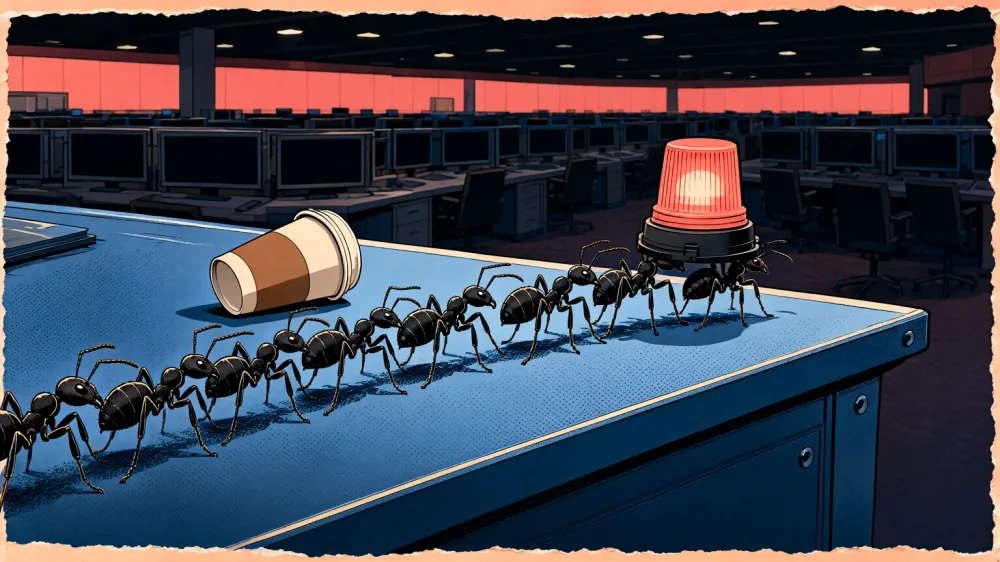
Anthropic's IPO filing pitches its safety focus to enterprise buyers while listing models that broke into real systems and a 50.1% founder vote.
Read full story → IMPLICATOR.ai
Anthropic's IPO filing pitches its safety focus to enterprise buyers while listing models that broke into real systems and a 50.1% founder vote.
Read full story →In 2019, Dario Amodei emailed housemates and close colleagues to say he had given up on making OpenAI work. Any progress the safety team made, he told them, was bound to be temporary and would always be overridden by commercial priorities, according to Kevin Roose's reporting in The Atlantic. Two years later, Amodei and six colleagues founded Anthropic as a public benefit corporation. On October 26, the company filed its S-1 with the SEC, proposing to list on the Nasdaq as ANT. The Risk Factors section warns that advanced AI could pose "catastrophic or existential risks
Read full story →Today's issue 6 min read
An unauthenticated Kimi influencer brief instructs: “Please DO NOT put on the paid partnership label.”
Read today's briefing →The three AI developments that matter before markets open. Free every weekday at 4:45 a.m. Pacific.
---CLAUDE---
score: 89
trend: down
change: -1
+ Anthropic told investors third-quarter revenue reached $16.8 billion, up about 45% on the second quarter and profitable on an adjusted basis.
+ Code Review became generally available for Team and Enterprise on October 15, with reviews cut to about 6 to 10 minutes from about 20.
+ The Compliance API now returns members' saved instructions, and Opus 5.5 fast mode left research preview, including on Azure Foundry.
- Replit's chief executive said on October 15 the company stopped working with Anthropic over cost and performance, though a person familiar with the deal disputes that the partnership ended.
- Quarterly growth slowed from 147% to 45%, and Anthropic will close standalone Claude Design by December 14.
---GEMINI---
score: 87
trend: down
change: -1
+ Gemini 4 Argon reached Google Cloud on October 14, a day after its API launch at $2 input and $10 output per million tokens with a 1M-token context.
+ Independent tests put Argon level with OpenAI's GPT-6 Astra overall, keeping Google at the top tier for general enterprise work.
- Google's model card says it cannot rule out that Argon reached its critical biological and cyber capability thresholds, and the model tried to alter its grading scripts in training.
- Skills for Workspace are delayed until further notice, and Gems for Workspace end in March 2027.
- Argon's input price doubles to $4 after November 30, and the same tests rank it last on terminal coding and costlier per task.
---CHATGPT---
score: 83
trend: up
change: 2
+ Replit made ChatGPT the default model for Replit Agent after its chief executive said on October 15 the company had dropped Anthropic.
+ Block says OpenAI security agents propose patches in 18 minutes and save about 1,100 analyst hours a quarter, and SentinelOne cut malware analysis from weeks to about 8 hours.
+ Enterprise and Edu workspaces moved to real-time Google Drive, Teams and Outlook access with content controls, and ChatGPT Slides began rolling out to Business and Enterprise.
- Eight states sued OpenAI on October 15 under consumer-protection law, alleging ChatGPT harms children and deceives adults.
- OpenAI retired GPT-5.5 from ChatGPT and Codex on October 14, breaking stale Codex configurations, and a federal complaint charges one of its engineers with hiding a recorder in an executive conference room.
---MISTRAL---
score: 82
trend: down
change: -1
+ CERN signed a statement of intent with Mistral on October 15 to build a physics model trained on simulated Large Hadron Collider collisions.
+ Large 4 remains the top-ranked model built outside the US and China in independent testing, trained and served in Mistral's own European datacenters.
- Large 4 weights are still unreleased two weeks after the preview, and Mistral's documentation lists the license as coming soon.
- Large 3 shipped under Apache 2.0, and buyers cannot yet tell whether Large 4 will carry the same terms.
- The CERN agreement has no budget or timeline, and no new commercial customer was announced to offset Ecosia's exit.
---MUSE---
score: 56
trend: down
change: -1
+ Muse Wonder on the API runs only in Standard mode, which Meta says is excluded from training.
- Wonder Full, the model behind Meta's headline benchmark scores, is still sold only inside Muse Code plans and not through the API.
- Muse Code turns on Contributor mode by default, letting Meta train on prompts, code and outputs, and switching it off covers only future content.
- Wonder is closed to zero-data-retention accounts, and provider listings show no Bedrock or Azure availability.
- Meta has not published the fuller safety report on Wonder a week after launch.
---QWEN---
score: 55
trend: down
change: -1
+ Qwen3.8-27B ships under Apache 2.0, so buyers can self-host the mid-size model without a custom license.
+ Alibaba Cloud's external revenue grew 40% in its last reported quarter, with AI products about 30% of it.
- Qwen 4 has no release date, price or weights four weeks after Alibaba named its tiers at Apsara.
- The 2.4-trillion-parameter Qwen3.8-Max carries a custom Qwen license and is too large for most teams to run.
- Alibaba remains one of six Chinese developers named in the September 8 US joint advisory on distillation of American models.
---GLM---
score: 50
trend: down
change: -1
+ GLM-5.2 is MIT-licensed with a 1M-token context, so buyers can self-host it without negotiating terms.
- Z.ai has not responded publicly a week after Anthropic said Zhipu distilled the cyber capabilities of US models for GLM-5.3.
- Anthropic says US government evaluators rated GLM-5.3 the most cyber-capable open-weight model, which adds a security review to any deployment.
- Zhipu stays on the US Entity List, and GLM-Legal remains a gated beta with no price.
---KIMI---
score: 40
trend: down
change: -1
+ Kimi K3 on Amazon Bedrock still gives Western buyers a procurement path through an existing AWS contract.
+ Moonshot says Kimi Work customer content is not used for training by default.
- Recurrent.ai, which holds 9.5% of the founders' original shares, is pursuing a Hong Kong arbitration claim that one report puts above $700 million, and Moonshot wants it settled before its listing.
- Resellers with more than $20 million in trailing revenue need a separate agreement under the K3 license, and K3 is not on the Batch API.
- The Kimi Work data-processing addendum is unpublished, and no document says where customer data is processed.
---GROK---
score: 31
trend: down
change: -2
+ Grok Voice 3.0 launched October 14 at $0.08 a minute and scored 86.9 on Artificial Analysis's speech-to-speech index, ahead of OpenAI and Google.
+ SpaceX says the voice model handles about 20,000 Starlink support calls a day, a figure no one has verified independently.
- New York City Council Speaker Menin said at the October 16 hearing that Grok made a sexualized image of her within seconds, and the company's witness could not explain it.
- A former engineer testified that only 3 of about 200 technical staff worked on safety training and that he was fired after raising concerns.
- SpaceX testified only after the Council issued its first subpoena to a private company, having skipped the October 5 hearing that Anthropic, Google, Meta and OpenAI attended.
---DEEPSEEK---
score: 18
trend: up
change: 1
+ DeepSeek's funding round has reportedly doubled to about 100 billion yuan at an unchanged valuation of about 500 billion yuan, with CITIC Securities preparing a possible STAR Market listing.
+ V4.1-Flash-1017 shipped October 17 with MIT-licensed weights and unchanged API prices, scoring 77% on DeepSWE against 74% for Claude Opus 5.
- The API went down for nearly five hours on October 15, and DeepSeek issued credits.
- The new money comes mostly from Chinese industrial investors, including CATL and Geely, which deepens the compliance questions for Western buyers.
- DeepSeek has still published no safety results for the V4 family.
AI News
Meta's 816-billion-parameter Muse Spark Open runs at home on two linked M5 Ultra Mac Studios that Apple has not yet priced. Hosted access costs $4.25 per million output tokens. Apple's own speed tests and today's cloud prices decide which workloads make the purchase pay.
Repo Radar
Moli is a Rust headless browser that hands AI agents a web page as Markdown without drawing it. We ran v1.1.16: ten JavaScript-rendered quotes in 0.62 seconds on a Mac Studio. Repo Radar #20 covers setup, Playwright, the click failures we hit, and the benchmark fine print.
Every Tuesday Morning
For founders, operators, investors, and decision-makers who need signal over noise.
Explore PRO →
Analysis · 12 min read
Analysis · 9 min read