Implicator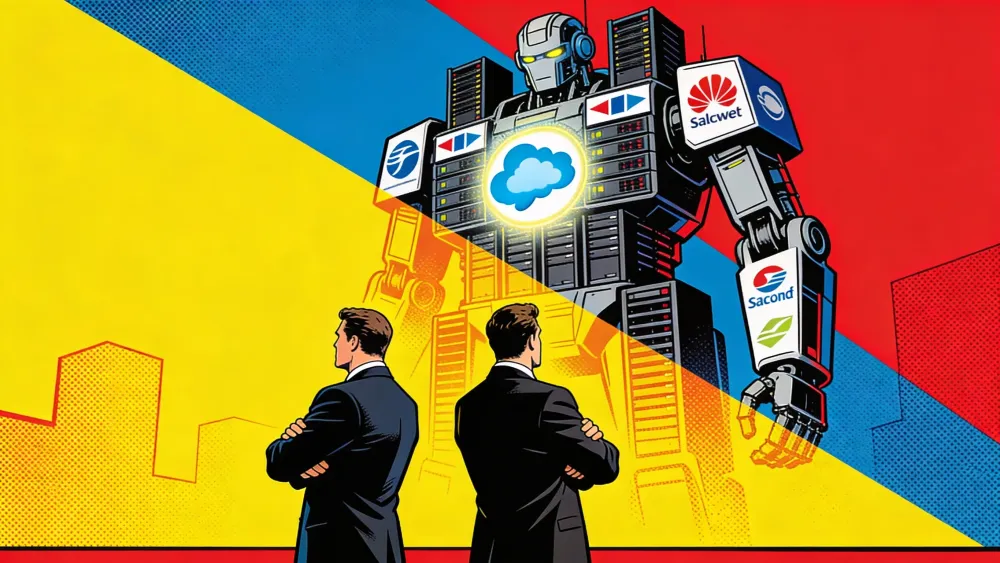
Two weeks before anyone outside the company knew Kana existed, Tom Chavez and Vivek Vaidya were on stage at the IAB Annual Meeting in Palm Springs. The audience knew them. A decade earlier, the pair had stood on stages like this one bragging about "billions of uniques" processed by Krux, the data management platform they later sold to Salesforce for $700 million. This time they were pitching something different: AI agents that could do a marketer's job, not just organize a marketer's data.
When a moderator asked where agentic marketing sits on the adoption curve, Chavez said "between 2 and 3, possibly a full-on 3." The answer was honest enough to be useful. It also described the exact stage of market maturity where Chavez and Vaidya have built their fortunes, twice.
Kana emerged from stealth on February 18 with $15 million in seed funding led by Mayfield. Kana sells AI agents that handle data analysis, audience targeting, campaign management, and a new discipline called answer engine optimization, all woven into whatever marketing stack a company already runs. The founding team, completing its fourth venture together, frames this as the next logical step after building the pipes (Rapt, acquired by Microsoft for $180 million in 2008), the data layer (Krux), and the studio that incubated it all (super{set}).
The question is whether founders who twice sold their companies to the same incumbents they now intend to outrun can pull it off a fourth time. Salesforce, the buyer of their last venture, shipped Agentforce 360 in 2025. Adobe has Firefly. HubSpot launched Breeze. Depending on whom you ask, the marketing AI market runs somewhere between $27 billion and $550 billion. In this crowd, $15 million buys roughly twelve months of runway and the right to prove a thesis.
The Breakdown
- Kana raised $15M seed from Mayfield to build AI marketing agents with synthetic data and answer engine optimization
- Founders Chavez and Vaidya sold Rapt to Microsoft ($180M) and Krux to Salesforce ($700M), totaling $1.2B in exits
- Salesforce, the buyer of their last company, now competes directly via Agentforce 360 and the Qualified acquisition
- No paying customers announced; twelve-month window before incumbents mature their own AI agent features
A career pattern strict enough to be a formula
Chavez and Vaidya's partnership spans 25 years and follows a consistent arc. Find a structural problem in marketing technology. Build a product that solves it. Sell to an incumbent before the incumbent builds its own version.
Rapt, their first company, attacked yield management for online publishers. Founded in the late 1990s, it used operations-research math to help publishers like Yahoo and AOL price ad inventory. Chavez holds a Stanford PhD in engineering-economic systems. Vaidya was the first engineer hired. More than half the top 25 U.S. publishers ran on Rapt's forecasting system when Microsoft acquired the company in March 2008 for $180 million, folding it into its Atlas Publisher Suite alongside the $6 billion aQuantive deal.
Stay ahead of the curve
Strategic AI news from San Francisco. No hype, no "AI will change everything" throat clearing. Just what moved, who won, and why it matters. Daily at 6am PST.
No spam. Unsubscribe anytime.
Krux came next. Founded in 2010, it became the dominant data management platform for Fortune 500 brands. At peak scale, the system processed 200 billion data-collection events per month across 3 billion browsers and devices. HBO, JetBlue, Kellogg, and the BBC were customers. Salesforce bought it in late 2016. The cash portion was $340 million; stock brought the total closer to $700 million. "We're trading gas for rocket fuel," Chavez told Salesforce employees at the time. Krux's code still runs inside Salesforce Marketing Cloud. Every audience segment, every data-collection trigger, sits on infrastructure Chavez and Vaidya's team wrote. Vaidya stayed on after the acquisition and ran engineering for the whole product. Eight hundred engineers reported to him.
In 2019, rather than start another single company, the pair launched super{set}, a startup studio backed by $65 million. They later expanded to $180 million under management. The studio's first formation, Habu, built data clean room software and sold to LiveRamp for roughly $200 million in January 2024. Ketch, another super{set} company, tackles data privacy compliance. Kana is the third high-profile graduate, incubated for nine months before raising external capital.
The combined exit value across Rapt, Krux, and Habu tops $1 billion. Chavez claims 17.5x returns to early investors. The pattern is clear enough to be a pitch in itself: each company applies deep marketing-tech expertise to whatever structural gap the current cycle exposes. The risk is equally clear. Past exits do not guarantee the next one, and the incumbents waiting on the other side are the same companies that wrote the acquisition checks.
What the agents actually do
Strip away the marketing vocabulary and Kana's product splits into three bets, each aimed at a different crack in the current system.
Synthetic data generation sits at the base. Third-party cookies are dying. Privacy regulation keeps thinning the data pool. Marketers have less to work with every quarter. Kana fills the gap with synthetic audiences, fabricated data sets designed to mimic real behavioral patterns closely enough to run campaign tests without buying expensive third-party feeds. Whether synthetic data can match the fidelity of real behavioral data at the scale enterprise teams need is an open question. But the cost savings are tangible, and the regulatory pressure on real data is not easing.
On top of that sits what Kana calls "Just-In-Time Data Integration," a trademarked term for a data fabric that connects to existing CRM systems, ad platforms, and data warehouses on the fly. If you run campaigns through Salesforce, pull analytics from Google, and keep customer records in Snowflake, Kana's pitch is that its layer draws from all three without forcing you to rip anything out. Lower friction than incumbents who want full-stack replacement.
Then come the agents. Kana's agents handle the grunt work: reading media briefs, picking audiences, buying media, tracking results, writing up what happened. Each agent owns one piece of the workflow. The company calls them "loosely coupled." In practice, one agent finishes its job and hands results to the next without someone manually connecting the two. Marketers review and approve outputs before deployment. No CMO will hand budget allocation to an unsupervised algorithm, so every action gets a human sign-off before money moves.
Kana's genuinely novel piece is answer engine optimization. As consumers get product recommendations from ChatGPT, Perplexity, and other AI assistants rather than Google search results, brands face a visibility problem that traditional SEO cannot solve. Kana claims its agents can optimize a brand's presence across these AI answer engines in real time. The discipline is new enough that few competitors have embedded it natively into a broader marketing platform.
Why now, and why the timing might matter
Scott Brinker's 2025 Marketing Technology Supergraphic counted 15,384 tools in the martech category, a hundred-fold increase since 2011. Yet more than 90% of marketing organizations report integration pain as a persistent problem. The tools multiplied faster than anyone's ability to connect them.
Agentic AI offers a potential resolution. Rather than consolidating tools, an agent layer can orchestrate them. The agent reads data from one system, makes decisions, and executes actions in another, all without requiring a marketer to toggle between five dashboards before lunch. Gartner forecasts that 40% of enterprise applications will embed AI agents by the end of 2026.
The timing has a second dimension. Privacy regulation and browser-level cookie restrictions gutted the third-party data market that powered the previous generation of ad targeting. Krux, the company Chavez and Vaidya sold to Salesforce, was a product of that era. Kana's synthetic data play is a direct response to the world their old company helped build, and that regulators subsequently dismantled.
Third-party data costs are rising while quality drops. First-party data is valuable but limited in scope. Synthetic generation, if it works at the precision marketers demand, splits the difference. The if is doing a lot of work in that sentence. But the structural pressures are real, and the old solutions are not coming back.
The incumbents they helped build
The hardest fact in Kana's pitch deck is this: the companies best positioned to win agentic marketing are the ones Chavez and Vaidya already sold to.
Salesforce launched Agentforce 360 at Dreamforce 2025 as its flagship AI product and acquired Qualified, an agentic marketing firm, in early 2026. The company is not losing sleep over Kana. It is barely aware of it. Salesforce holds CRM relationships with most of the Fortune 500, and its Data Cloud already ingests the data that agents need to make decisions. When a Salesforce customer wants AI marketing agents, the path of least resistance runs through the same login screen they open every morning.
HubSpot's Breeze AI suite covers content creation, prospecting, email personalization, and lead scoring, bundled into the platform that mid-market companies already pay for. Adobe integrates Firefly generative AI and Sensei intelligence across its Experience Cloud. Microsoft embeds Copilot into Dynamics 365.
Each of these companies can offer agents as a feature, included in an existing subscription. Kana has to sell agents as a standalone product to customers who may already pay for one of those platforms. That is the structural disadvantage of competing from below.
There is a second constraint. Kana's "build with" model, where the team customizes agents alongside each customer, generates stickiness but threatens scale. Professional services margins are lower than software margins. Customization is expensive. Every hour an engineer spends configuring agents for one client is an hour not spent building product for many customers. Vaidya framed this as a speed advantage to TechCrunch: "We can move with insane speed that these big companies just cannot." Speed is real. But it also burns cash faster.
No paying customers have been named. That matters. The $15 million goes toward hiring engineers and salespeople. A year from now, the customer list will settle that argument.
Two founders, one playbook, a fourth time
Chavez and Vaidya are not betting on technology. They are betting on a pattern.
At Rapt, they identified the gap between publisher inventory and pricing optimization. They built a product and sold before Microsoft could build its own. At Krux, they identified the gap between marketing data silos and audience targeting. They built a platform and sold before Salesforce could build its own. At Habu, the super{set} studio identified the gap between privacy regulation and data collaboration. It built clean room software and sold before LiveRamp could build its own.
The playbook: find the structural gap, build fast, exit before the incumbent catches up.
At Kana, the structural gap is the distance between what AI can now do and what marketing teams can actually execute. The 15,384-tool martech category suggests an industry drowning in capability but starving for orchestration. Chavez and Vaidya are wagering that 25 years of scar tissue lets them build orchestration faster than Salesforce, Adobe, or HubSpot can bolt it onto their existing platforms.
"We have the opportunity not to create bespoke solutions, but to highly tailor and configure these solutions to meet customers where they are," Chavez told TechCrunch. "Larger companies just are never going to get there."
Mayfield's Navin Chaddha endorsed the bet with $15 million and a board seat. The investment fits Mayfield's broader "AI Teammates" thesis and the firm's $100 million AI Garage initiative. It also reflects a bond that predates any term sheet. Chaddha and Vaidya both graduated from IIT Delhi and together co-founded Plaksha University, a technology school in India. Whether Chaddha is backing a thesis or a friend is a question only returns will settle.
The agent layer nobody owns yet
Kana's stealth exit, alongside Salesforce's Agentforce and HubSpot's Breeze, marks a broader shift in marketing technology. The control layer is migrating from dashboards to agents, from human-operated interfaces to AI-managed workflows.
The shift runs deeper than new features on old platforms. When agents allocate budgets, select audiences, and optimize campaigns, the marketer becomes a supervisor, not an operator. The companies that own the agent layer own the margin.
Nobody owns that layer yet. Incumbents have distribution but carry architectures built for a dashboard-driven world. Startups like Kana have purpose-built agents but lack distribution and customer trust. The next two years will sort this out. The sorting will not be gentle.
The super{set} studio model adds a subplot. Kana's success would validate something venture capital badly wants to believe: that a small team of repeat founders, backed by a dedicated studio and $180 million in committed capital, can outbuild platforms worth hundreds of billions. The more likely outcome is that incumbent distribution wins. It usually does.
Twelve months and a scoreboard
Chavez told an IAB audience in Palm Springs that agentic marketing sits "between 2 and 3" on the adoption curve. He was being precise. The technology works. Adoption lags. Enterprise procurement cycles are slow. The window between "working product" and "bundled incumbent feature" is where startups either break through or get absorbed.
Kana's test is concrete. Within twelve months, the company needs to convert its $15 million seed into a roster of named enterprise customers generating measurable results, enough to raise a Series A before the incumbents' AI features mature from keynote demos into shipping products. Salesforce's next Dreamforce lands in September. Adobe MAX follows in October. Every month without Kana customers on the record is a month closer to the next wave of product announcements from companies with thousands of engineers and billions in revenue.
The founders have done this before. Three times. They know the clock, and they know the companies chasing them, because they helped build those companies. That familiarity will make them faster. It will not make Salesforce slower. And in a race where distribution decides the winner, speed alone has never been enough.
Frequently Asked Questions
What is answer engine optimization and why does it matter?
AEO optimizes brand visibility in AI assistants like ChatGPT and Perplexity rather than Google search. As consumers shift to AI-powered recommendations, brands absent from LLM outputs lose visibility that traditional SEO cannot recover. Kana embeds AEO natively into its agent platform.
How does Kana's synthetic data generation work?
Kana generates fabricated audience data sets designed to mimic real behavioral patterns. Marketers use them to test campaigns and model audiences without buying third-party data feeds, which are becoming costlier and less reliable as privacy regulations tighten and cookies disappear.
What is super{set} and how does it relate to Kana?
super{set} is a startup studio co-founded by Chavez and Vaidya in 2019 with $180 million under management. It incubated Kana for nine months before the Mayfield seed round. Previous formations include Habu (sold to LiveRamp for $200M) and Ketch (data privacy).
How does Kana compete against Salesforce Agentforce?
Kana positions itself as a flexible layer that integrates with existing marketing stacks rather than replacing them. Salesforce bundles agents into its CRM subscription, giving it a distribution advantage. Kana argues incumbents move too slowly to customize solutions for individual customers.
Who is Navin Chaddha and why did Mayfield lead the round?
Chaddha is Mayfield's managing partner and an IIT Delhi graduate who co-founded Plaksha University with Vaidya. The investment fits Mayfield's AI Teammates thesis and its $100 million AI Garage initiative. Chaddha joins Kana's board.




Harkaram Grewal
Maps the India–Germany–U.S. AI triangle from New Delhi. Background in cross-market operations and business development. Writes about supply chains, enterprise adoption, and talent—the unsexy forces that actually move global AI.