OpenAI's CFO floated a federal backstop for AI infrastructure, then reversed within hours after White House rejection. The whiplash exposed the core problem: OpenAI needs $1.4 trillion while generating $20 billion. The math doesn't work.
Microsoft declares it's building "humanist superintelligence" to keep AI safe. Reality check: They're 2 years behind OpenAI, whose models they'll use until 2032. The safety pitch? Product differentiation for enterprise clients who fear runaway AI.
Three Stanford professors just raised $50M to prove OpenAI and Anthropic generate text wrong. Their diffusion models claim 10x speed by processing tokens in parallel, not sequentially. Microsoft and Nvidia are betting they're right.
Early AI adopters face a brutal truth: productivity tanks before it soars. A new study of 30,000 U.S. manufacturers reveals this counterintuitive pattern.
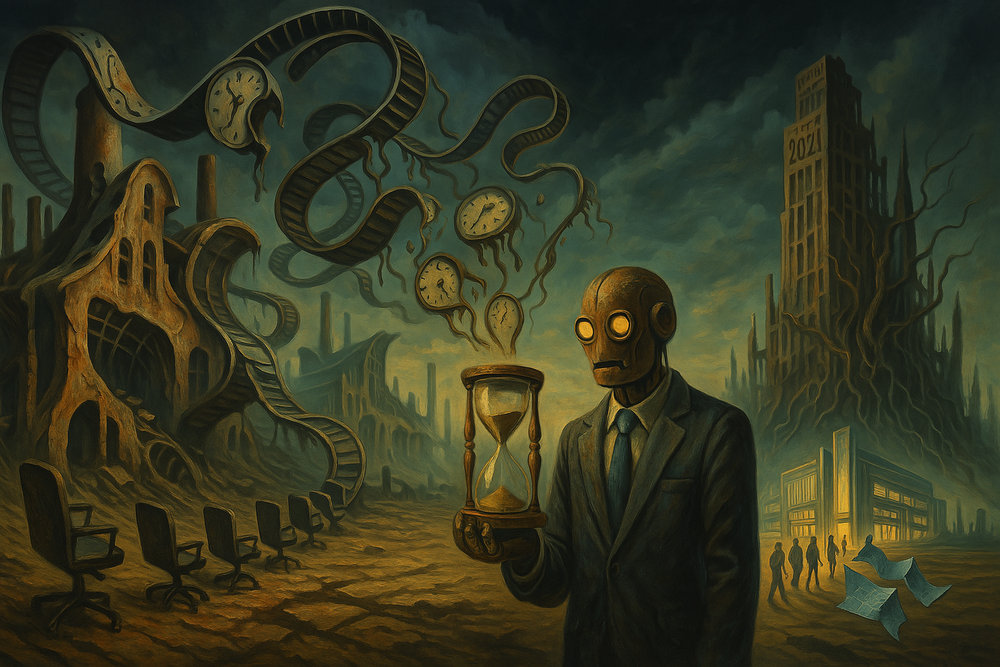
Companies that embraced AI between 2017 and 2021 first watched their productivity plummet. The culprit? AI disrupted their finely-tuned operations, like just-in-time inventory systems.
But those who survived the initial chaos emerged stronger. These companies eventually outperformed their peers in sales, productivity, and even hiring. The catch? Many firms didn't make it through the turbulent transition.
Older, larger companies struggled the most. "Surviving this seems like part of the problem," says Kristina McElheran, the University of Toronto researcher behind the study.
The findings challenge the rosy narrative that AI simply "augments" jobs. During the study period, AI adoption crept up from 7.5% to 9.1% among surveyed firms.
ECB President Christine Lagarde added perspective: up to 29% of European workers face high AI exposure. But she expects job destruction to balance with job creation.
Why this matters:
The AI productivity paradox mirrors the 1990s computer revolution - new tech often hurts before it helps
Companies rushing to adopt AI might want to pack a parachute - and some patience
Tech translator with German roots who fled to Silicon Valley chaos. Decodes startup noise from San Francisco. Launched implicator.ai to slice through AI's daily madness—crisp, clear, with Teutonic precision and sarcasm.
E-Mail: marcus@implicator.ai
Microsoft declares it's building "humanist superintelligence" to keep AI safe. Reality check: They're 2 years behind OpenAI, whose models they'll use until 2032. The safety pitch? Product differentiation for enterprise clients who fear runaway AI.
Apple will pay Google $1B yearly to power Siri with a 1.2 trillion parameter AI model—8x more complex than Apple's current tech. The company that owns every layer now rents the most critical one. The spring 2026 target masks a deeper dependency trap.
Sam Altman predicts AI CEOs within years while betting billions on human-centric infrastructure. His Tyler Cowen interview reveals three tensions: monetizing without breaking trust, energy bottlenecks limiting AI, and models that persuade without intent.
Palantir beat earnings but fell 8% at 250x forward P/E, triggering global risk reset. Banking chiefs gave cover for year-end de-risking while AI capex outpaces revenue visibility. When leaders wobble, concentration risk becomes system risk.