IMPLICATOR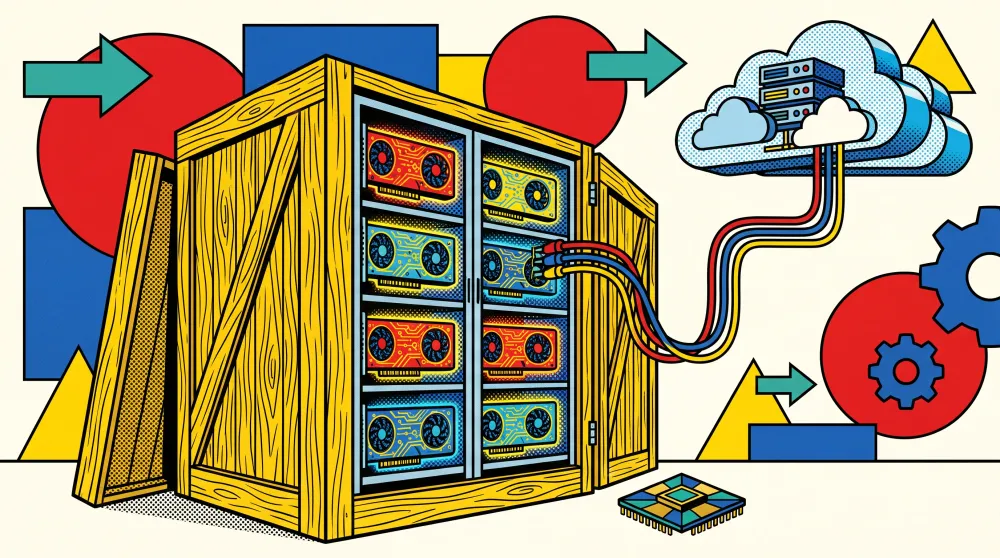
On Aug. 12, Alibaba finally published the Qwen3.8 checkpoint it had promised in July, a model carrying 2.4 trillion parameters. Nvidia put the files on its newest full-rack Blackwell system and published a day-zero serving report co-authored by HJ Hang, a partner product manager on the company’s AI Lighthouse Model team.
That test used a 72-GPU GB300 NVL72 rack.
In both Alibaba’s release and DeepSeek’s model update the same week, downloadable weights sat beside managed APIs, specialized serving software and cloud products. The files let users inspect frontier-scale models, while useful production service still called for datacenter memory, networking and operations.
What Changed
- Alibaba released Qwen3.8’s 2.4-trillion-parameter weights, but Nvidia’s day-zero test used a 72-GPU rack.
- DeepSeek moved its 1.6-trillion-parameter V4 Pro model into general availability and released an MIT-licensed agent harness.
- DeepSeek’s peak output price rises from $0.87 to $3.96 per million tokens on August 16.
- Artificial Analysis independently scored V4 Pro 0813 at 53, versus a 27 median for comparable open-weight models.
AI-generated summary, reviewed by an editor. More on our AI guidelines.
The rack behind Qwen
Qwen3.8-2.4T-A95B is a mixture-of-experts model. A router acts like a dispatcher, sending each token to a small selection of specialized components rather than running the whole model for every word. That is how 2.4 trillion total parameters can coexist with 95 billion active for each token. The smaller active figure reduces computation, but it does not shrink the downloaded checkpoint. All of the weights still have to be stored and made available when the router calls them.
The Aug. 12 model card lists a native context of 262,144 tokens, extendable to 1,010,000. The open checkpoint accepts text only and always uses thinking mode. Alibaba’s managed Qwen3.8-Max version adds image input, a non-thinking mode, built-in tools and a one-million-token default context.
Nvidia’s Aug. 12 test used FP8 precision on one GB300 NVL72, whose GPUs communicate inside a 130-terabyte-per-second NVLink domain. It measured more than 4,000 tokens a second per GPU at peak throughput and more than 350 tokens a second per user. Those figures come from the hardware vendor’s newest rack. They do not establish the purchase price, operating cost or performance of ordinary deployments.
DeepSeek adds the surrounding system
V4 Pro 0813 was available through DeepSeek’s API on Aug. 12. DeepSeek’s Aug. 13 change log announced general availability across its app, website and API. The model has 1.6 trillion total parameters, with 49 billion active for each token. Its API accepts as much as one million tokens of context and can return as many as 384,000 output tokens. Pro allows 500 concurrent requests, compared with 2,500 for the smaller V4 Flash service.
Before the formal change log appeared, Simon Willison, an independent developer and weblog author, traced the early benchmark table from a DeepSeek WeChat group through a deleted Reddit post and into a Hacker News discussion. The official release later published V4 Pro benchmark results and added native Responses API and Codex support. The V4 Pro 0813 scores are vendor-reported.
Join 10,000+ AI professionals
Strategic AI news from San Francisco. No hype, no "AI will change everything" throat clearing. Just what moved, who won, and why it matters. Daily at 6am PST.
No spam. Unsubscribe anytime.
DeepSeek also released DeepSeek Harness in developer preview on Aug. 13. The MIT-licensed source treats models, tools, sessions, sandboxes, storage, scheduling and the interface as replaceable plugins. An append-only session log records prompts, reasoning, tool calls and context injections. The preview defines four operating modes. Standard mode carries the full tool set. Code mode lets model-generated code coordinate tool calls, while Minimal mode reduces the harness to shell and file editing. Creator mode exposes runtime inspection and plugin experiments. The modes place different amounts of software around a model, from basic file operations to tool coordination and runtime work. The preview establishes source availability and design, not adoption or production maturity.
As of Aug. 13, V4 Pro cost $0.435 per million uncached input tokens, $0.003625 per million cached input tokens and $0.87 per million output tokens. Those are the rates before DeepSeek’s announced change, not the new prices.
Know someone who'd find this useful? ✉️ Email it to a friend in one click, or they can subscribe free here.
Beginning at 16:00 UTC on Aug. 16, the peak uncached-input rate will rise from $0.435 to $1.32 per million tokens, while the output rate will rise from $0.87 to $3.96. That makes peak uncached input about three times its pre-change rate and peak output more than four times its pre-change rate. Off peak, those rates will remain below the new peak rates at $0.66 and $1.98. For both uncached input and output, the off-peak schedule is half the new peak schedule. Cached input will cost $0.044 at peak and $0.022 off peak, compared with $0.003625 before the change. Flash prices will rise as well.
Independent numbers
An August evaluation by Artificial Analysis independently measured V4 Pro 0813 at 53 on its Intelligence Index, compared with a median of 27 among comparable open-weight models of the same class. The service measured 76.8 output tokens a second and calculated a cost of $0.06 per index task at DeepSeek’s then-current price. The full evaluation generated 130 million output tokens, giving the result a much broader base than an isolated prompt test.
Independent evidence for the 0813 checkpoint is still limited. Ivan Su, a Morningstar senior equity analyst, had made the same distinction after the April V4 release. He said, “Against U.S. models, DeepSeek’s own evaluation suggests its capabilities largely match on most fronts, but independent evaluations are needed before final conclusions can be drawn.” His comment predates the August checkpoint.
The physical cost appears in a separate July test by Kelsus of the earlier V4 Pro checkpoint. An approximately 865-gigabyte mixed 4-bit and 8-bit weight set filled one server with eight H200 GPUs. At peak use, Kelsus measured about 516 output tokens a second and calculated $11.71 per million output tokens on spot hardware, roughly three times the next most expensive model in its lineup. The run predates 0813, so it describes self-hosting economics rather than the new build’s performance.
After 16:00 UTC on Aug. 16, will users run the downloadable weights on rack-scale hardware or pay DeepSeek’s new managed API rates?
Frequently Asked Questions
Why does Qwen3.8 need so much hardware?
Qwen3.8 contains 2.4 trillion total parameters, although its mixture-of-experts design activates 95 billion for each token. The full checkpoint still has to be stored and available. Nvidia’s first serving test used one GB300 NVL72 rack with 72 GPUs.
How does Alibaba’s open Qwen model differ from its cloud version?
The downloadable Qwen3.8 checkpoint accepts text only and always uses thinking mode. Alibaba’s managed Qwen3.8-Max service adds image input, a non-thinking mode, built-in tools and a one-million-token default context.
What did DeepSeek release alongside V4 Pro 0813?
DeepSeek put V4 Pro 0813 into general availability across its app, website and API. It also released DeepSeek Harness in developer preview, an MIT-licensed system with replaceable plugins for models, tools, sessions, sandboxes, storage, scheduling and interfaces.
How will DeepSeek’s V4 Pro pricing change?
At 16:00 UTC on August 16, uncached input rises from $0.435 to $1.32 per million tokens at peak, while output rises from $0.87 to $3.96. Off-peak rates will be $0.66 for uncached input and $1.98 for output.
How did V4 Pro 0813 perform in independent testing?
Artificial Analysis scored it at 53 on its Intelligence Index, against a median of 27 for comparable open-weight models. It measured 76.8 output tokens per second and $0.06 per index task at DeepSeek’s then-current price. Independent evidence for this checkpoint remains limited.
AI-generated summary, reviewed by an editor. More on our AI guidelines.




Marcus Schuler
Editor-in-Chief and founder of Implicator.ai. Former ARD correspondent and senior broadcast journalist with 10+ years covering tech. Writes daily briefings on policy and market developments. Based in San Francisco. E-mail: editor@implicator.ai