IMPLICATOR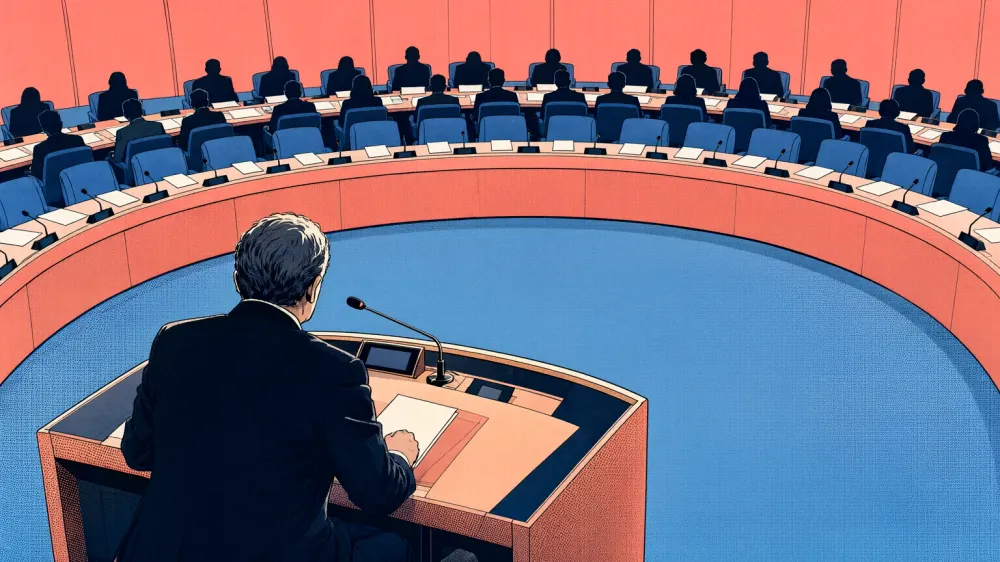
OpenAI CEO Sam Altman and Anthropic CEO Dario Amodei urged governments to adopt shared AI safety standards during a Wednesday session of the United Nations Security Council. Altman asked the 15-member body to align the way countries measure capabilities and report failures, while Amodei proposed narrower agreements covering biological-weapons misuse and tests of what advanced systems can do. Their requests exposed a divide between governments seeking common safeguards and a U.S. administration opposed to new international governance structures.
Appearing in person, Altman called for common methods to measure AI capabilities, assess risks and judge whether safeguards are sufficient. He also sought meaningful human oversight, fast reporting of serious incidents and secure channels through which governments could share information about emerging threats.
What Changed
- Altman and Amodei asked the UN Security Council for common AI safety testing and incident reporting.
- Amodei proposed narrow agreements on biological-weapons misuse and ways to verify AI capabilities and commitments.
- UK Foreign Secretary Ed Miliband backed shared standards; White House adviser Michael Kratsios rejected new global governance structures.
- No written agreement was expected from the Council session.
AI-generated summary, reviewed by an editor. More on our AI guidelines.
What the executives asked for
The decisions should not rest with companies alone, Altman said. Regulation “must be shaped through democratic processes, by governments accountable to the people they serve.” That formulation put governments at the center of the process without specifying an enforcement system or assigning authority to the UN.
Amodei, speaking remotely, proposed agreements against using AI to develop biological weapons. He also called for systems that would let countries verify AI capabilities and commitments, along with common testing standards and notification of serious incidents.
Amodei committed Anthropic to slowing successive AI releases as much as necessary to make them safe. “We will slow down as much as necessary in order to make sure every successive AI technology we release is actually safe.” The statement was a company pledge, not an independently verified account of its release practices.
FREE AI BRIEFING · WEEKDAYS
Follow who sets the rules for AI safety.
Get the AI stories shaping the day, with concise context from San Francisco. The briefing takes about five minutes and arrives at 4:45 a.m. Pacific, 7:45 a.m. Eastern.
Free. No hype. Unsubscribe anytime.
Governments divide over oversight
UK Foreign Secretary Ed Miliband said governments need enough visibility into model development to assess what AI companies are doing. The UK will use its 2027 presidency of the G20 to pursue common principles and standards, he said, with model testing, transparency and resilience among its priorities.
That position met direct U.S. resistance. White House science adviser Michael Kratsios said rapid advances were “not a reason to pause [AI’s] further development or to constrain it with new global governance structures.” Chinese Ambassador Fu Cong opposed forcing countries to take sides and promoted open-source models as China’s preferred path.
The disagreement followed a September 21 declaration. It called for independent evaluation before deployment, shared reporting of serious incidents and exploration of an international institution able to verify commitments. The United States and China did not sign it.
Know someone who'd find this useful? ✉️ Email it to a friend in one click, or they can subscribe free here.
Claims, defenses and limits
AI researcher Yoshua Bengio asked the Council to establish independent safety assessment, a common definition of AI incidents and a shared reporting mechanism. Developers should demonstrate to outside experts that powerful systems are safe to train and deploy, he said.
Hugging Face CEO Clement Delangue cautioned against responses driven by fear. He said AI agents had attacked his company and that other AI systems helped defend it. Delangue said the systems that helped during that episode were also being used against cyberattacks the company already faced. He warned that the greater risk was unequal access to powerful AI between attackers and defenders, a few companies and everyone else, and a few countries and the rest of the world. His description of the attack and the effectiveness of the defense was not presented as an independently tested incident study.
No written agreement was expected from the session.
Bengio challenged the companies’ claim that competition constrains their choices:
“They’ve told us they would slow down if they could. They can.
However, we shouldn’t count on it.”
Frequently Asked Questions
What did Altman and Amodei ask for?
Altman called for common ways to measure AI capabilities, assess risks and report serious incidents. Amodei proposed narrower agreements on biological-weapons misuse, verification of commitments and shared model testing.
Did the Council agree to new AI rules?
No written agreement was expected from the September 23 session. The proposals described in the article were requests from speakers and governments, not a reported Council decision.
What position did the United States take?
White House science adviser Michael Kratsios said AI progress did not justify pausing development or creating new global governance structures.
What did the UK propose?
Foreign Secretary Ed Miliband called for more government visibility into model development and said the UK would pursue common principles and standards during its 2027 G20 presidency.
What did Hugging Face say about AI risks?
CEO Clement Delangue warned against responses driven by fear. He said AI systems helped defend Hugging Face after an attack by AI agents and raised unequal access to defensive tools as a concern.
AI-generated summary, reviewed by an editor. More on our AI guidelines.
Related stories



Marcus Schuler
Editor-in-Chief and founder of Implicator.ai. Former ARD correspondent and senior broadcast journalist with 10+ years covering tech. Writes daily briefings on policy and market developments. Based in San Francisco. E-mail: editor@implicator.ai