IMPLICATOR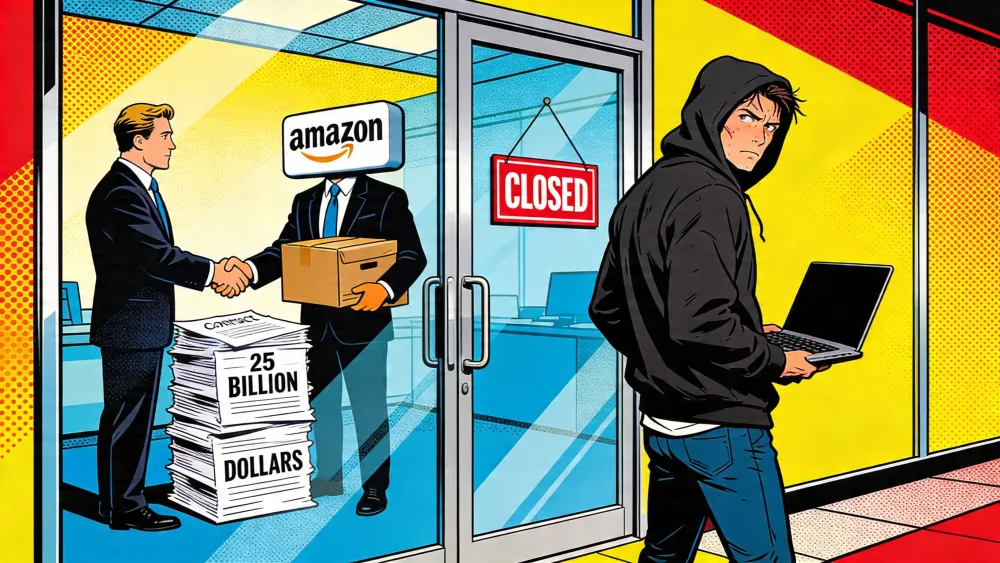
Claude Code made Anthropic the terminal-dwellers' favorite. This week, without fanfare, the company stopped listing it on the $20 Pro plan. The writing is on the wall, and the ink is corporate blue.
The shift arrived through documentation, not a press release. Anthropic's Claude Code support page, archived as recently as April 10, promised access through "your Pro or Max plan." The page now names Max only. The public pricing page reflects the cut on desktop and mobile. No announcement. No changelog entry. Whether the change applies to new subscribers, every Pro customer, or some messier middle, Anthropic has declined to say.
The silence is itself the test. Edit the page, measure the churn, decide the policy.
Call it "tier alignment." Call it "matching product scope to pricing reality." Better: call it what it is. The bait has been lowered. The switch is underway.
Earlier this month, Anthropic told OpenClaw users to pay extra after discovering that a single power user could burn $5,000 in daily API-equivalent compute on a $200 Max plan. A year ago, the company launched $100 and $200 Max tiers to capture heavier workloads. This week, Amazon expanded its cumulative Anthropic investment toward a reported $25 billion. The arithmetic writes itself.
Anthropic no longer needs the solo developer. It never did, once the enterprise checks cleared.
This is the classic Valley playbook, just on a compressed clock. Remember 2008? Facebook was the supplicant then, asking developers to please build, handing out organic reach by the bucket. Six years and a lot of ad contracts later, the relationship reverses itself. Those same apps get choked off, quietly, without a press release or a warning shot. Zynga, the Washington Post Social Reader, the Causes app, the Bejeweled clones that colonized your aunt's browser tabs: cultivated, then starved of reach. The lesson was blunt. Developer goodwill carries no book value once the enterprise market stabilizes.
The Anthropic cycle took seventeen months, not six years.
The bait was the reputation.
Cory Doctorow, in his 2023 essay on what he calls enshittification, named the pattern. His thesis is that platforms are first good to their users, then good to their business customers, then they extract value from both until the product is a husk. From this follow three lessons. First, the user-delighting phase is not a gift; it is capital expenditure on reputation. Second, business customers are the real product, and their willingness to pay is the only metric that survives scrutiny. Third, the platform owes nothing to the people who seeded its myth, and acts accordingly once the seeds have grown.
Apply the model. Claude Code's reputation as the developer's coding companion was not manufactured by an ad campaign. It was manufactured by thousands of independent builders with blogs, Mastodon threads, YouTube reviews, GitHub stars. They told their friends. Their friends told Fortune 500 procurement. Fortune 500 procurement wrote the nine-figure contract. The loop is now closed, and the people who completed it for free are no longer on the invitation list.
Reputation is rented. It cannot be owned.
There is no villain here in the cartoon sense. Anthropic carries real compute costs and real investor pressure. A $20 subscription that burns $200 in inference is a business model only in the venture-funded phase of a company's life.
But honesty requires naming the trade. Anthropic built an aura of principled, developer-friendly craftsmanship. That aura was priced at $20. It is now worth more, and the people who generated it are being informed, politely, that their work is complete.
Picture the near scenario. Autumn, say, October. A freelancer in Lisbon opens her terminal, types the command she has typed every workday for two years. The response this time isn't code. It's an upgrade prompt. One hundred a month, or nothing. She upgrades. Three weeks later, the $100 tier hits a wall that routes her to $200. Six months after that, Anthropic rolls out a $500 Professional Developer Seat because "sustained professional workloads now exceed the scope of our consumer tiers." The $20 plan, by then, sits behind glass in the museum of venture-subsidized pricing. Was that the deal she signed up for? The deal she signed up for has been migrated.
None of this is illegal, and little of it is surprising. The pattern is older than Anthropic, older than Silicon Valley, older than venture capital itself. It is what happens when a company discovers that its reputation was a loan, not an asset, and the creditors are easy to ignore.
A platform is not a promise. It is a sequence of pricing pages, each one more expensive than the last.
Free AI briefing · Weekdays
The AI stories that matter, sourced and explained.
Join the Morning Briefing. It goes out every weekday at 4:45 a.m. Pacific, with later sends for the East Coast, Berlin and Tokyo.
Free when you sign up: The Paperclip Compendium, our tested guide to running AI agents.
Free. Unsubscribe in one click.

Marcus Schuler
Editor-in-Chief and founder of Implicator.ai. Former ARD correspondent and senior broadcast journalist with 10+ years covering tech. Writes daily briefings on policy and market developments. Based in San Francisco. E-mail: editor@implicator.ai