Implicator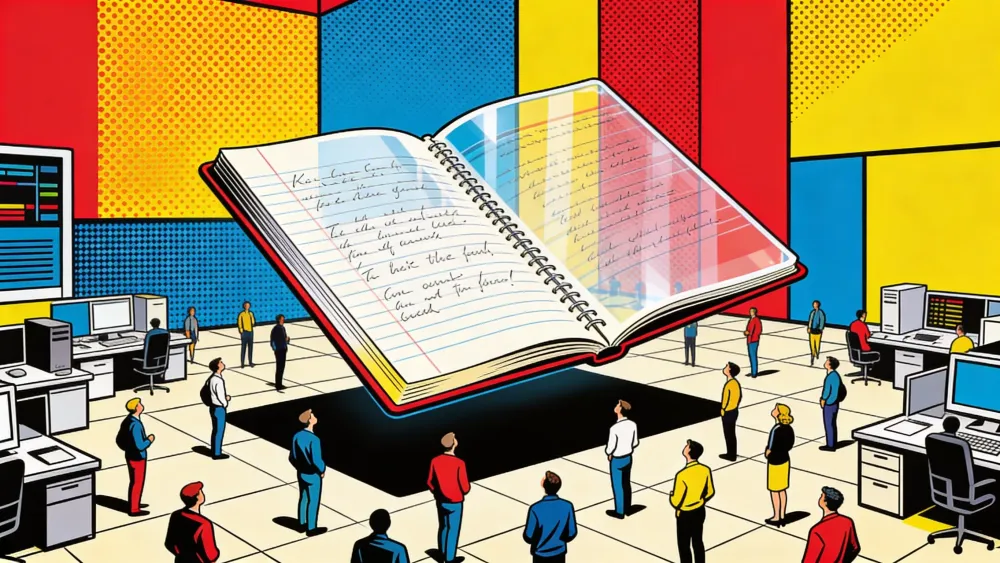
Anthropic's Head of Product Ami Vora let slip a detail about the company's internal operations at a Salesforce press event on Tuesday, sandwiched between demos of Slackbot's 30 new AI capabilities. Inside Anthropic, every leader keeps an open Slack channel. They call them "notebooks." Anyone in the company can subscribe, and the expectation is that you will write in yours.
"Every week I write, 'These are my goals for the week. This is how I did against my goals last week,'" Vora said. "Never 100%, as you can imagine. 'Here's what I'm thinking about for a product direction. Here's where I'm seeing teams come together or maybe need a little more clarity.' And everybody does this. Every level of leadership and every function."
That last line is the one that matters. Not some leaders. Not the ones who feel like sharing. Everybody. Every level. Every function.
Key Takeaways
- Anthropic requires every leader to maintain a public "notebook" channel visible to the entire company
- Head of Product Ami Vora revealed the practice at a Salesforce press event Tuesday
- The system validates Steve Yegge's observations about collective momentum replacing hierarchy
- Open notebooks double as a selection filter for leadership temperament under scrutiny
What the notebooks actually do
Most companies run on information asymmetry. Executives sit in rooms that other employees can't enter. They make decisions behind closed doors, then hand down conclusions with the reasoning stripped out. The notebooks invert this. Leadership thinking becomes a public feed. Confusion gets surfaced in the same channel where strategy gets articulated. An engineer three levels removed from a product decision can subscribe to the notebook of the person making it, watch the reasoning develop week by week, and see where priorities shifted and why.
Vora called the result "ambient knowledge." The phrase is precise. Nobody has to schedule a meeting to find out what the Head of Product is worried about. They read the notebook. The information just sits there, accumulating context, available on demand.
Steve Yegge's "Anthropic Hive Mind" essay, published earlier this year and based on conversations with roughly 40 Anthropic employees, described a company that runs on collective momentum rather than executive hierarchy. Planning horizons of 90 days. Teams of two to four. Products shipping from idea to launch in under two weeks. The notebooks are what make that velocity work. When everyone reads the same feed, it gets harder to be wrong quietly. Strategy and execution start running on the same clock, and the gap shrinks to however long it takes to scroll through last week's entries.
The filter nobody talks about
But the notebooks do something else that Vora did not say out loud. They function as a selection mechanism.
The executives who do well under that kind of exposure tend to be people who think clearly enough to write in public without a comms team cleaning up after them. They can float a half-formed idea without losing credibility. Admit they missed a goal. Hold their reasoning open to people who might know the territory better. That is a specific kind of person. Not every senior leader at a large company fits the description.
Stay ahead of the curve
Strategic AI news from San Francisco. No hype, no "AI will change everything" throat clearing. Just what moved, who won, and why it matters. Daily at 6am PST.
No spam. Unsubscribe anytime.
The ones who resist open notebooks are telling you something too. Usually that they are protecting ambiguity, the kind that serves them more than the organization. Private channels, closed-door meetings, and selectively distributed memos all create pockets where context can be shaped before anyone else sees it. Notebooks eliminate the shaping. What you wrote last Tuesday is still there on Friday when the decision lands differently than expected.
At a company that has tripled its workforce to more than 3,000 employees and is burning through growth at a pace that took Anthropic's annualized revenue past $19 billion in early 2026, the organizational stakes are real. Yegge's essay warned that companies lose their creative edge when the ratio of people to meaningful work tips in the wrong direction. Politics fill the vacuum. The notebook system is one bet against that outcome, a structural commitment to transparency that makes it harder for the politics to take root.
Why most companies won't copy this
The practice sounds simple. Write what you're thinking. Share it with everyone. But simplicity is not the barrier. Vulnerability is. Posting your goals and then posting that you missed 40% of them requires a tolerance for visible imperfection that most corporate cultures punish rather than reward. Annual reviews don't care that you were honest about falling short. They care that you fell short.
Anthropic can sustain this because the work still outruns the workforce. When every engineer is oversubscribed and every product team is sprinting, nobody has time to weaponize a missed goal in someone's notebook. The information gets consumed, applied, and replaced by next week's update. Strip away the oversubscription and the same transparency becomes a liability. People will use the notebooks against each other. That's what organizations do when meaningful work runs out.
Vora joined Anthropic in December 2025 after running product at Faire and holding senior roles at WhatsApp and Facebook. She said someone on her team told her to start a notebook on her first day. Not her second week. Not after onboarding. Day one. The culture did not wait for her to be ready for it.
Whether it scales past 4,000 employees is the question Yegge's own framework predicts. But right now, the notebooks are doing something that most companies only claim to value. They are making leadership accountable in writing, in public, every single week. No filter. No edit. No chance to rewrite what you thought last Tuesday.
Frequently Asked Questions
What are Anthropic's notebooks?
Public Slack channels maintained by every leader at Anthropic. They publish weekly goals, product thinking, and where teams need clarity. Any employee can subscribe and follow the reasoning behind decisions in real time.
Who disclosed this practice?
Ami Vora, Anthropic's Head of Product, described the notebook system at a Salesforce press event on March 31, 2026. She joined Anthropic in December 2025 after senior product roles at Meta and Faire.
How do notebooks connect to Steve Yegge's Anthropic Hive Mind essay?
Yegge described Anthropic running on collective momentum rather than hierarchy, based on 40 employee conversations. The notebooks are the infrastructure enabling that culture, compressing the gap between strategy and execution across the organization.
Why can't most companies copy this approach?
The barrier is vulnerability, not simplicity. Posting goals and publicly admitting you missed them requires a tolerance for visible imperfection that most corporate cultures punish. It only works when employees are too busy with real work to weaponize transparency.
Can notebooks scale as Anthropic grows past 4,000 employees?
That is the open question. Yegge's framework predicts companies lose their edge when headcount outpaces meaningful work. If growth slows, the notebooks that enable alignment could become targets for internal politics instead.


Marcus Schuler
Tech translator with German roots who fled to Silicon Valley chaos. Decodes startup noise from San Francisco. Launched implicator.ai to slice through AI's daily madness—crisp, clear, with Teutonic precision and sarcasm. E-Mail: [email protected]