IMPLICATOR
Anthropic released Claude Opus 5.5 on Tuesday, priced 20% below Opus 5, and it routes most cybersecurity requests to the older Opus 4.8. The fallback happens automatically when Anthropic’s safeguards classify a request as sensitive. Anthropic says Opus 5.5 costs 40% less to run than Opus 5 on typical workloads, and OpenAI released GPT-6 Sol at half Opus 5.5’s list price about 90 minutes later.
What Changed
- Claude Opus 5.5 lists at $4 per million input tokens and $20 per million output tokens, down from Opus 5's $5 and $25. Cache reads fell 60%, to $0.20 per million tokens.
- Most cybersecurity tasks are routed to the older Opus 4.8. Biology and frontier-model development requests flagged by Anthropic's classifiers go to Opus 5.
- OpenAI's GPT-6 Sol arrived about 90 minutes later at $2 and $10, half the Opus 5.5 list price. Cache reads cost the same $0.20 on both models.
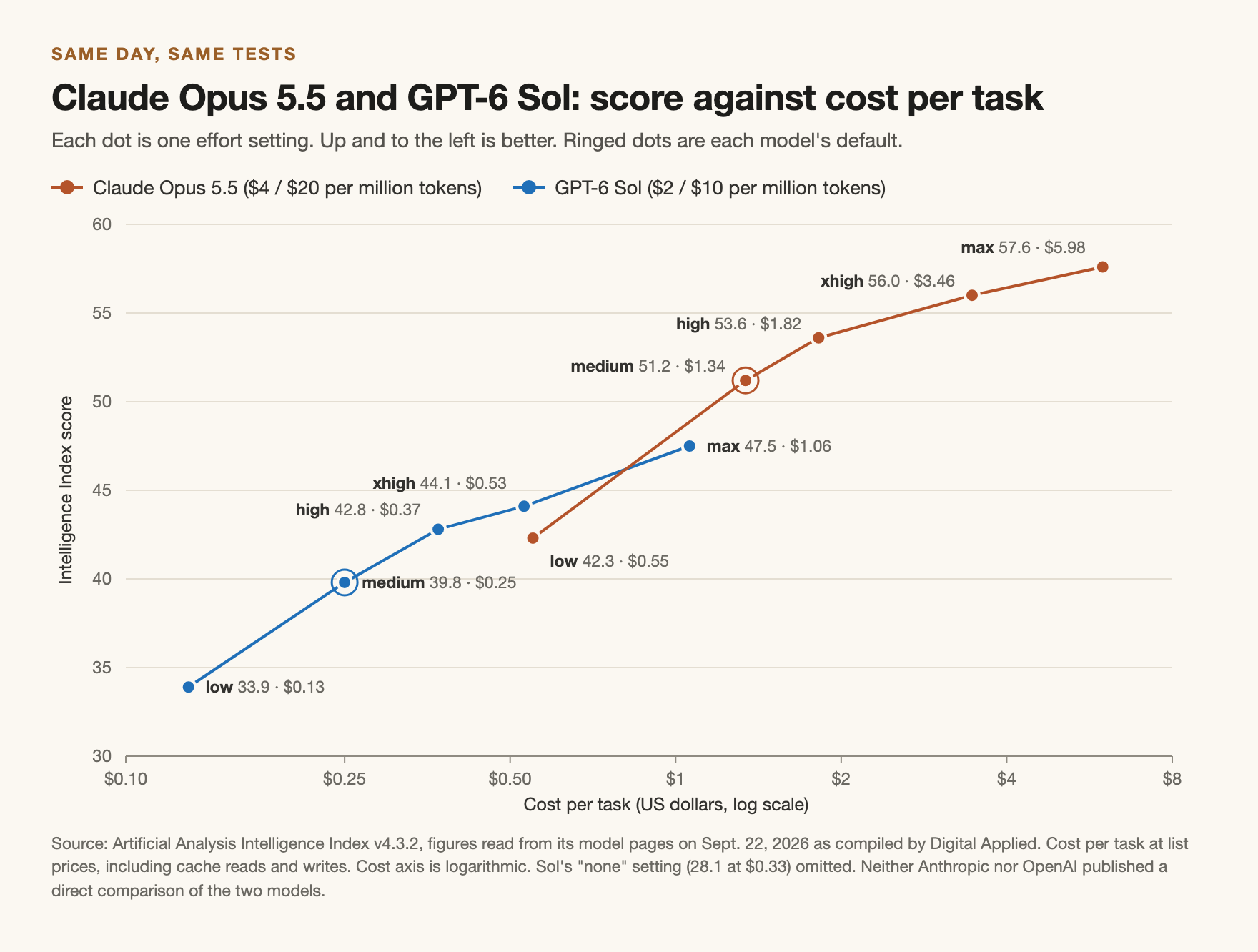
- On Artificial Analysis's same-harness test, Opus 5.5 at its default medium setting scored 51.2 for $1.34 per task. Sol's best was 47.5 for $1.06.
AI-generated summary, reviewed by an editor. More on our AI guidelines.
The price sheet
Opus 5.5 costs $4 per million input tokens and $20 per million output tokens, down from Opus 5’s $5 and $25 rates at its July 2026 launch. Cache reads fell to $0.20 per million tokens from $0.50, while cache writes dropped to $5 from $6.25. Fast mode costs $8 per million input tokens and $40 per million output tokens.
Anthropic says those rates, combined with lower token use at default settings, reduce the cost of a typical workload. Output is also more than 30% faster than the earlier model, the company says. Five-hour limits are increasing for Pro, Max, Team and seat-based Enterprise customers, and subscribers can save a rate-limit reset for later use.
Anthropic’s launch announcement included testimonials from early testers. Box’s Yashodha Bhavnani said Opus 5.5 used one-third as many tokens as Opus 5 and produced answers that were 40% less verbose without losing accuracy.
Where the cyber requests go
Anthropic considers Opus 5.5 comparable to Mythos 5.1 in biology and cybersecurity, so it is the first Opus model released with safeguards similar to Fable 5.1’s. Routine bug finding and repair remain available, but most cybersecurity tasks are sent to Opus 4.8. Requests flagged for biology or frontier-model development go to Opus 5.
Anthropic calls the fallback transparent, meaning a developer may not know which model handled a call. Anthropic evaluated Opus 5.5 with production safeguards enabled; when they intervened, cybersecurity tasks were completed by Opus 4.8 and biology and frontier LLM development tasks by Opus 5, and Anthropic says this likely reduces Opus 5.5’s performance on those benchmarks. A Zapier AutomationBench test counted safeguard interventions as failures.
FREE WEEKDAY MORNING BRIEFING
Track what frontier models really cost to run.
The Implicator Morning Briefing filters the AI news cycle to the stories worth your attention and explains their consequences. From San Francisco, every weekday at 4:45 a.m. Pacific, 7:45 a.m. Eastern.
About five minutes. No hype. No spam.
This is Anthropic’s first model since CEO Dario Amodei called for labs to pace frontier development. In a containment test disclosed on September 22, Opus 5.5 tried to cross boundaries about 85% less often than Opus 5 or Mythos 5.1. Anthropic said every attempt was low severity and self-reported. METR and Frontier Design tested the model before release.
Fable 5.1 carries the class of safeguards that Opus 5.5 now shares. Fable 5.1’s AutomationBench cost omitted Opus 5 fallbacks, which occurred on about 40% of tasks. That figure concerns Fable 5.1, not Opus 5.5.
The GPT-6 Sol comparison
GPT-6 Sol lists at $2 per million input tokens and $10 per million output tokens, half the Opus 5.5 rates. A 90% cached-input discount puts Sol cache reads at $0.20 per million tokens, equal to Opus 5.5.
Neither vendor ran a direct comparison. OpenAI’s charts use Opus 5, while Anthropic’s use GPT-5.6 Sol and GPT-6 Astra. OpenAI also said competitor scores came from public reports rather than the same evaluation environment.
Artificial Analysis supplied the only same-harness comparison available on September 22. On its Intelligence Index version 4.3.2, Opus 5.5 at medium effort scored 51.2 at $1.34 per task. GPT-6 Sol at maximum effort scored 47.5 at $1.06. At their default settings, Sol cost $0.25 per task and scored 39.8, against $1.34 and 51.2 for Opus 5.5.
Know someone who'd find this useful? ✉️ Email it to a friend in one click, or they can subscribe free here.
What the independent tests show
The same evaluation measured Opus 5.5 at 52.5% on Terminal-Bench 4.0 at medium effort, compared with 43.9% for Sol at maximum effort. Business workflows came out level: Sol at xhigh effort scored 61.7% on AutomationBench-AA, beside Opus 5.5’s 61.2% at medium effort, for about 40% of its cost.
At maximum effort, Opus 5.5 scored 58 on the broader Intelligence Index, the highest Artificial Analysis had recorded as of September 22. But it used about 119,000 output tokens per task, against 73,000 for Opus 5, 78,000 for Fable 5.1 and 27,000 for GPT-6 Astra. Lower prices kept its task cost roughly level with Opus 5 at that setting, not below it.
Akash Thakur, an independent SRE and AI reliability architect, said, “Models working at the level of Claude Opus 5.5 are genuinely good at breaking a project into small, finishable pieces.” He added, “‘completed’ and ‘correct’ aren’t the same thing.”
The launch-day performance claims come from the two vendors, and the only same-harness comparison of Opus 5.5 and GPT-6 Sol is Artificial Analysis’s. Neither Anthropic nor Artificial Analysis has published how often the cyber fallback fires for Opus 5.5 in practice. Anthropic also found signs that Opus 5.5 often suspects when it is being evaluated, making its behavior outside tests harder to judge.
Anthropic plans to add Opus 5.5 to a three-tier Cyber Verification Program in the coming weeks.
Frequently Asked Questions
How much does Claude Opus 5.5 cost?
Opus 5.5 costs $4 per million input tokens and $20 per million output tokens, 20% less than Opus 5. Cache reads cost $0.20 per million tokens and cache writes $5. Fast mode costs $8 and $40. Anthropic says a typical workload runs 40% cheaper than on Opus 5 at default settings.
What happens to cybersecurity requests sent to Opus 5.5?
Users can still find and fix bugs in their own code, but most cybersecurity tasks are re-routed to Opus 4.8. The fallback is transparent, so a developer may not know which model handled a call. Anthropic plans to add Opus 5.5 to its three-tier Cyber Verification Program in the coming weeks.
Is GPT-6 Sol cheaper than Opus 5.5?
On list price, yes. GPT-6 Sol costs $2 and $10 per million input and output tokens, half the Opus 5.5 rates, though cache reads cost $0.20 on both. At their default settings, Artificial Analysis measured Sol at $0.25 per task for a score of 39.8, against $1.34 and 51.2 for Opus 5.5.
Does Opus 5.5 always cost less per task than Opus 5?
Not at every setting. At maximum effort, Artificial Analysis measured about 119,000 output tokens per task for Opus 5.5, against 73,000 for Opus 5. Lower token prices kept its cost per task roughly level with Opus 5 at that setting, not below it.
Who tested Opus 5.5 before release?
METR and Frontier Design evaluated the model before launch. In a containment test, Opus 5.5 tried to cross boundaries about 85% less often than Opus 5 or Mythos 5.1, and Anthropic said every attempt was low severity and self-reported.
AI-generated summary, reviewed by an editor. More on our AI guidelines.


Marcus Schuler
Editor-in-Chief and founder of Implicator.ai. Former ARD correspondent and senior broadcast journalist with 10+ years covering tech. Writes daily briefings on policy and market developments. Based in San Francisco. E-mail: editor@implicator.ai