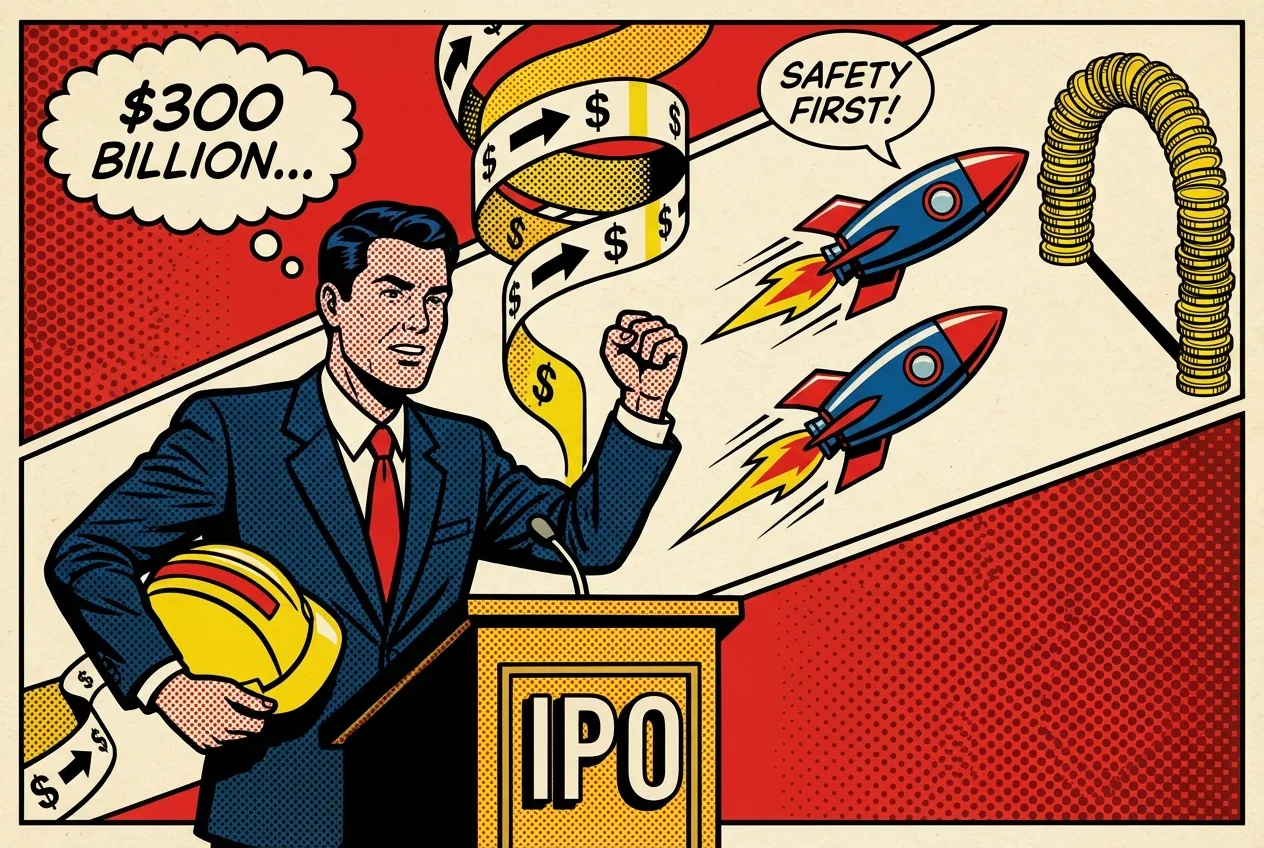
Anthropic hired IPO lawyers today, the same day it announced acquiring Bun, its first-ever acquisition. Both moves landed while the company is mid-negotiation on a funding round that would value it north of $300 billion. Coincidence seems unlikely.
The San Francisco AI lab, founded by former OpenAI researchers who departed over safety concerns, has spent five years building a reputation as the "responsible" alternative in the frontier AI race. That positioning has translated into enterprise traction that now rivals or exceeds OpenAI's on several metrics. It has also created a compelling IPO narrative, one that investors seem eager to test against public market scrutiny before OpenAI gets there first.
But the financial picture beneath Anthropic's safety-first marketing reveals tensions that don't resolve cleanly. A company burning $2.8 billion more cash than it takes in annually is positioning itself as the efficient alternative to OpenAI's infrastructure spending spree. Its investors are enthusiastic about racing to public markets while the company remains deeply unprofitable. And its first acquisition announcement, engineered for maximum visibility, arrived precisely when Anthropic needed to signal operational momentum.
Key Takeaways
• Anthropic hired Wilson Sonsini for IPO preparation and announced its first acquisition (Bun) on December 2, signaling accelerated public market ambitions
• Claude Code hit $1 billion run-rate revenue in six months; total company revenue grew from $1B in January to $7B by October 2025
• Safety-first positioning has captured roughly 33% of the enterprise market and $3.1B in API revenue, but alienated key Trump administration figures
• Company claims 2.1x revenue per compute dollar versus OpenAI, yet still burns $2.8B more cash than it generates annually
The Efficiency Question
Anthropic's leadership has made compute efficiency central to its pitch. Dario Amodei, the company's CEO, has been openly sardonic about competitors' infrastructure announcements. "These announcements are kind of frothy," he told Fortune. "Can you buy so many data centers that you over-leverage yourself? All I'll say is, some people are trying."
The numbers Anthropic has shared with investors support this framing, at least partially. Internal projections cited by The Information show Anthropic forecasting 2.1 times more revenue per dollar of computing cost than OpenAI through 2028. Daniela Amodei, the company's president, put it bluntly: "Anthropic is a minor player, comparatively, in terms of our actual compute. How have we arguably been able to train the most powerful models? We are just much more efficient at how we use those resources."
That efficiency story has limits. Anthropic still projects burning $2.8 billion more cash than it generates this year alone. Its $78 billion projected compute spending through 2028 is smaller than OpenAI's $235 billion budget, but "smaller" and "small" are different words. Both companies remain years from profitability. Anthropic says 2028. OpenAI's projections suggest 2030.
And Anthropic isn't exactly avoiding the infrastructure race. In mid-November, it announced a $50 billion deal with cloud company Fluidstack to build customized data centers in Texas and New York, its largest infrastructure commitment to date. Amazon's Project Rainier is constructing facilities that will give Anthropic access to more than 1 million of Amazon's Trainium 2 chips by year-end. Google, despite competing directly with Claude through Gemini, is providing 1 million TPUs.
The efficiency advantage may be real. It may also be narrowing. When your competitor is burning cash at three times your rate but growing at roughly similar speeds, the math gets complicated.
Safety as Enterprise Moat
What started as ideological differentiation has become Anthropic's primary competitive weapon in enterprise sales. The company didn't stumble into this positioning. It engineered it.
Anthropic's founding story, seven researchers departing OpenAI in 2020 over concerns about safety being deprioritized for commercial products, created immediate credibility with enterprise customers who were skeptical of AI vendors' trustworthiness claims. But the company has reinforced that positioning through technical innovations that directly address business concerns.
Constitutional AI, a technique Anthropic pioneered, gives Claude a written set of principles drawn from sources including the UN Universal Declaration of Human Rights and Apple's terms of service. Constitutional classifiers, additional AI models screening both inputs and outputs for compliance. Red teams probing for vulnerabilities. A threat intelligence group that has uncovered Chinese hackers using Claude to penetrate Vietnamese infrastructure and North Korean fraudsters using it to land IT jobs at American companies.
Enterprise customers notice. Nick Johnston, who leads strategic technology partnerships at Salesforce, says Salesforce's customers, particularly in finance and healthcare, pushed his company toward Anthropic specifically because they perceived Claude as more secure than alternatives. Menlo Ventures survey data shows Anthropic commanding roughly a third of the enterprise market, compared with 25% for OpenAI and 20% for Google Gemini.
Kate Jensen, who heads Anthropic's Americas operation, frames reliability and safety as essentially identical for enterprise use cases. "Does the model do what you asked it to do? Yes or no? That shouldn't really be a massive enterprise differentiator, but right now in AI, it is."
The strategy has produced concrete results. Anthropic reports API revenue of $3.1 billion compared with OpenAI's $2.9 billion, according to figures shared with investors this summer. More than 300,000 enterprise customers. A sevenfold increase in customers spending more than $100,000 annually.
But safety positioning creates its own constraints. Anthropic's careful approach has alienated influential figures in the Trump administration. White House AI czar David Sacks has repeatedly attacked the company as part of the AI "doomer industrial complex." Vice President JD Vance has expressed skepticism about safety efforts hobbling American competitiveness with China. Amodei was notably absent from a September White House dinner attended by other top AI executives, and missed the president's state visit to the U.K.
The company maintains it has "lots of friends in the Trump administration" and points to shared priorities on energy generation for data centers. It has won a $200 million Pentagon contract. But the political risk is real, particularly for a company about to enter public markets where government contracts and regulatory treatment matter enormously.
Racing to Public Markets
Anthropic hiring Wilson Sonsini to prepare for an IPO represents what the Financial Times characterized as "a significant step up" in preparations for what could become one of the largest public offerings in history.
The law firm has advised Anthropic since 2022 and has handled high-profile tech IPOs including Google, LinkedIn, and Lyft. One person with knowledge of Anthropic's plans told the Financial Times the company could be prepared to list in 2026. Another cautioned that timeline was unlikely.
What's clear is that Anthropic's investors are pushing for speed. The FT reported they are "enthusiastic" about seizing initiative from OpenAI by listing first. OpenAI itself is undertaking preliminary IPO work, though CFO Sarah Friar said in November that a public offering isn't in the startup's "near-term plans."
Both companies face the same fundamental challenge: convincing public market investors to back massively unprofitable AI research labs whose financial performance is genuinely difficult to forecast. Revenue is growing extraordinarily fast. So are costs. The gap between the two isn't closing quickly.
Anthropic's revenue trajectory looks impressive in isolation. Annual run rate hit $1 billion in January 2025, grew to $5 billion by August, and reached $7 billion by October. The company told investors it could generate $26 billion in 2026 and a staggering $70 billion by 2028.
But IPO investors will scrutinize unit economics, competitive positioning, and the sustainability of growth rates that no company can maintain indefinitely. They'll ask whether enterprise customers are locked in or shopping between providers as model performance converges. They'll want to understand why Anthropic needs to keep raising private capital, reportedly pursuing its third venture round in 18 months even after closing a $13 billion raise in August.
The race to list first may matter less than the quality of the story each company can tell. And right now, Anthropic's story has an unusual advantage: it can position profitability as closer than OpenAI's while spending less on infrastructure. Whether that efficiency premium survives public market due diligence is another question.
The Bun Acquisition and Strategic Optics
Anthropic's acquisition of Bun, the JavaScript runtime founded by Jarred Sumner in 2021, landed the same day as the IPO lawyer news. The company's first-ever acquisition. Announced precisely when Anthropic needed to demonstrate operational momentum beyond revenue growth.
The deal makes technical sense. Bun powers Claude Code's infrastructure, and Anthropic has been a close partner for months. Bun's all-in-one toolkit, combining runtime, package manager, bundler, and test runner, is built using Zig and Apple's JavaScriptCore, yielding faster startup times and lower memory usage than Node.js-based alternatives. For a company whose coding product just hit $1 billion in run-rate revenue six months after public launch, controlling that infrastructure stack has obvious value.
Mike Krieger, Anthropic's chief product officer and Instagram cofounder, emphasized the strategic logic: "Jarred and his team rethought the entire JavaScript toolchain from first principles while remaining focused on real use cases. Bringing the Bun team into Anthropic means we can build the infrastructure to compound that momentum."
Bun had raised $7 million in 2022 from investors including Kleiner Perkins but hadn't yet found a revenue model. Sumner was candid about the acquisition's appeal: "Instead of putting our users and community through 'Bun, the VC-backed startup tries to figure out monetization,' thanks to Anthropic, we can skip that chapter entirely."
Simon Willison, the developer and blogger who has tracked Anthropic's revenue figures closely, noted that Claude Code's $1 billion run-rate represents a substantial chunk of Anthropic's overall revenue. "I had suspected that a large chunk of this was down to Claude Code," he wrote. "A large chunk of the rest of the revenue comes from their API customers, since Claude Sonnet/Opus are extremely popular models for coding assistant startups."
Anthropic framed the acquisition as aligned with its "strategic, disciplined approach to acquisitions" and signaled it won't be the last. The company will "continue to pursue opportunities that bolster our technical excellence, reinforce our strength as the leader in enterprise AI, and most importantly, align with our principles and mission."
For a company preparing to go public, acquisitions serve multiple purposes beyond the operational. They demonstrate capital deployment capability. They create news cycles. They signal confidence. Announcing your first acquisition the same day you hire IPO lawyers isn't accidental.
Why This Matters
For investors considering the coming AI IPO wave: Anthropic's efficiency claims deserve scrutiny, but its enterprise positioning creates genuine differentiation from OpenAI's consumer-heavy approach. The race to list first may favor whichever company can present clearer unit economics.
For enterprise customers evaluating AI vendors: Anthropic's safety-focused approach has produced measurable security advantages, but political headwinds from the Trump administration create regulatory uncertainty that could affect government contracts and long-term competitive positioning.
For the developer ecosystem: Claude Code's $1 billion milestone in six months, combined with the Bun acquisition, signals Anthropic's serious commitment to owning the AI-assisted development toolchain. Expect more infrastructure acquisitions as the company consolidates its position before going public.
❓ Frequently Asked Questions
Q: What is Bun and why did Anthropic acquire it?
A: Bun is a JavaScript runtime created by Jarred Sumner in 2021. It combines a runtime, package manager, bundler, and test runner into one tool, built using Zig and Apple's JavaScriptCore. This makes it faster than Node.js alternatives. Anthropic uses Bun to power Claude Code's infrastructure. The acquisition gives Anthropic control over a critical piece of its coding product stack, which just hit $1 billion in run-rate revenue.
Q: What does "run-rate revenue" actually mean?
A: Run-rate revenue takes current monthly revenue and projects it over a full year. When Anthropic says Claude Code reached $1 billion in run-rate revenue, it means recent monthly revenue would add up to $1 billion if sustained for 12 months. It's a standard startup metric but doesn't guarantee future performance. Anthropic's total company run-rate grew from $1 billion in January 2025 to $7 billion by October.
Q: Why would Anthropic want to go public before OpenAI?
A: Being first to market could give Anthropic advantages in setting investor expectations for AI company valuations. An IPO provides cheaper capital than private funding rounds and creates public stock useful for acquisitions. Anthropic's investors are reportedly "enthusiastic" about listing first, viewing it as a chance to establish the company as a credible OpenAI alternative before its larger rival shapes public market perceptions.
Q: What is Constitutional AI and how does it make Claude safer?
A: Constitutional AI is a training technique Anthropic pioneered. It gives Claude a written set of principles, drawn from sources like the UN Declaration of Human Rights and Apple's terms of service, that guide its behavior. During training, the model learns to evaluate its outputs against these principles. This makes it harder for users to manipulate Claude into producing harmful content, which appeals to security-conscious enterprise customers.
Q: How big would Anthropic's IPO be compared to other tech IPOs?
A: At a potential $300-350 billion valuation, Anthropic's IPO would rank among the largest ever. Facebook's 2012 IPO valued the company at $104 billion. Alibaba's 2014 IPO hit $231 billion. Anthropic would surpass both. OpenAI, valued at $500 billion privately, could be even larger. Both companies remain unprofitable, making these valuations unusually aggressive for public market debuts.
 Marcus Schuler
 Marcus Schuler
 Maria Garcia