Implicator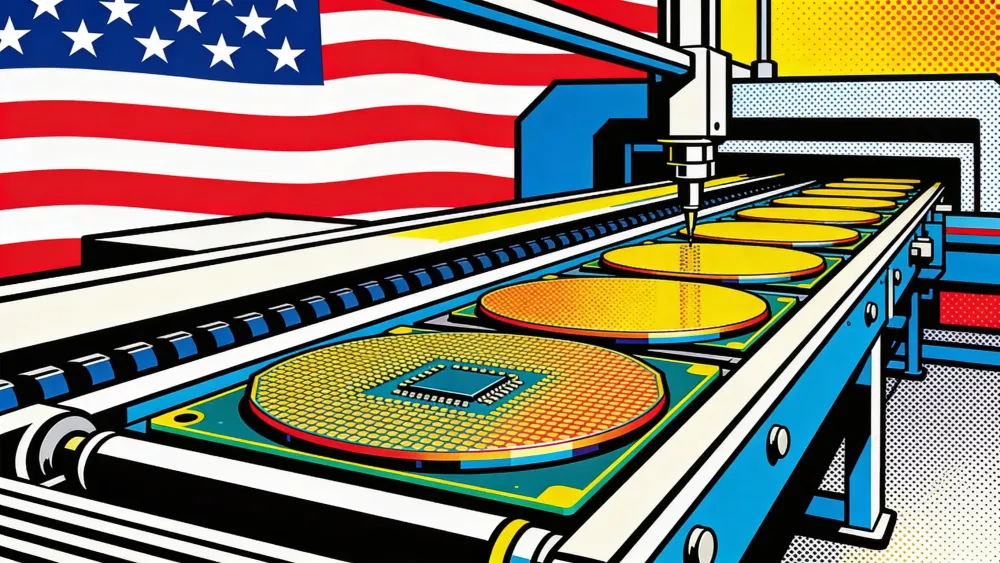
Apple on Thursday added four companies to its American Manufacturing Program: Bosch, Cirrus Logic, TDK, and Qnity Electronics, with $400 million pledged through 2030 for domestic sensor and semiconductor production. That money feeds into a $600 billion, four-year spending pledge Apple rolled out in August 2025. CEO Tim Cook stood in the Oval Office with President Donald Trump for that original announcement. The announcement lands four days after Cook addressed the China Development Forum in Beijing, taking the stage after Chinese Premier Li Qiang to praise the "extraordinary" pace of Chinese factory automation. That kind of split screen tells you something about the political contortions required of any company building products on two continents right now.
Key Takeaways
- Apple adds Bosch, Cirrus Logic, TDK, and Qnity Electronics to AMP with $400 million through 2030
- Program has sourced 20 billion U.S.-made chips from 24 factories; 100M+ TSMC Arizona chips expected in 2026
- Most advanced Apple silicon still comes from Taiwan; nine of ten iPhones still assembled in China
- Apple absorbed $3.3 billion in tariffs; Supreme Court ruling opens path to potential refunds
What the new partners actually make
The four companies each plug a different hole in Apple's domestic chip supply. TDK has been an Apple supplier for more than 30 years. Now it will make sensors on American soil for the first time. Among them: the motion-sensing hardware that keeps iPhone cameras stable. Those sensors end up in devices sold worldwide, not just in the U.S., which means Apple is pulling a larger share of its global chip demand from American fabs.
Bosch will produce integrated circuits for sensing hardware at TSMC's facility in Camas, Washington. Think Crash Detection, the feature that calls 911 when your car stops suddenly, along with activity tracking on Apple Watch. Over in Malta, New York, Cirrus Logic will work GlobalFoundries' fab lines to build mixed-signal semiconductors. Those are the chips behind Face ID. Qnity Electronics and HD MicroSystems fill the less visible end of the announcement, providing raw materials for chip fabrication and high-performance computing.
None of this is iPhone assembly. That distinction matters. Nine out of ten of the roughly 220 million iPhones sold annually still come off production lines in China, according to the BBC. Apple's domestic push targets the components that go into those phones, not the final product consumers hold in their hands.
The AMP scorecard so far
AMP has been running for roughly eight months. The numbers are getting hard to wave away. According to Apple, the program has sourced more than 20 billion chips made in the U.S. Twenty-four factories across 12 states. That beat the company's own targets. TSMC's Arizona fab alone should ship Apple well over 100 million advanced chips this year, a big jump from 2025. An Apple executive told the Phoenix Business Journal the company is "buying as much of the output of this fab as we can."
The initial AMP partners are posting their own milestones. Amkor broke ground on a $7 billion semiconductor packaging facility in Peoria, Arizona, with 750,000 square feet of cleanroom space and 3,000 projected jobs. Apple will be the first and largest customer. GlobalWafers has begun production at a new $4 billion silicon wafer plant in Sherman, Texas. And Corning's facility in Harrodsburg, Kentucky, is now 100% dedicated to making cover glass for iPhone and Apple Watch sold worldwide. Every unit, shipped globally.
And in February, Apple announced it would begin producing the Mac mini at its Houston factory later this year, the first time the product will be built in the U.S. The Houston campus, already manufacturing AI servers ahead of schedule at roughly 10 units per hour, will double its footprint.
The Taiwan problem that $400 million doesn't solve
For all the ceremony around domestic manufacturing, Apple's most advanced silicon still depends on facilities 8,000 miles away. The A19 chip in the iPhone 17 and the M5 processor both rely on Taiwan's leading-edge manufacturing technology, not Arizona's. Taiwan holds the leading process nodes, the deepest engineering talent pools, and the production volumes that no American facility can match yet.
The domestic pipeline tells you where things stand. Purified silicon gets melted into 12-inch wafers in Sherman, Texas. Those wafers ship to TSMC's Arizona fab for extreme ultraviolet lithography. But packaging, the step where bare chips become functional components, still goes overseas. Amkor's Peoria campus won't begin production until 2028. Until then, Arizona-made chips travel back across the Pacific to get finished.
TSMC's Arizona operation is expanding fast. Fab 4 is already fully booked through late 2027 before construction even starts, according to TrendForce, and 3nm mass production at Fab 2 is expected by the second half of 2027. But the gap between "chips etched in Arizona" and "a complete domestic supply chain" remains wide. Apple's $400 million investment narrows that gap at the component level. It does not close it.
Get Implicator.ai in your inbox
Strategic AI news from San Francisco. No hype, no "AI will change everything" throat clearing. Just what moved, who won, and why it matters. Daily at 6am PST.
No spam. Unsubscribe anytime.
Tariffs, refunds, and the $3.3 billion question
The timing of this announcement is not accidental. Apple has absorbed roughly $3.3 billion in tariff costs since Trump's trade policies took effect, averaging about $1 billion per quarter. Cook chose to eat those expenses rather than raise prices on consumers.
Then the Supreme Court intervened. On February 20, a 6-3 majority struck down the bulk of Trump's IEEPA tariffs in Learning Resources Inc. v. Trump, ruling that the law does not authorize a president to impose tariffs unilaterally. The decision triggered potential refund claims totaling up to $165 billion from American importers, according to CNBC. Apple could be one of the largest beneficiaries. The company has not said whether it will seek to recoup what it has already paid.
Trump responded by imposing a new 15% global tariff under Section 122 of the Trade Act of 1974, a provision limited to 150 days without congressional approval. On Thursday, the same day Apple announced its AMP expansion, Trump told a National Republican Congressional Committee dinner that Justices Gorsuch and Barrett "sicken me" for their votes in the tariff case.
So Apple finds itself expanding domestic manufacturing under a program that launched with an Oval Office handshake, even as the president's signature trade policy lies in ruins at the Supreme Court. The $400 million investment reads one way if you see it as genuine industrial strategy. It reads differently if you consider that Apple may soon file paperwork asking the government to return $3.3 billion in tariffs the Supreme Court declared illegal.
Beijing on Sunday, Washington on Thursday
The sharpest tension runs through Cook's calendar. Four days before Apple touted its American manufacturing expansion, the CEO was in Beijing telling the China Development Forum that Apple is "committed to working alongside our supplier partners" in China and highlighting that more than 90% of Apple's Chinese production runs on clean energy. iPhone sales in China were up 23% year-on-year in the first nine weeks of 2026, according to Counterpoint Research, bucking a 4% decline in the overall market.
China still accounts for nearly 18% of Apple's revenue. The company still manufactures most of its iPhones there. And while the U.S.-China trade truce reached in October lowered effective tariff rates to less than 50%, that agreement lasts only a year. Trump had planned to visit Beijing this month for further trade talks. The Iran war pushed those plans back by weeks.
What Apple is doing here isn't a choice between the U.S. and China. Cook is building parallel supply chains in both countries at the same time, praising each government's industrial ambitions in the same week, sometimes the same breath. That works as long as Washington and Beijing stay willing to be flattered. If either capital demands exclusivity, the $400 million committed to Bosch and TDK becomes a rounding error.
Apple likes to cite the domestic headcount. Four hundred fifty thousand jobs supported across all 50 states, with plans to add 20,000 more in engineering and AI roles. A training center in Houston opens later this year. The brochure numbers are real enough.
And yet. The most advanced chips still come from Taiwan. Most iPhones still come from China. You already know this. And $400 million, spread across four partners over four years, works out to $25 million per company per year. For a company sitting on a $3.66 trillion market capitalization, that number lands somewhere between strategic investment and political gesture. The answer probably depends on which capital you ask.
Frequently Asked Questions
What companies did Apple add to its American Manufacturing Program?
Apple added Bosch, Cirrus Logic, TDK, and Qnity Electronics. TDK will manufacture sensors in the U.S. for the first time, Bosch produces integrated circuits at TSMC's Washington facility, Cirrus Logic develops Face ID chips with GlobalFoundries in New York, and Qnity supplies semiconductor materials.
How much is Apple investing in the new manufacturing partnerships?
Apple pledged $400 million through 2030 for the four new partners. This feeds into a broader $600 billion, four-year commitment to U.S. manufacturing announced in August 2025.
How many U.S.-made chips has Apple sourced through AMP?
More than 20 billion chips from 24 factories across 12 states. In 2026, Apple expects to purchase over 100 million advanced chips from TSMC's Arizona fab alone.
Are iPhones now manufactured in the United States?
No. Apple's domestic push targets components, not final assembly. Nine out of ten iPhones still come off production lines in China. The Houston facility will produce Mac mini and AI servers, not iPhones.
How do the Supreme Court tariff ruling and this announcement relate?
Apple absorbed roughly $3.3 billion in tariffs under Trump's trade policies. The Supreme Court struck down the IEEPA tariffs on February 20, opening potential refund claims totaling up to $165 billion for all importers. Apple announced its AMP expansion the same day Trump criticized the ruling.


Maria Garcia
Bilingual tech journalist slicing through AI noise at implicator.ai. Decodes digital culture with a ruthless Gen Z lens—fast, sharp, relentlessly curious. Bridges Silicon Valley's marble boardrooms, hunting who tech really serves.