 IMPLICATOR
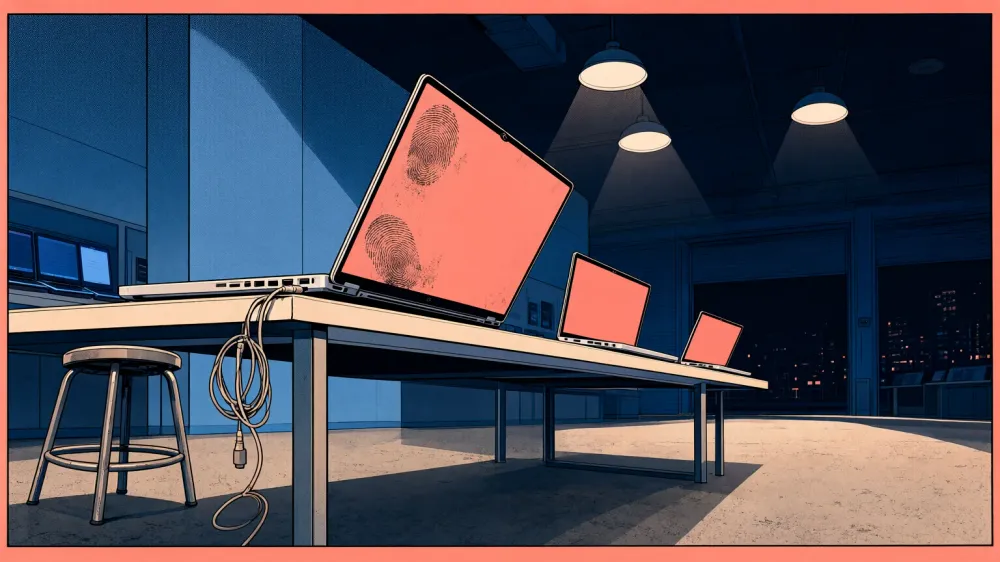
Apple announced its first touchscreen MacBook Pro on Wednesday, ending more than a decade in which the company refused to build a laptop you could touch. The 14-inch model starts at $2,899 with an M5 Pro chip, and the 16-inch at $3,399. Steve Jobs once called touchscreen laptops "ergonomically terrible," and the entry price sits well above the non-touch MacBook Pro Apple introduced a day earlier.
What Changed
- Apple announced its first touchscreen MacBook Pro on Wednesday: the 14-inch starts at $2,899 with an M5 Pro chip, the 16-inch at $3,399.
- A day earlier Apple unveiled a non-touch 14-inch MacBook Pro with the M6 chip from $1,999.
- The touch models weigh 3 and 4 pounds, lighter than the non-touch versions at 3.4 and 4.7 pounds.
- macOS changes little for touch, and hands-on reviewers doubt Apple can fix all the ergonomics of reaching for a laptop screen.
AI-generated summary, reviewed by an editor. More on our AI guidelines.
What the money buys
Both sizes use a new PROLED XDR display, a tandem OLED panel with a 120Hz refresh rate and up to 2,000 nits of brightness. Apple says the touch sensor is "built directly into the display panel," not laid on top of it, which helps reduce latency. Apple designed a hinge that steadies the screen when users touch it, and a Dynamic Island replaces the notch found on most current MacBooks.
Buyers choose between M5 Pro and M5 Max chips, with up to 128GB of unified memory and up to 16TB of storage. The M5 Pro version drives three external displays and the M5 Max up to four. A fully specced configuration costs $14,549. The machines are available from November 6.
The lineup beside it
A day before the event, Apple unveiled a standard 14-inch MacBook Pro with the M6 chip, starting at $1,999. The cheaper machine runs the M6; the touchscreen models run M5 Pro and M5 Max.
FREE · ABOUT FIVE MINUTES
Follow Apple's hardware bets as they ship.
Implicator cuts the flood to the developments worth your attention, with concise reporting on what changed and why it matters. Delivered every weekday at 4:45 a.m. Pacific, 7:45 a.m. Eastern.
From San Francisco. No spam. Unsubscribe anytime.
Weight runs the other way. The non-touch M6 models start at 3.4 pounds, while the 14-inch touchscreen model weighs 3 pounds. The 16-inch touch version comes in at 4 pounds, against 4.7 pounds for the non-touch M5 Pro model. Putting the two 16-inch machines side by side, The Verge's reviewers found the touch version slightly thinner, with a footprint "a smidge smaller."
Late to a Windows habit
Touchscreens have been mainstream on Windows laptops for well over a decade. Apple tried a narrower version nearly 10 years ago with the Touch Bar on a MacBook Pro, which it later removed. Jobs and Tim Cook both scoffed at a touchscreen Mac in the past, and rumors that Apple was building one circulated for nearly three years before Wednesday.
The machine is one of two marquee launches for new CEO John Ternus, who formerly led hardware engineering at Apple. The other was the iPhone Duo, the company's first foldable, which he introduced in September.
How much macOS changes
Not a lot. Allison Johnson, a senior reviewer at The Verge, found Apple is not rushing to rework macOS for touch. Trackpad gestures such as swiping from the right edge to open the notification center now work on the display, and the system magnifies drop-down menu options and the window controls when tapped. Pinching to zoom on photos and swiping to scroll through webpages work too.
Know someone who'd find this useful? ✉️ Email it to a friend in one click, or they can subscribe free here.
Apple's own apps arrive optimized for touch, and the system translates touches into clicks. Apple listed Notion, Canva, Zoom, Word, Excel, PowerPoint, Lightroom and DaVinci Resolve among third-party apps that use the new controls.
The arm problem
Apple pitches the Dynamic Island as a place to search files and use Siri AI. The weights, brightness and latency claims above are Apple's own specifications.
Terrence O'Brien and Antonio G. Di Benedetto, who handled the machine at the event, were less sure about the posture itself. It is unlikely Apple can fix all the "terrible" ergonomics of lifting an arm to touch a laptop screen, they wrote, adding that the company had put some effort into making macOS more touch-friendly.
Frequently Asked Questions
How much does the touchscreen MacBook Pro cost?
The 14-inch model starts at $2,899 with an M5 Pro chip and the 16-inch at $3,399. A fully specced configuration costs $14,549. The machines are available from November 6.
How does it compare with the non-touch MacBook Pro?
A day before the event, Apple unveiled a standard 14-inch MacBook Pro with the M6 chip starting at $1,999. The touch models run M5 Pro or M5 Max chips and weigh less: 3 pounds for the 14-inch against 3.4 pounds for the non-touch M6 models.
What changes in macOS for touch?
Not a lot. Trackpad gestures work on the display, the system magnifies menus and window controls when tapped, and touches are translated into clicks. Apple listed apps such as Notion, Zoom, Word, Lightroom and DaVinci Resolve as using the new controls.
What are the display specifications?
The PROLED XDR display is a tandem OLED panel with a 120Hz refresh rate and up to 2,000 nits of brightness. Apple says the touch sensor is built into the display panel rather than laid on top, which helps reduce latency.
Why did Apple resist a touchscreen Mac for so long?
Steve Jobs called touchscreen laptops ergonomically terrible, and Jobs and Tim Cook both scoffed at the idea. Apple tried the Touch Bar nearly 10 years ago and later removed it.
AI-generated summary, reviewed by an editor. More on our AI guidelines.



Free AI briefing · Weekdays
The AI stories that matter, sourced and explained.
Join the Morning Briefing. It goes out every weekday at 4:45 a.m. Pacific, with later sends for the East Coast, Berlin and Tokyo.
Free when you sign up: The Paperclip Compendium, our tested guide to running AI agents.
Free. Unsubscribe in one click.

Marcus Schuler
Editor-in-Chief and founder of Implicator.ai. Former ARD correspondent and senior broadcast journalist with 10+ years covering tech. Writes daily briefings on policy and market developments. Based in San Francisco. E-mail: editor@implicator.ai