IMPLICATOR
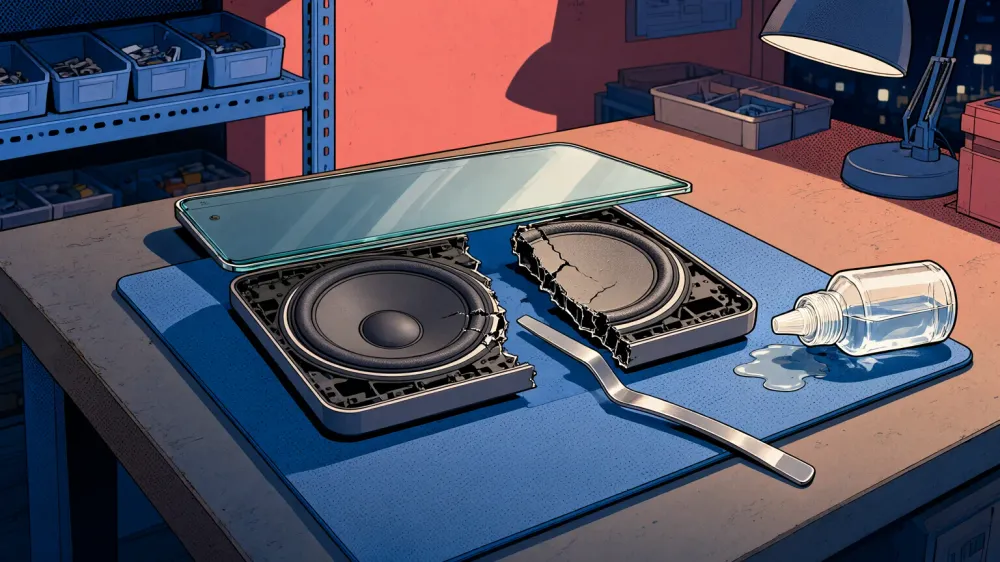
iFixit's teardown of Apple's HomeView ended with a ripped connector, a speaker snapped in two and more force on the logic board than the repair team was comfortable with. The hub sells for $299 in both its tabletop and wall-mounted versions. iFixit called it a surprising step backward, because Apple had been getting better at making its iPads and HomePods repairable.
Apple announced the HomeView on October 13 as its first smart home hub. It pairs a 7-inch display on top with a speaker base below.
What Changed
- iFixit's HomeView teardown ended with a ripped connector, a speaker snapped in two and heavy force on the logic board.
- Adhesive holds the display, the speakers and a heat shield under the logic board, which iFixit called a remarkably risky part to remove.
- The speaker base is built a lot like a HomePod, with a modular USB-C port and modular passive speakers.
- iFixit has no official repairability scorecard for this category of device.
AI-generated summary, reviewed by an editor. More on our AI guidelines.
Apple's recent repair record
The progress iFixit had counted on was real. The original HomePod took a hacksaw to open. By the second generation, the team could get inside without destroying anything. iPads gained easier battery access, replaceable USB-C ports and official repair manuals.
The HomeView started badly at the front glass. As in an iPad, reaching anything behind the display means going through it first. The team heated the screen on a mat, but the aluminum enclosure carried the heat away, and the adhesive "held on harder than on any Apple product we've opened recently."
Inside, one bracket over the display connector uses a Phillips screw on one side and a Torx screw on the other. iFixit wrote that "two driver types for a single bracket is a poor choice."
Connectors and speakers
The left speaker's connector was the first casualty. Its leads ripped out of the plastic housing, which stayed put on the board. On the right speaker, the team scraped the glue, added heat and took a knife to the connector's seams, and still could not remove it without damage.
"These brittle plastic connectors are designed to go in, stay in, and not be removed," iFixit wrote.
Two large speakers fill most of the space behind the display. Speakers have moving parts that can wear out or fail, and iFixit figured these should be easy to remove. The team poured so much isopropyl alcohol behind them that the excess dripped out through the speaker grilles. A metal pry tool bent under the force. Then the speaker snapped in two, showing thick pads of adhesive on its underside. Apple's own MacBook team uses a much lighter adhesive to secure its speakers, iFixit noted. A third microphone hides under a bracket that is both screwed in and glued down with a thin strip of adhesive.
A heat sink that holds the board
Apple turned the entire aluminum chassis into a heat sink, which iFixit called "a smart design." A second shield under the logic board carries heat into the back of the enclosure, and that shield is glued in place. The thermal bond makes removing the board "a remarkably risky operation."
All the important chips are soldered to the board. They include the A18 system-on-chip, an 8GB RAM chip from SK Hynix and a 64GB NAND chip made by Kioxia.
Know someone who'd find this useful? ✉️ Email it to a friend in one click, or they can subscribe free here.
The base fares better
The speaker base went more smoothly. It is built a lot like a HomePod, and four Torx screws release its bottom plate. The USB-C port is modular, as are the two passive speakers, and the power supply board pops free after a few screws and a couple of connectors.
The woofer's cable is extremely short, and the team could barely reach its release with a pry tool. The cables between the halves run through the pivot, so separating screen and base takes specialized tools or a likely destructive disassembly of the screen side.
The wall-mounted model has smaller internal speakers and a slightly wider logic board, which holds capacitors that sit in the tabletop version's base.
No official score
iFixit does not have an official repairability scorecard for this category of device, so the teardown carries no score. Shahram Mokhtari joked that the HomeView would rate a "BEEP this thing" out of 10.
iFixit's written conclusion was plainer. "Nobody at Apple fought for the day a HomeView breaks."
Frequently Asked Questions
What did iFixit find inside Apple's HomeView?
Heavy adhesive on the display, the speakers, the speaker connectors and a heat shield under the logic board. The team ripped a connector and snapped a speaker in two while taking it apart.
Why is the logic board hard to remove?
Apple turned the aluminum chassis into a heat sink. A second shield under the logic board carries heat into the back of the enclosure and is glued in place, so removing the board takes considerable force.
Is any part of the HomeView easy to repair?
The speaker base fared better. It is built a lot like a HomePod, its USB-C port is modular, and the two passive speakers are modular too. An extremely short woofer cable still makes work there difficult.
How do the tabletop and wall-mounted models differ inside?
The wall-mounted model has smaller internal speakers and a slightly wider logic board, which holds capacitors that sit in the tabletop version's base. Both versions are priced at $299.
Did iFixit give the HomeView a repairability score?
No. iFixit does not have an official repairability scorecard for this category of device.
AI-generated summary, reviewed by an editor. More on our AI guidelines.




Marcus Schuler
Editor-in-Chief and founder of Implicator.ai. Former ARD correspondent and senior broadcast journalist with 10+ years covering tech. Writes daily briefings on policy and market developments. Based in San Francisco. E-mail: editor@implicator.ai