IMPLICATOR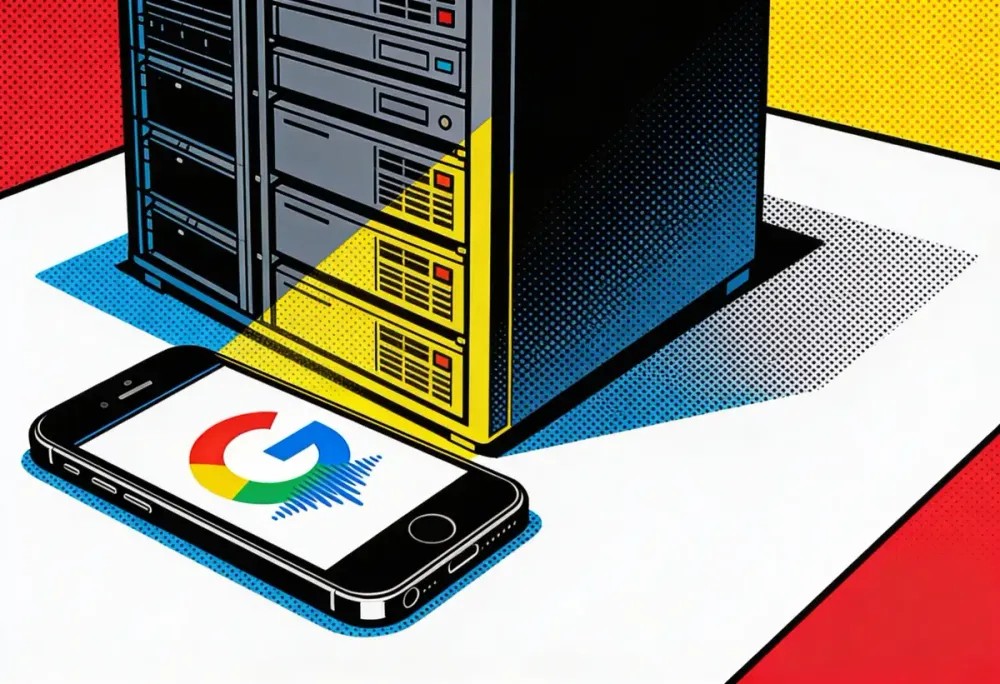
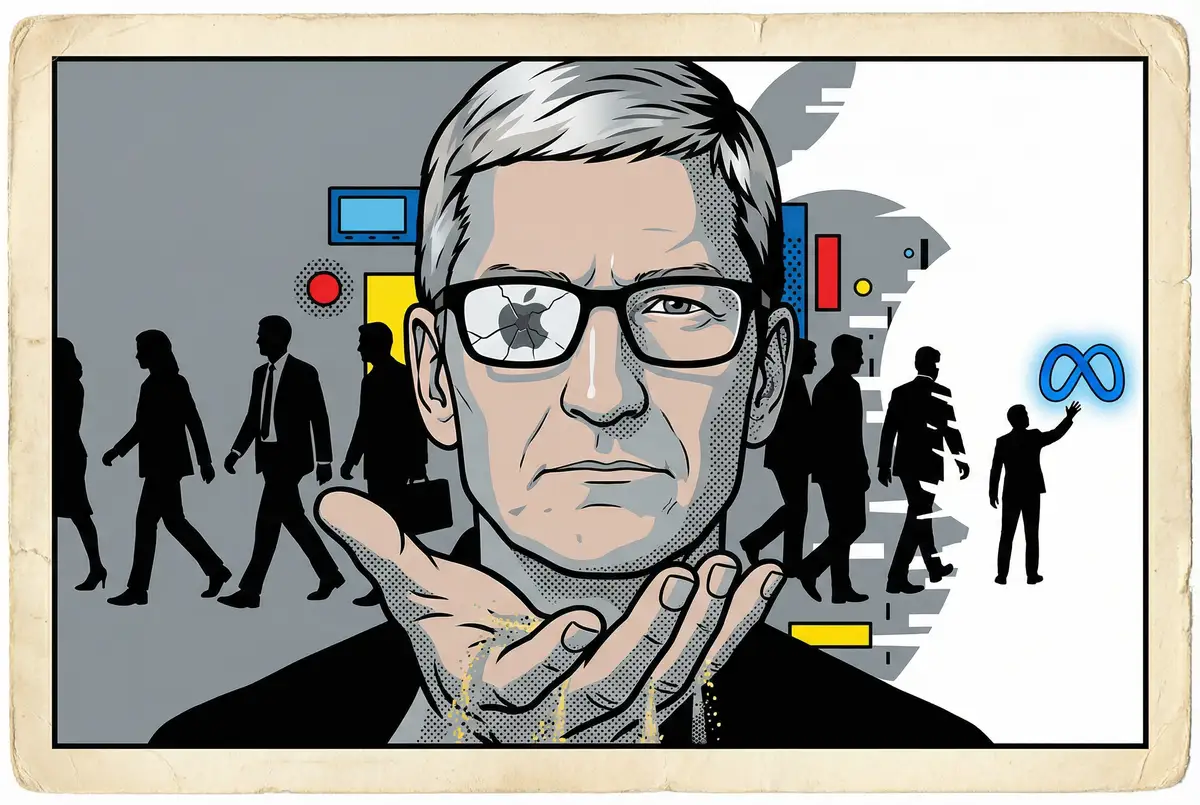
The statement landed Sunday night, timed for the dead hours when companies want news filed but not read. "After careful evaluation, we determined that Google's technology provides the most capable foundation for Apple Foundation Models," Apple told CNBC. Translation: Siri lost. Gemini won. The company that once mocked Google's privacy record now needs Google's AI to power its most personal product.
The Breakdown
• Apple pays Google ~$1 billion/year for a custom 1.2 trillion parameter Gemini model, 8x larger than Apple's own AI
• The deal reverses a decade of Google paying Apple $20 billion annually for Safari search defaults
• AI chief John Giannandrea was reassigned in summer 2025 and left Apple entirely by December
• Google's market cap surpassed Apple's for the first time since 2019, briefly touching $4 trillion
The $1 billion confession
Apple will pay Google roughly $1 billion annually for access to a custom 1.2 trillion parameter Gemini model. Put that in perspective. Apple's own cloud-based AI tops out at 150 billion parameters. The difference isn't horsepower. It's category. Apple built a calculator. Google built the mainframe it connects to.
The deal flips a decade-long financial arrangement on its head. Google currently pays Apple roughly $20 billion per year to remain Safari's default search engine. Now money flows the other direction too. Apple becomes both Google's customer and its distribution partner, a dependency that should worry anyone who remembers Apple's positioning as the privacy-first alternative to data-hungry competitors.
But here's what Apple isn't saying. The multi-year partnership didn't materialize because Cupertino wanted a strategic ally. Apple's own AI effort had hit a wall. Remember WWDC 2024? The demo promised an AI-upgraded Siri with personal context, in-app actions, on-screen awareness. None of it shipped. Apple owned up to it in March. "It's going to take us longer than we thought." Then came the personnel moves. AI chief John Giannandrea got reassigned over the summer. By December, he was out entirely.
The technical capitulation
Anyone who has asked Siri a complicated question knows the silence. The spinning animation. The eventual response that answers a simpler question than the one you asked. That pause is Apple's AI gap made audible.
Strip away the corporate language and you find a company that tried to build something it couldn't finish. Apple's engineers spent years developing large language models in buildings where the cafeteria serves better food than most restaurants and the parking lots fill with Teslas and Rivians. The talent was there. The compute was there. The results weren't.
Google's Gemini 3, released last November, forced the issue. Sam Altman reportedly declared a "code red" at OpenAI after Google's model leapfrogged industry benchmarks. Picture that meeting in San Francisco. Now picture the quieter one in Cupertino, where the team that just lost its chief had to explain why their work still couldn't match a competitor's demo.
Get Implicator.ai in your inbox
Strategic AI news from San Francisco. No hype, no "AI will change everything" throat clearing. Just what moved, who won, and why it matters. Daily at 6am PST.
No spam. Unsubscribe anytime.
The Gemini model Apple licensed will handle what Apple calls "summarizer and planner functions." Processing information from multiple sources. Coordinating actions across apps. The cognitive work that makes an assistant feel intelligent rather than scripted. Apple's own models retain the privacy-sensitive tasks. Your face data stays on-device. But the thinking, the part that matters, happens somewhere else.
Apple insists the arrangement protects user data. The custom Gemini model runs on Apple's Private Cloud Compute servers, not Google's. Google never touches user information directly. This architecture lets Apple maintain its privacy narrative while outsourcing the intelligence.
And yet. Apple built its brand on control. Hardware. Software. Services. Everything integrated, everything owned. Now the most intimate feature on your iPhone runs on a Google brain wearing an Apple mask.
The market response
Wall Street noticed the shift before Apple confirmed it. Alphabet's market capitalization surpassed Apple's for the first time since 2019 on January 7. By Monday morning, Google briefly touched $4 trillion in value. If you've been following the leaderboard, that matters. Only Nvidia, Microsoft, and Apple had crossed that threshold. Google joined the list by winning AI. Apple fell behind by losing it.
The analyst community smells blood. Wedbush's Dan Ives identified the Google partnership as one of four factors that would determine Apple's 2026 stock performance. Three of those four now depend on whether Google delivers what Apple couldn't build. Citi named Google a top internet pick for 2026, and when you read their reasoning, the subtext is clear: Google has the chip, the infrastructure, and the model. Apple has the users. Roughly 2 billion active devices. But devices without intelligence are just glass rectangles that run warm in your pocket.
What Apple gets wrong about privacy
Apple's statement emphasized that new features will "unlock innovative experiences for our users." The company has always spoken about AI in these terms. Experience. Innovation. Privacy protection. What it hasn't addressed is the structural change this partnership represents.
When Apple controlled Siri's underlying technology, user queries stayed within Apple's ecosystem entirely. Even if the results disappointed, the data loop remained closed. Now that loop includes Google, regardless of what contractual protections Apple negotiated. Google builds the model. Google updates the model. Google determines what the model can and cannot do. Apple licenses the output.
This creates a problem Apple hasn't publicly acknowledged. Siri learns from user interactions. Queries about health. Questions about relationships. Requests for directions to places you might not want others to know about. That training data now shapes a model built by Google, even if Google never sees individual user records. The aggregate patterns become Google's intellectual property.
Apple's privacy pitch has always rested on architecture. What happens on your device stays on your device. But intelligence requires scale that on-device processing can't deliver. The iPhone in your hand has a neural engine. It's very good. It's also trying to compete with warehouse-sized data centers full of custom TPUs running at power draws that would brown out a neighborhood. Apple tried for years to close that gap with efficiency. It couldn't.
Google's quiet victory
The timing carries its own message. Google spent 2024 playing defense. ChatGPT dominated consumer attention. Perplexity threatened search. The DOJ wanted to break the company apart, and for a while it looked like they might succeed. None of that stopped Demis Hassabis. His team at DeepMind kept their heads down and shipped code while the lawyers fought in court.
Gemini 3 landed in November 2025 with capabilities that made competitors nervous. Google integrated the model into Gmail, Search, and Workspace within weeks. Not demonstrations at developer conferences. Actual products shipping to actual users. While OpenAI raised another funding round, Google shipped.
Daily at 6am PST
The AI news your competitors read first
No breathless headlines. No "everything is changing" filler. Just who moved, what broke, and why it matters.
Free. No spam. Unsubscribe anytime.
And now the company that spent twenty years trying to compete with Apple's ecosystem gets to power Apple's flagship feature. Google didn't need to convince consumers to switch platforms. It just needed to build something Apple couldn't match. The billion-dollar licensing fee is nice. The validation is worth more.
The Financial Times noted that Alphabet's stock surge pushed Larry Page past Oracle's Larry Ellison as the world's second-richest person behind Elon Musk. That's what happens when your technology becomes essential to your biggest rival.
What comes next
Apple says the enhanced Siri will debut "later this year." Spring 2026, probably. You'll tap the same icon and speak the same commands. The responses will be smarter, more contextual, more capable of handling complex requests. Apple will present these improvements as native innovations. Nowhere in the interface will you see Google's name.
But the underlying reality remains. Apple spent billions on AI research and came up short. The company that refused to license operating systems, that built its own chips rather than depend on Intel, that created its own maps rather than rely on Google, now runs its voice assistant on Google's model.
This isn't a partnership. It's an admission.
Apple still manufactures the hardware. Still controls the App Store. Still collects the services revenue. But when you ask Siri something complicated, the question travels to a 1.2 trillion parameter model that Apple couldn't build and Google could.
The glass rectangle in your pocket still has an Apple logo on the back. The brain inside it belongs to someone else now.
Frequently Asked Questions
Q: How much is Apple paying Google for Gemini?
A: Roughly $1 billion per year, according to Bloomberg reporting. This flips the financial relationship between the companies. Google currently pays Apple about $20 billion annually to remain the default search engine in Safari.
Q: Will Google have access to Siri user data?
A: Apple says no. The custom Gemini model runs on Apple's Private Cloud Compute servers, not Google's infrastructure. Google doesn't touch user queries directly. However, the aggregate patterns from Siri interactions will shape a model Google builds and owns.
Q: When will the new Siri launch?
A: Apple says "later this year," likely spring 2026. The company originally promised these AI upgrades at WWDC 2024 but admitted in March 2025 that development was taking longer than expected.
Q: What happened to Apple's internal AI team?
A: Apple's AI chief John Giannandrea was reassigned over summer 2025 and left the company entirely by December. Vision Pro head Mike Rockwell took over AI responsibilities. The leadership shakeup followed repeated delays in delivering promised Siri features.
Q: How big is the Gemini model compared to Apple's AI?
A: The custom Gemini model has approximately 1.2 trillion parameters. Apple's own cloud-based AI tops out around 150 billion parameters. That's an 8x difference in scale, which translates to substantially more capability for complex reasoning and multi-step tasks.
Related Stories
Free AI briefing · Weekdays
The AI stories that matter, sourced and explained.
Join the Morning Briefing. It goes out every weekday at 4:45 a.m. Pacific, with later sends for the East Coast, Berlin and Tokyo.
Free when you sign up: The Paperclip Compendium, our tested guide to running AI agents.
Free. Unsubscribe in one click.

Marcus Schuler
Editor-in-Chief and founder of Implicator.ai. Former ARD correspondent and senior broadcast journalist with 10+ years covering tech. Writes daily briefings on policy and market developments. Based in San Francisco. E-mail: editor@implicator.ai