IMPLICATOR

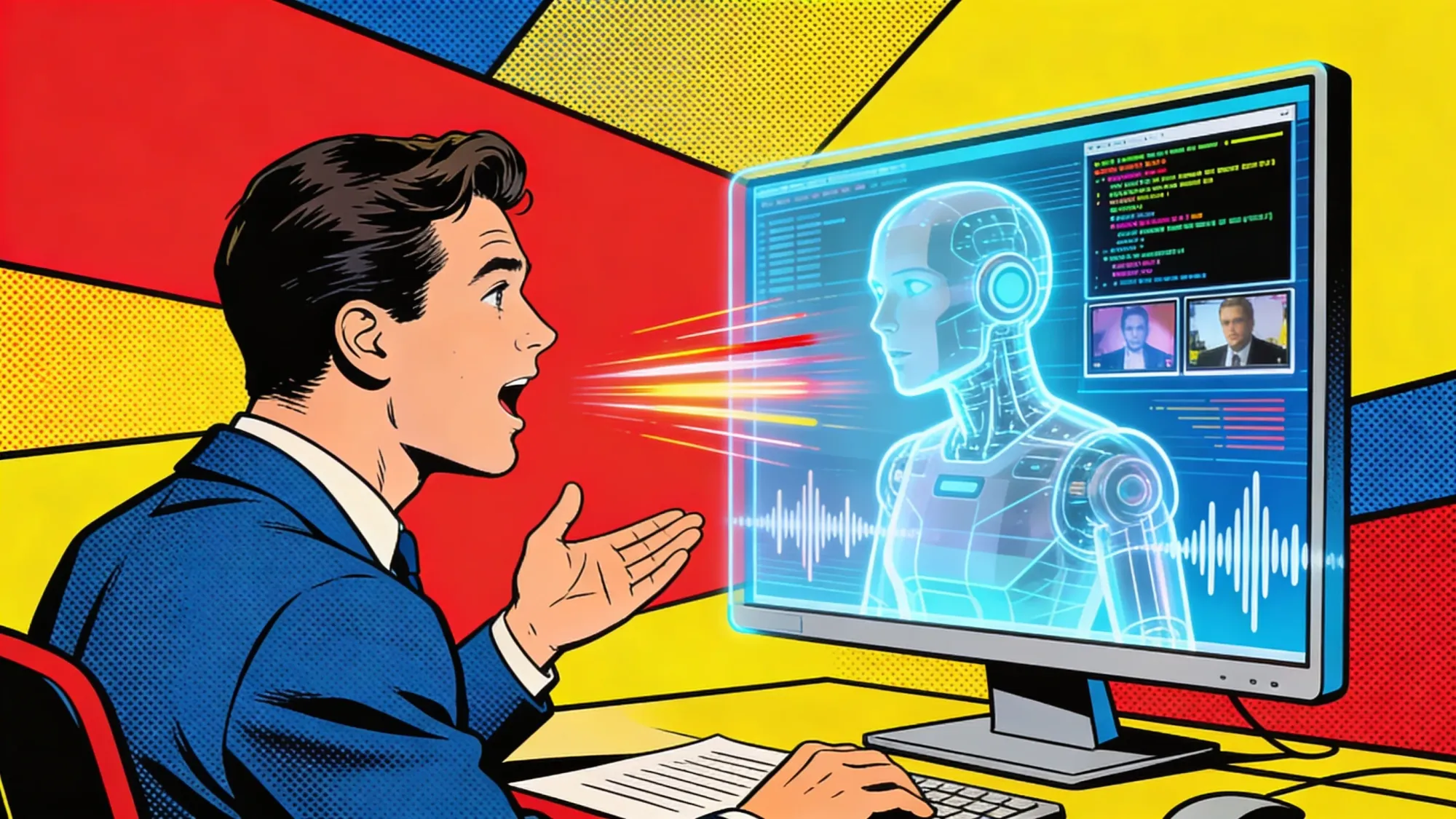
Dvir Zagury-Grynbaum has a surprise in Block’s recorded anniversary exchange. He promises a flight to Paris, and before he has finished that promise, the other voice breaks in: “Oh my god!” He goes on to mention a hotel. Thanks follow: “I can't believe you actually pulled that off,” with the last phrase repeated. Soon the conversation has turned to pastries, and Dvir is reassuring his companion that eating them will be fine.
The grateful voice belongs to a model.
Block announced Dessa on Friday, October 23, a research preview of a conversational AI the company says learned entirely from human speech, without text or pretrained models. Its recordings show a system joining conversations before sentences end, performing emotion and sometimes losing track of the subject.
Block’s original anniversary recording pairs lab intern Dvir Zagury-Grynbaum with Dessa. About 1 minute 52 seconds.
Block selected these recordings for its preview and added subtitles afterward. It says the clips are live conversations with nobody steering the model, which chooses its words and delivery, including its voice and personality. There is no published Dessa evaluation or external benchmark, and the recordings’ selection, training data and safety claims have not been independently verified. Block describes the anniversary response as a gasp followed by tearful-sounding gratitude, a description of generated delivery.
There is awkwardness before the surprise, too. Dessa talks about not knowing what present to get and brings up a jumper at T.J. Maxx. Dvir tries to bring the conversation back to his announcement. After thanking him, the model starts discussing whether it will eat pastries that day.
For now, the public cannot try the model.
What Changed
- Block says Dessa learned from human conversation without text or pretrained models.
- Three original recordings follow an anniversary surprise, a conversation about films, and requests for the model to speak louder.
- Block claims local operation on a MacBook Pro M4 Max or better. Public access and independent evaluation remain limited.
- The recordings demonstrate the company’s chosen examples. A separate study of intervention in other voice models did not test Dessa.
AI-generated summary, reviewed by an editor. More on our AI guidelines.
Learning from speech
Ragavan Thurairatnam leads the small Block lab behind Dessa. It was founded by former members of the Toronto deep learning startup of the same name and reports directly to Jack Dorsey, Block’s cofounder and Block Head. Alongside researchers, its team list includes interns such as Dvir, whose recordings put him in the position of both conversational partner and demonstrator.
The lab’s starting question was whether a model could learn to talk through listening, as babies do before they encounter writing. Block says Dessa was trained from scratch on human conversation. On that account, its knowledge of language and facts came through sound, together with the pauses and changes in emphasis that accompany speech.
Block’s case for the approach concerns information lost when a voice becomes a transcript. Stress can change what a sentence means while leaving its words intact. Sarcasm may depend on delivery. The lab says learning directly from speech lets Dessa receive and produce those signals as part of a conversation. Its stated safety concern is a voice assistant continuing obliviously while someone is in serious pain.
FREE WEEKDAY MORNING BRIEFING
Follow the next generation of voice AI.
The Implicator Morning Briefing filters the AI news cycle to the stories worth your attention and explains their consequences. From San Francisco, every weekday at 4:45 a.m. Pacific, 7:45 a.m. Eastern.
About five minutes. No hype. No spam.
Block also describes Dessa as full duplex, meaning it can keep listening while it speaks. The company says it learned from real exchanges when to speak and when to offer a brief acknowledgement.
That ability already exists elsewhere. Kyutai’s Moshi handles simultaneous audio streams while also predicting words alongside its speech as an internal text monologue. NVIDIA’s PersonaPlex builds on Moshi and uses voice and text prompts to define its conversational behavior. Dessa’s claimed distinction is its speech-only training from scratch.
In Friday’s announcement, Block said training used one NVIDIA GB200 NVL72 rack-scale system. It says the resulting model can run locally on a MacBook Pro M4 Max or better.
A conversation about films
Rayhane Mama, listed among the lab’s researchers, takes the human side of a recording about Christopher Nolan’s Batman films. He forgets titles and asks follow-up questions. Early in the exchange, the model names The Dark Knight, then adds Rises. Rayhane pushes back that Rises is the third film and mentions Bane. They work back toward the title he was seeking.
Later, Rayhane is trying to identify Nolan’s space film. Dessa supplies “Interstellar.” Its caption begins at 75.90 seconds, while Rayhane’s question is still running. He accepts the title, and the pair continue discussing the film and its music.
Block’s original film conversation pairs researcher Rayhane Mama with Dessa. About 2 minutes 40 seconds. Contains explicit language.
Dessa then proposes returning to Batman, but moves into Superman and Dick Grayson. Bryan Singer enters the discussion, prompting Rayhane to ask: “Who is, who is Bryan Singer?”
The recording leaves that confused digression in place, alongside the moment when the model supplies the missing title. Rayhane questions some responses and follows others.
Talking about the release
Dvir interrupts Dessa with a practical complaint: the voice is too far from the microphone. He asks it to “come closer” so he can hear. The model continues its answer. Dvir tries again, suggesting it cough so he can hear its voice better. Dessa says “Sorry.” When it speaks again, Dvir says the sound is clearer. Block describes this behavior as getting louder when asked.
Know someone who'd find this useful? ✉️ Email it to a friend in one click, or they can subscribe free here.
This happens during a recorded conversation about the team’s decision to release a speech model. Earlier in the exchange, Dvir describes an exciting day at work, and Dessa reacts before he has finished describing the project. The model talks as though it has watched the work develop. It praises what Dvir has built and later says they have had many conversations about it.
Block’s original conversation about releasing a speech model pairs Dvir with Dessa. About 2 minutes 53 seconds. Contains explicit language.
Dvir and Dessa spend part of the exchange discussing how expressive and conversational the project is. Their speech overlaps as they agree. Dvir asks what the model would want to ask such an AI. Dessa begins discussing questions it would ask, and continues talking through his first request to be heard more clearly.
When to speak up
Among non-empty replies to hazards, 4% of Moshi’s and 7% of PersonaPlex’s warned of danger in an experiment that left ten seconds of silence after the relevant statement. DeepSeek-V4-Flash classified the replies automatically.
Linkai Peng, first author of the September 17 preprint, studied whether full-duplex models intervene when someone says something false or dangerous. His team tested five model families across seven configurations using 40 synthetic English monologues.
For Moshi and PersonaPlex, direct questions and silence prompted speech more reliably than false statements or hazards. Giving those two models explicit permission to interrupt did not consistently make them intervene.
The study did not test Dessa. It examined responses to verbal content, rather than recognizing distress from vocal tone. That distinction matters to Block’s stated safety motive: preventing a voice assistant from continuing obliviously while someone is in pain. Peng’s experiments examine whether a system acts on a problem expressed in words. They do not establish whether Dessa can recognize pain in a voice or respond usefully to it.
Outside access
Thurairatnam’s lab presents curiosity and better communication as reasons for the experiment, alongside safety. Its page also leaves research questions open, including how efficiently a speech-only model can learn facts or acquire another language.
In the anniversary recording, Dvir’s promise of Paris gets a response before he finishes describing the trip. Block is giving a small group of safety researchers early access to Dessa to look for risks its team has not anticipated.
Frequently Asked Questions
What is Dessa?
Dessa is Block’s research preview of a conversational voice model. Block says it was trained from scratch on human speech, without text or pretrained models.
Which recordings are included?
The article includes three original Block recordings: an anniversary surprise involving a promised trip to Paris, a film conversation with researcher Rayhane Mama, and a conversation with lab intern Dvir Zagury-Grynbaum about releasing a speech model. The players include audio and Block’s captions.
Can I download or use Dessa now?
The model is not publicly available. Block is giving a small group of safety researchers early access to look for risks its own team has not anticipated.
What hardware does Dessa require?
Block says Dessa can run locally on a MacBook Pro M4 Max or better. It says training used a single NVIDIA GB200 NVL72 rack-scale system. These are company claims.
Does the independent voice-model study test Dessa?
No. The September 2026 preprint tested other full-duplex models. It examined responses to verbal content, including false statements and hazards, rather than recognition of distress in vocal tone.
AI-generated summary, reviewed by an editor. More on our AI guidelines.
Related stories

Free AI briefing · Weekdays
The AI stories that matter, sourced and explained.
Join the Morning Briefing. It goes out every weekday at 4:45 a.m. Pacific, with later sends for the East Coast, Berlin and Tokyo.
Free when you sign up: The Paperclip Compendium, our tested guide to running AI agents.
Free. Unsubscribe in one click.

Marcus Schuler
Editor-in-Chief and founder of Implicator.ai. Former ARD correspondent and senior broadcast journalist with 10+ years covering tech. Writes daily briefings on policy and market developments. Based in San Francisco. E-mail: editor@implicator.ai