Implicator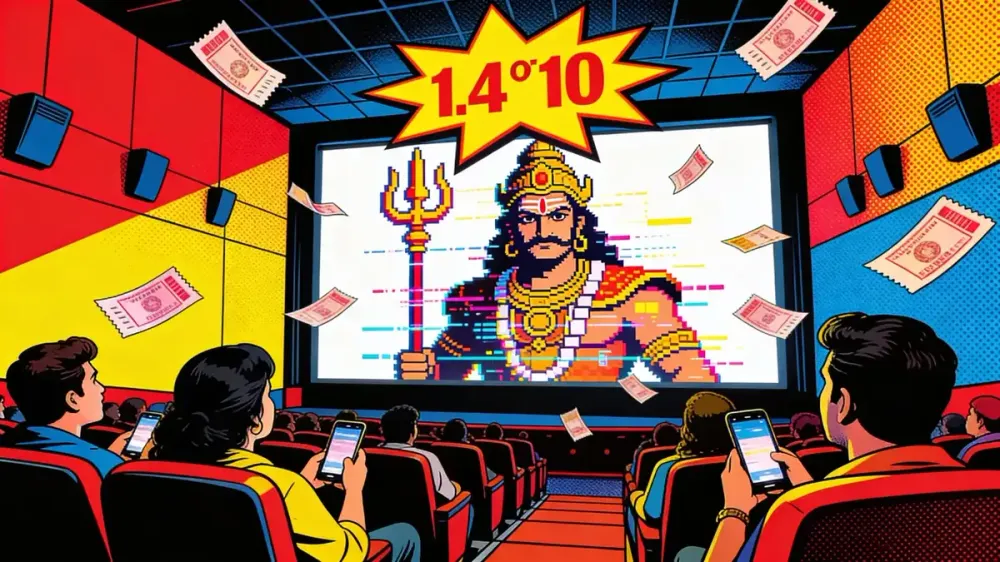
A show based on the ancient Hindu epic "Mahabharat" holds a 1.4 out of 10 on IMDb. Reviewers call the lip-sync broken, the styling unnatural, the sequences cheap. The series has logged 26.5 million views on JioStar's streaming platform since October.
Nobody in the Indian film industry finds this contradictory. That should tell you everything about where AI-generated entertainment is heading.
India's film studios are not experimenting with AI. They are reorganizing their entire business around it, at a speed and scale that makes Hollywood's cautious pilots look like science fair projects. Collective Artists Network, one of Bollywood's top talent agencies, now runs an AI production studio called Galleri5 out of Bengaluru. It has eight AI-generated titles in development, all focused on Hindu mythology. Production costs? One-fifth of traditional filmmaking. Timelines? One-quarter. Abundantia Entertainment, a major Bollywood production house, just invested $11 million in an AI studio and expects AI-generated content to account for a third of its revenue within three years.
The economics are not subtle. And they do not require audience approval to work.
Key Takeaways
- India's film studios are deploying AI at a scale unseen elsewhere, cutting production costs to one-fifth and timelines to one-quarter of traditional filmmaking
- Eros Media World is reviewing its 3,000-title catalog for AI-altered re-releases after a rewritten ending drew backlash but sold 12 points above average ticket rates
- Hollywood's union protections and India's total absence of guardrails have created a two-speed AI adoption divide across the global film industry
- Audiences consistently rate AI-generated content poorly but watch it in massive numbers, decoupling quality from consumption in ways that reward further AI investment
AI-generated summary, reviewed by an editor. More on our AI guidelines.
The gap between quality and commerce has never been wider
India produces more movies than any other country. But the audience is shrinking. Moviegoers fell from 1.03 billion in 2019 to 832 million in 2025, according to consulting firm Ormax Media. Box-office revenue hit a record $1.4 billion last year, but that number hides a fragile reality: fewer people buying pricier tickets, revenue concentrated in a handful of blockbusters, and post-pandemic choppiness that has not stabilized.
Studios are cornered. Streaming platforms squeezed theatrical margins. Audiences fragmented across 22 official languages and hundreds of dialects. And then AI arrived with a proposition that a financially stressed industry could not refuse.
Eros Media World re-released a 2013 hit, "Raanjhanaa," last year with an AI-altered ending that replaced a tragic death with a happy reunion. Lead actor Dhanush said on X that the AI remake "stripped the film of its very soul." Audiences agreed, loudly. Then 35% of available tickets for the Tamil-language version sold during its release month, 12 percentage points above the 2025 average, according to India's largest cinema chain PVR Inox.
Now Eros is reviewing its entire 3,000-title catalog "to identify candidates for AI-assisted adaptation," its group CEO Pradeep Dwivedi told Reuters. The company's Indian unit warned last year of "competition from digital platforms" as its consolidated annual revenue from operations fell 44%.
"It's both a revenue opportunity and a creative renewal strategy," Dwivedi said.
Creative renewal. For a company rewriting other people's endings with algorithms because it cannot afford to make new stories.
Hollywood builds guardrails. India builds studios.
The contrast across the Pacific is stark. Under SAG-AFTRA's agreement with studios, performers must give informed consent before their likeness is digitally altered or replicated. The Directors Guild bars AI from creative decisions without the director's involvement. SAG-AFTRA recently endorsed the Trump administration's AI policy framework, calling for "strong protections for human creativity." Union negotiations remain deadlocked, with AI protections at the center.
Get The Implicator in your inbox
Strategic AI news from San Francisco. No hype, no "AI will change everything" throat clearing. Just what moved, who won, and why it matters. Daily at 6am PST.
No spam. Unsubscribe anytime.
Hollywood's assistant class tells a different story. A Hollywood Reporter investigation found support staff across studios, networks, and agencies using AI daily for everything from composing emails to generating script coverage. Some upload unpublished scripts to ChatGPT and Claude to generate summaries. "Shadow AI" use, meaning tools deployed without company approval or security oversight, is widespread. No one is training assistants on proper use. The irony is thick: Hollywood's official position is caution, but the people who actually run the day-to-day operations have already integrated AI into creative workflows. They just do not talk about it.
India skipped the hand-wringing entirely. Google partnered with Bollywood director Shakun Batra to produce a five-part cinematic series using its Veo 3 and Flow AI tools. Microsoft provides AI computing power to Collective Artists Network. Nvidia showed up at India's AI film festival in February, promising to slash computing costs so "anyone can create something substantial without putting a lot of money" into production. Mukesh Ambani's Reliance, which co-owns JioStar with Disney, has committed $110 billion to build AI computing infrastructure across India over seven years.
Bollywood director Anurag Kashyap captured the mood: "In India, cinema isn't about art. It's purely business, so studios are going to use it to make mythologicals. Our audience is a sucker for it."
You cannot protect what audiences will not defend
Here is the question nobody in India's film industry wants to sit with. If audiences keep watching content they rate 1.4 out of 10, what exactly is the incentive to improve it?
An academic survey of 150 Indian cinema professionals published in January 2025 found that 85% endorsed AI adoption and 75% saw production timelines shortened by 30% on average. But 60% said adapting AI tools to traditional workflows posed real difficulties. The tension is not between AI and humans. It is between what the industry knows it is losing and what the spreadsheet says it is gaining.
The efficiency argument sounds airtight until you notice what it actually produces. The "Mahabharat" series emerged from Collective's cinematic AI lab with motion-capture suits feeding body data into AI character generators. The technology is sophisticated. The output is not. Reviewers noted unnatural styling, broken lip-sync, sequences that felt low-quality. JioStar's Alok Jain called the response "a mix of appreciation and healthy debate, which is natural for any ambitious creative leap."
That framing is doing a lot of heavy lifting. A 1.4 rating is not a debate. It is a verdict that the market has chosen to ignore.
This pattern shows up globally now. Netflix's Argentine sci-fi series "The Eternaut" used AI to generate a collapsing-building scene. Audiences caught it immediately. At the Runway AI Summit in Manhattan last week, executives compared AI to fire and the printing press, just days after OpenAI shut down Sora, a move that ended Disney's planned $1 billion AI investment with the company. Star Wars producer Kathleen Kennedy asked the one question the room wanted to avoid: "How are you going to teach taste?"
You do not need to teach taste if your business model does not require it.
The template that every entertainment industry will copy
India's film industry is not an outlier. It is a preview. The conditions that enable AI adoption at scale exist everywhere: shrinking margins, fragmented audiences, platform pressure, and labor that either cannot or will not organize against the shift. India just got there first because the economic squeeze was more acute and the institutional resistance was weaker.
Consulting firm EY projects AI could boost Indian media and entertainment revenue by 10% and reduce costs by 15% over the medium term. Those are not numbers that invite philosophical reflection. They are numbers that get pitched to boards.
The Hollywood Reporter India captured the critique cleanly: "The efficiency that AI is producing is not in service of greater freedom, but greater profit. The question of AI's efficiency is rarely followed up with, efficiency to what end?"
To what end. Eros rewrites endings. Collective generates mythology. JioStar streams a 1.4-rated epic to millions. Assistants in Los Angeles paste scripts into ChatGPT because they support three bosses on one salary. And somewhere in Bengaluru, filmmakers in motion-capture suits feed gestures into a pipeline that produces characters no one believes but everyone watches.
The question was never whether AI filmmaking would be good. The question was whether it needed to be. India just answered.
Frequently Asked Questions
How much does AI reduce film production costs in India?
According to Rahul Regulapati of Collective Artists Network's Galleri5 studio, AI slashes production costs to one-fifth of traditional filmmaking costs for genres like mythology and fantasy. Production timelines drop to one-quarter. Abundantia Entertainment invested $11 million in an AI studio and expects AI content to generate a third of revenue within three years.
What is the Mahabharat AI series and how has it performed?
JioStar, a joint venture between Reliance and Disney, airs an AI-generated adaptation of the ancient Hindu epic. The series has logged 26.5 million views since its October 2025 launch but holds a 1.4 out of 10 rating on IMDb, with reviewers citing broken lip-sync and unnatural styling.
How does Hollywood's approach to AI filmmaking differ from India's?
Under SAG-AFTRA's agreement, U.S. studios cannot digitally alter an actor's performance without informed consent. The Directors Guild bars AI from creative decisions without director involvement. India has no equivalent protections, allowing studios to pursue aggressive AI experiments including full AI-generated films and AI-altered re-releases.
What is Eros Media World doing with AI re-releases?
Eros re-released its 2013 hit Raanjhanaa with an AI-altered ending that changed the protagonist's death to a happy reunion. Despite backlash from the lead actor, 35% of tickets sold during its release month. The studio is now reviewing its entire 3,000-title catalog for similar AI adaptations.
Are Hollywood workers using AI despite official caution?
A Hollywood Reporter investigation found support staff across studios and agencies using AI daily for composing emails, generating script coverage, and summarizing unpublished scripts. This 'shadow AI' use happens without company approval or training, even as union negotiations focus on AI protections.
AI-generated summary, reviewed by an editor. More on our AI guidelines.


Harkaram Grewal
Maps the India–Germany–U.S. AI triangle from New Delhi. Background in cross-market operations and business development. Writes about supply chains, enterprise adoption, and talent—the unsexy forces that actually move global AI.