IMPLICATOR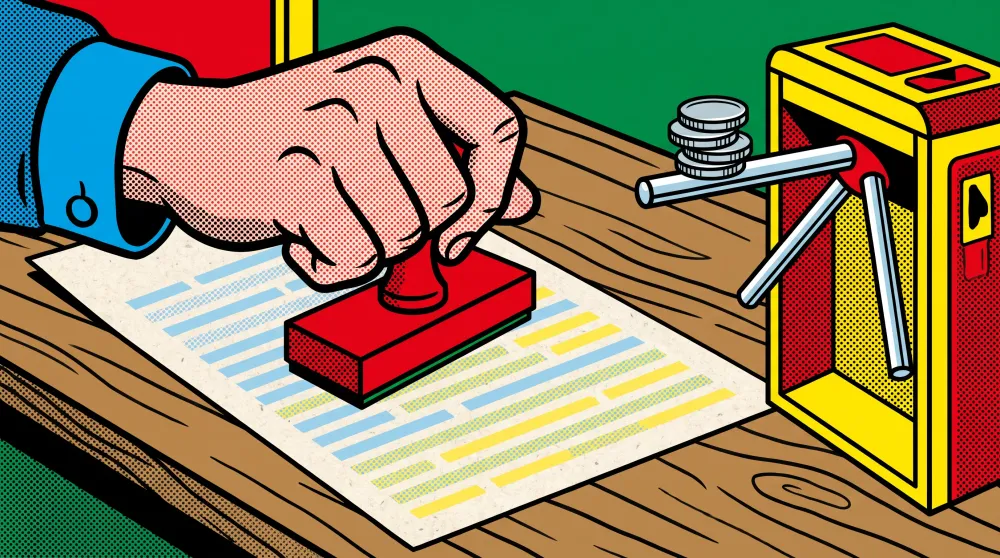

From San Francisco
1 |
The Editorial |
Morning, humans.
Three companies picked a setting for you, and none of them asked. Claude Max subscribers are canceling over a watermark that survives a spell check and cannot be switched off on any tier. Stripe agreed to pay more than $7 billion for OpenRouter, the meter its own payments already run through. Qwen 3.8 ships at maximum reasoning by default, where one pelican drawing took 21 minutes.
Stay curious,
Marcus Schuler
2 |
The Big Story |
Claude Max subscribers are canceling paid plans over the invisible watermark Anthropic began stamping into Claude's text worldwide on Aug. 2.
The mark nudges low-stakes word choices according to a secret key, leaving a statistical pattern rather than hidden characters. It can survive when Claude only proofreads or translates writing a person produced themselves. Nobody can opt out on any plan or API tier, enterprise accounts included.
Four departing subscribers on the $100-a-month Max tier described the same worry, that edited work of their own would carry the mark. Anthropic says it has seen no rise in cancellations, and no verified count exists either way.
Why This Matters:
- Any team using Claude to edit human drafts now ships text carrying a provenance mark it can neither remove nor audit.
- Anthropic promised a detection API and has not shipped one, so the mark stays unreadable by the people it labels.
3 |
Also Today |
Stripe has agreed to buy OpenRouter for more than $7 billion, below the roughly $10 billion discussed last month.
OpenRouter routes developer requests across more than 400 models and meters the spending, and Stripe has collected its fees since January. The price is more than five times the $1.3 billion valuation it carried in May. Neither company confirmed the deal.
4 |
The Outside Read |
MIT Technology Review's Grace Huckins explains how corporate labs have pushed university AI researchers to the edge of their own field.
Universities cannot afford the GPUs required to train frontier models, while outside researchers cannot inspect Claude or ChatGPT, and a Berkeley professor compares their position to biologists in a world where private companies alone control CRISPR. Huckins is strongest on the less profitable questions academics still ask, including evidence that models give less sophisticated responses to prompts phrased in ways more commonly used by women than by men.
5 |
The One Number |
6 |
Today's Headlines |
- Metabase patched a SQL injection flaw already exploited in the wild, after attackers used it to gain administrative access to self-hosted instances.
- Nvidia cut its proposed guarantee for OpenAI's Ohio data-center financing below $120 billion, less than half the $250 billion once discussed.
- Apple asked a federal court to approve a 15% commission on purchases made outside the App Store, putting a concrete schedule in front of the judge.
- California cleared Aurora and Kodiak to test autonomous heavy trucks on public highways with safety drivers aboard.
- DeepSeek took V4 Pro generally available across app, web and API, with separate peak and off-peak rates effective Aug. 16.
- Z.ai released GLM-5.3 to coding-plan users while the downloadable weights stay behind a two-week security review.
Tue 8/18 |
Economy: the Bureau of Labor Statistics releases July import and export price indexes at 8:30 a.m. Eastern. |
Tue 8/18 |
Fed: July industrial production and capacity utilization land at 9:15 a.m. Eastern. |
Wed 8/19 |
Policy: the Federal Reserve publishes minutes from its July 28-29 FOMC meeting at 2 p.m. Eastern. |
Thu 8/20 |
Tech: Google's Pixel 11 and Pixel 11 Pro reach retail shelves. |
7 |
The 5-Minute Skill |
Turn a policy notice into a decision deadline.
A regulator's notice mixes current rules with proposals and commentary. Use this to find the action that has an actual clock.
Your raw input: the full notice, plus a short note naming the affected project, its owner, and any date already on your calendar.
The prompt:
Why this works: the prompt makes the model classify claims before recommending action. Requiring source quotations and explicit gaps reduces confident guesses, and the deadline test converts dense policy prose into an operational decision.
What to use: Claude or ChatGPT with the full notice attached. A smaller model handles a short notice, but verify every quotation against the source.
8 |
Fresh Funding |
9 |
AI Image of the Day |

10 |
The Rausschmeisser* |
Google now lets Gemini and Flow users strip the visible watermark from images its own models generated, while invisible SynthID and C2PA metadata stay in the file. (TechCrunch, August 14, 2026)
Our take: The visible watermark had one job, telling a human being at a glance that nobody photographed this. Google has made that label optional and kept the invisible one, which only Google can read. Provenance just moved from the viewer to the vendor.
Elsewhere in this issue, a company is losing paying customers because it will not let anyone remove an invisible mark. Google's answer is to remove the visible mark and keep the one nobody outside the building can check. Both companies will tell you they are committed to transparency. Only one of them is getting asked about it.
Free AI briefing · Weekdays
The AI stories that matter, sourced and explained.
Join the Morning Briefing. It goes out every weekday at 4:45 a.m. Pacific, with later sends for the East Coast, Berlin and Tokyo.
Free when you sign up: The Paperclip Compendium, our tested guide to running AI agents.
Free. Unsubscribe in one click.
Marcus Schuler
Editor-in-Chief and founder of Implicator.ai. Former ARD correspondent and senior broadcast journalist with 10+ years covering tech. Writes daily briefings on policy and market developments. Based in San Francisco. E-mail: editor@implicator.ai