IMPLICATOR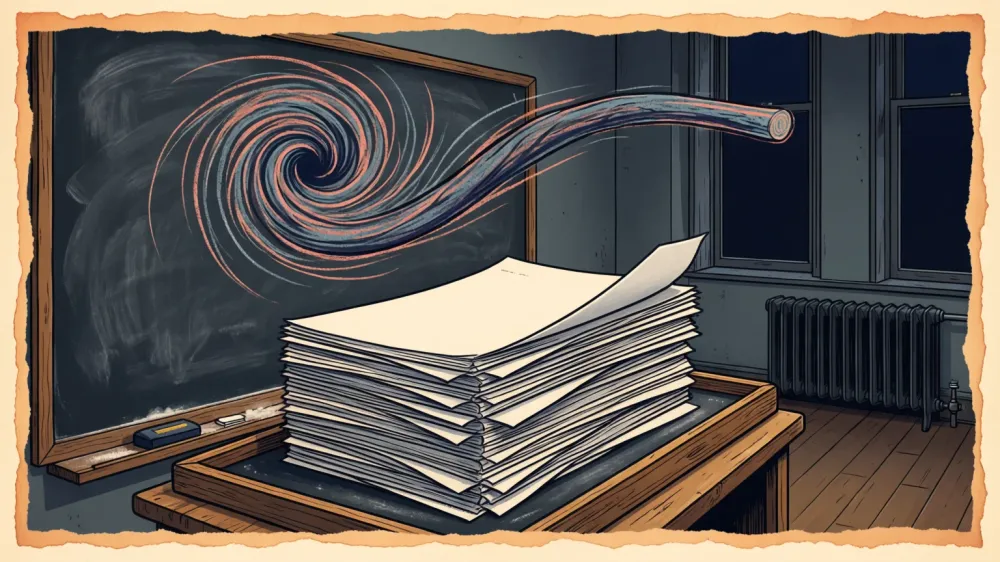
Luis Martínez-Zoroa, now at CUNEF University, spent his doctoral years developing a way to make fluid equations fail on paper. His adviser, Diego Córdoba of Madrid’s Institute for Mathematical Sciences, helped turn it into an “infinite cascade,” a stack of ordinary solutions that becomes pathological when assembled. Their analytic work used no computers.
OpenAI says roughly 10,000 concurrent agents carried that idea to a Navier-Stokes result in 88 hours from launch.
The company says an internal model produced a proof of finite-time blowup, yet the result has not been independently verified and the Clay Mathematics Institute has not accepted it. The result uses an external force that many mathematicians exclude from the problem they care about, while New York University professor Tristan Buckmaster says OpenAI pursued that route only after learning about related work by him and Levent Alpöge.
What Changed
- OpenAI says an internal model, run as roughly 10,000 concurrent agents, produced a finite-time blowup proof for the three-dimensional Navier-Stokes equations in 88 hours.
- The Clay Mathematics Institute has not accepted the result and still lists Navier-Stokes among its unsolved Millennium Prize problems.
- The proof relies on a smooth external force, a route the written problem permits but that most working mathematicians exclude from the question they care about.
- NYU professor Tristan Buckmaster says OpenAI pursued that route only after learning of his work with Anthropic researcher Levent Alpöge. Sébastien Bubeck denies the account.
AI-generated summary, reviewed by an editor. More on our AI guidelines.
The method behind both proofs
The Navier-Stokes equations describe how fluids move. “Forcing” means adding a continuing outside push, much as a propeller keeps stirring water. “Blowup” is the point where the mathematical fluid reaches infinite speed in finite time, an impossible physical result showing that the model has broken down.
The forced case matters because Charles Fefferman’s official formulation permits it in statements C and D. Most working mathematicians picture the harder question without that push. OpenAI’s construction uses a smooth force to produce a vortex that spirals inward and stretches “like spaghetti,” with a shrinking center moving ever faster while total energy stays finite.
Martínez-Zoroa pioneered the underlying techniques in his 2021 dissertation. By 2023, he and Córdoba had produced blowup in the Euler equations with a rough forcing function, but their layered construction made the force unruly and failed the Clay criteria. The remaining step was to keep the force smooth as the cascade approached infinite speed.
Córdoba jokes: “I don’t use AI: I have Luis.” Buckmaster credits them more formally. “I believe Luis Martínez-Zoroa deserves a Fields Medal,” he wrote.
FREE · ABOUT FIVE MINUTES
Follow what AI can prove, and what it cannot.
Implicator cuts the flood to the developments worth your attention, with concise reporting on what changed and why it matters. Delivered every weekday at 4:45 a.m. Pacific, 7:45 a.m. Eastern.
From San Francisco. No spam. Unsubscribe anytime.
OpenAI’s concentrated search
Training of the unnamed internal model began Aug. 28 and continued through the Sept. 8 announcement. After OpenAI heard rumors on Sept. 1 that two Millennium Prize problems had been resolved, its researchers sent agents after every open one.
Nearly 100 agents spent about 50 hours on an unforced Euler result. OpenAI then redirected resources toward Navier-Stokes. The larger Navier-Stokes run generated 2.7 million agent messages and roughly 130 billion output tokens, against 4.9 million messages and about 300 billion output tokens across all the problems attempted, before reaching a result on Saturday, Sept. 5. GPT-6 Astra took another 17 hours to formalize and verify it in Lean.
OpenAI research chief Mark Chen put the company’s computing cost “in the millions of dollars,” while Sébastien Bubeck, who leads OpenAI’s math team, estimated several million. The roughly $15 million discussed at the press conference was a customer price for the same job, not OpenAI’s bill.
The disputed timeline
Buckmaster and Alpöge, an Anthropic employee, had spent about a year extending the Madrid pair’s work with Claude, Codex and Astra. Buckmaster paid for the tools from his research funds. Their three results covered finite-time blowup with smooth forcing for porous media, Boussinesq and three-dimensional Euler. They reached the latter two on Aug. 15 and completed Lean verification on Aug. 22.
On Sept. 3, Buckmaster emailed a prominent OpenAI mathematician to explain that theirs was a personal collaboration. The reply offered computing resources. During two calls on Sept. 6, Buckmaster learned that OpenAI had taken the smooth-force route. “When I heard ‘forced,’ it was a bright red flag,” he wrote.
Buckmaster says Bubeck twice sought to leave Alpöge off a proposed paper because he worked at Anthropic. He also says he was asked, “Why would you ruin your career?” after threatening to disclose the conversations.
Know someone who'd find this useful? ✉️ Email it to a friend in one click, or they can subscribe free here.
Bubeck denied asking that Alpöge be removed. He said the proposal concerned Buckmaster leading a rewrite of OpenAI’s proof, and that an Anthropic employee should not author OpenAI’s work. Bubeck apologized for the career remark as an “extremely poor choice of words” and said Buckmaster met him with slander and threats.
Buckmaster set his own limit plainly: “I have not seen OpenAI’s proof. I do not know what their model did, or how. I do not know whether our data was used. I am not accusing anyone of anything.”
OpenAI says neither its researchers nor its agents saw the pair’s work before publication. Asked whether the denial covered the agents, Chen replied, “that’s also our understanding.” The company says it cannot rule out that de-identified data from their product use improved its models.
The review still ahead
Martin Bridson, the Clay Institute’s president, called the announcement exciting but said evaluation would be “deliberately unhurried” and “absolutely rigorous.” The institute still lists Navier-Stokes as unsolved. OpenAI says it will not seek the $1 million prize attached to the problem since 2000.
The forced-versus-unforced divide will sit at the center of that review. A smooth external force is allowed by the written problem, but it drives the method, and there is no public evidence that the construction works without it.
Terence Tao, a mathematician at UCLA, called Buckmaster and Alpöge’s work a “remarkable achievement.” His concern was the pace around it: “There’s been this very strange and unprecedented decoupling, this year alone, between getting answers and getting understanding.”
Frequently Asked Questions
Did OpenAI solve the Navier-Stokes Millennium Prize problem?
OpenAI says an internal model produced a proof that the three-dimensional equations can develop a singularity in finite time, satisfying statements C and D of the official formulation. The Clay Mathematics Institute has not accepted the result and still lists the problem as unsolved. The proof has not been independently verified.
What is the forced versus unforced distinction?
Forcing means applying a continuing outside push to the fluid, much as a propeller keeps stirring water. OpenAI's construction uses a smooth force. Charles Fefferman's official formulation permits that route in statements C and D, but most working mathematicians picture the harder question without any such push, and there is no public evidence the construction works without it.
How much computing power did the proof take?
OpenAI ran roughly 10,000 concurrent agents, which generated 2.7 million agent messages and about 130 billion output tokens before reaching a result on Sept. 5. GPT-6 Astra took another 17 hours to formalize it in Lean. Research chief Mark Chen put the cost in the millions of dollars, and a customer running the same job would pay around $15 million.
What is the dispute between OpenAI and Tristan Buckmaster?
Buckmaster, an NYU professor, says OpenAI pursued the smooth-force route only after learning of his year-long work with Anthropic researcher Levent Alpöge, and that Sebastien Bubeck twice sought to leave Alpoge off a proposed paper. Bubeck denies asking for the removal and apologized for a remark about Buckmaster's career.
Whose method did both efforts use?
Luis Martinez-Zoroa and Diego Cordoba developed the forcing approach, with Martinez-Zoroa pioneering the underlying techniques in his 2021 dissertation and the pair producing Euler blowup with a rough forcing function by 2023. Buckmaster wrote that he believes Martinez-Zoroa deserves a Fields Medal.
AI-generated summary, reviewed by an editor. More on our AI guidelines.


Free AI briefing · Weekdays
The AI stories that matter, sourced and explained.
Join the Morning Briefing. It goes out every weekday at 4:45 a.m. Pacific, with later sends for the East Coast, Berlin and Tokyo.
Free when you sign up: The Paperclip Compendium, our tested guide to running AI agents.
Free. Unsubscribe in one click.

Marcus Schuler
Editor-in-Chief and founder of Implicator.ai. Former ARD correspondent and senior broadcast journalist with 10+ years covering tech. Writes daily briefings on policy and market developments. Based in San Francisco. E-mail: editor@implicator.ai