Implicator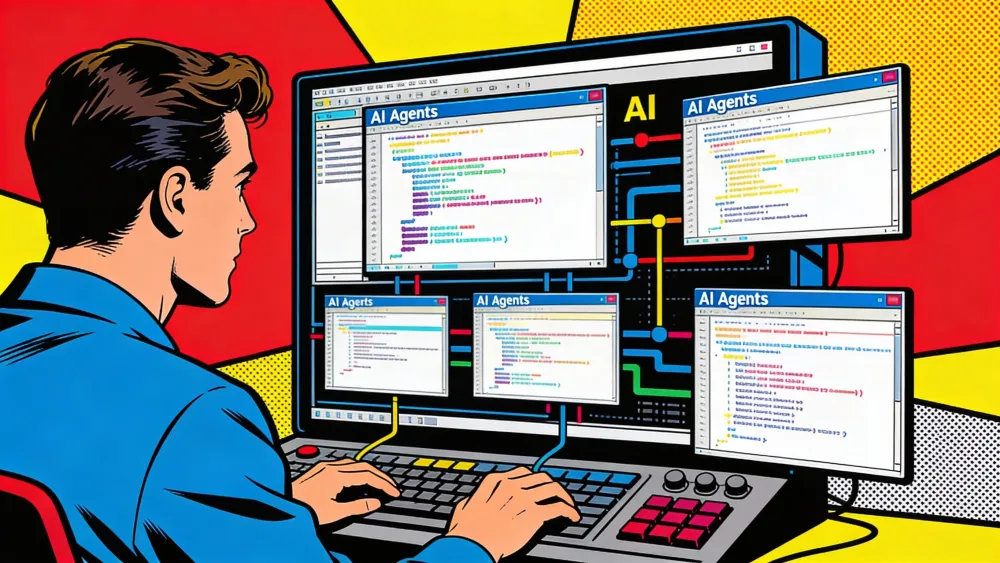
Cursor launched Cursor 3 on Thursday, replacing its code-editor-first design with a rebuilt agent-orchestration platform. The product, developed under the internal code name Glass according to WIRED, lets developers dispatch and monitor multiple AI coding agents across local machines and cloud virtual machines from a single interface. The launch comes as Claude Code has reportedly captured up to 54% of the AI coding market, per Menlo Ventures data, while OpenAI's Codex 5.3 pushes hard into the same space with unlimited access.
Key Takeaways
- Cursor 3 replaces the code-editor-first design with an agent-orchestration platform managing local and cloud AI agents
- Claude Code holds 54% of the AI coding market per Menlo Ventures, pressuring Cursor's pivot to agent delegation
- Annualized revenue hit $2 billion at a $29.3 billion valuation, but Composer 2's undisclosed Kimi origins drew criticism
- Early testers praise speed but flag cost concerns, with one reviewer spending $2,000 in two days of use
AI-generated summary, reviewed by an editor. More on our AI guidelines.
From editor to control room
Cursor built its name as the fastest-growing AI code editor in the market, outpacing even Slack's early growth curve. That identity is gone. Cursor 3 ditches the VS Code fork architecture entirely. The default view is an orchestration panel, with repositories on the left, chat-driven workflows in the center, and browser previews docked alongside. No file explorer. No code-first layout.
CEO Michael Truell calls this the "third era" of software development. First: autocomplete. Then: synchronous copilots. Now: fleets of autonomous agents that work for hours unsupervised. Ambitious framing. Right now, mostly aspirational.
$2 billion in revenue, $29 billion valuation
Anysphere, Cursor's parent company, has raised more than $3 billion from Nvidia, Google, and other backers. Annualized revenue hit $2 billion in March, doubling in three months, with 60% coming from enterprise contracts. Valuation after its $2.3 billion Series D: $29.3 billion.
Internally, 35% of Cursor's pull requests are already generated by autonomous agents on cloud VMs. Each agent gets a full development environment, tests its output by navigating the UI like a human, and returns merge-ready code with video demos attached. That's not a lab demo. That is the company's daily engineering workflow.
Composer 2 arrives with baggage
Powering the new platform is Composer 2, which Cursor says matches GPT-5.4 on coding benchmarks at one-tenth the inference cost. But the model carries a disclosure problem. TechCrunch reported last month that Composer 2 was built on Moonshot AI's open-source Kimi 2.5, and Cursor failed to say so upfront. The company confirmed the licensing arrangement only after users pressed. Developer trust, once cracked, does not heal on the same timeline as a product roadmap.
Get Implicator.ai in your inbox
Strategic AI news from San Francisco. No hype, no "AI will change everything" throat clearing. Just what moved, who won, and why it matters. Daily at 6am PST.
No spam. Unsubscribe anytime.
Early testers see promise and problems
Every.to's Vibe Check review found Cursor 3 fast and lightweight compared to Claude Code Desktop and Codex. But their panel flagged a core tension: power users already embedded in Claude Code won't switch unless this is dramatically better, and existing Cursor fans who loved the IDE feel like they've been left behind.
Then there's cost. One reviewer burned through roughly $2,000 in two days of normal use. That same workload runs at a flat monthly rate with Claude. Another noted that $200 per month gets you unlimited Opus access, while Cursor meters per token for comparable output. That's the math working against them.
The bet
Cursor is wagering that combining IDE heritage with agent orchestration creates something neither Claude Code nor Codex offers: one workspace where you delegate to agents and still drop into the code yourself. A new Design Mode lets developers select UI elements and describe changes in plain language. And the Automations system, launched in early March, triggers hundreds of automated agent runs per hour internally, from PagerDuty incident response to weekly codebase summaries on Slack.
Whether the broader market cares depends entirely on execution speed. Cursor 3 is the right direction. The gap it needs to close is not small.
Frequently Asked Questions
What is Cursor 3?
Cursor 3 is a rebuilt workspace from Anysphere that shifts from a traditional code editor to an agent-orchestration platform. Developers can dispatch, monitor, and manage multiple AI coding agents across local machines and cloud virtual machines from a single interface, working across multiple repositories.
How does Cursor 3 differ from Claude Code and Codex?
Cursor 3 integrates agent orchestration with an IDE, letting users switch between delegating tasks to agents and editing code directly. Claude Code and Codex focus on pure agent delegation. Cursor also offers a Design Mode for visual UI editing and an Automations system for event-triggered agent runs.
What is Composer 2 and why is it controversial?
Composer 2 is Cursor's in-house coding model that reportedly matches GPT-5.4 at one-tenth the cost. Controversy arose when TechCrunch reported it was built on Moonshot AI's open-source Kimi 2.5 model without upfront disclosure, damaging developer trust.
How much does Cursor 3 cost?
Cursor offers a free Hobby tier with limited requests. Pro costs $20 per month, Pro+ is $60, and Ultra is $200. Heavy agent usage is metered per token, and early testers reported spending up to $2,000 in two days compared to flat-rate alternatives like Claude.
What is the third era of software development?
CEO Michael Truell's framework divides AI coding into three eras. First was autocomplete through 2025. Second introduced synchronous copilots requiring active guidance. Third, starting in 2026, features autonomous agents that work independently for hours without supervision.
AI-generated summary, reviewed by an editor. More on our AI guidelines.




Maria Garcia
Bilingual tech journalist slicing through AI noise at implicator.ai. Decodes digital culture with a ruthless Gen Z lens—fast, sharp, relentlessly curious. Bridges Silicon Valley's marble boardrooms, hunting who tech really serves.