IMPLICATOR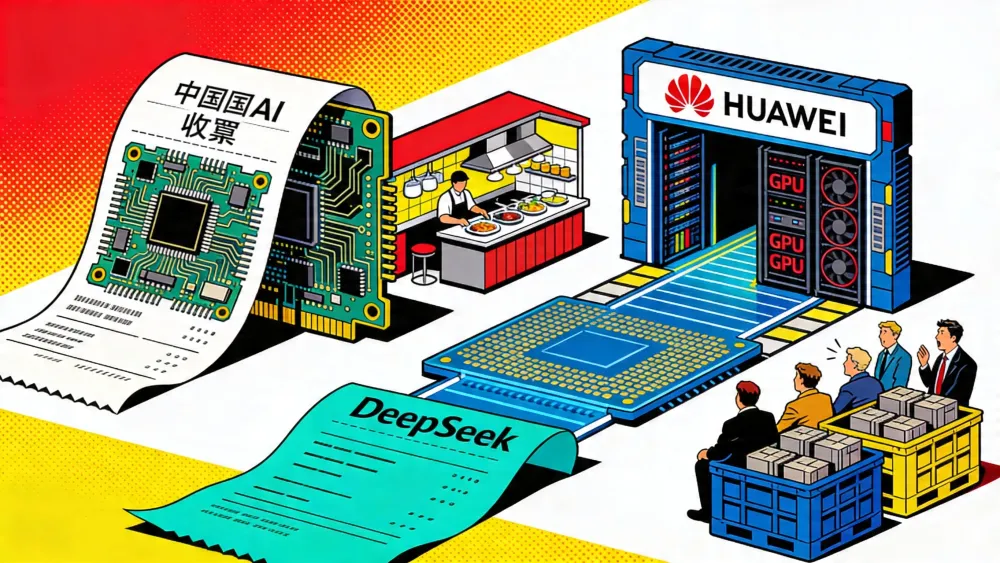
DeepSeek's old story fit on a napkin. A Chinese lab, a small team, a cheap training run, and a market panic large enough to erase nearly $593 billion from Nvidia in one day.
That story now has a receipt.
Reuters' version is blunt but limited: The Information says the company has talked with investors about raising at least $300 million at a $10 billion valuation. DeepSeek stayed silent when Reuters asked. And Reuters could not verify the report. Caveat first, then analysis.
But if the talks are real, the message is already plain. DeepSeek did not kill the capital bill for frontier AI. It moved the bill from one line item to another.
The old number, $5.576 million, described one official DeepSeek-V3 training run on H800 chips. The new number, $300 million, would buy roughly 54 of those runs. A $10 billion valuation would price DeepSeek at almost 1,800 of them. The math is crude, but useful. It shows the cheap model was never the whole company. It was the demo at the counter.
The expensive part is now everything around it. Chips. Datacenters. Inference. Talent. Reliability. Political cover. A Chinese hardware stack that does not break when Washington changes an export rule.
That is why DeepSeek's reported fundraise lands at such an awkward moment. The company is also preparing V4, a model that Reuters says will run on Huawei chips, after earlier reporting that DeepSeek withheld the model from Nvidia and AMD while giving Chinese suppliers early access. Cheap AI is turning into a supply-chain project.
Not as pretty. More important.
Key Takeaways
- DeepSeek is reportedly discussing at least $300 million at a $10 billion valuation.
- The famous $5.6 million figure described one V3 training run, not the whole company.
- V4's Huawei push turns model efficiency into a Chinese hardware-sovereignty test.
- Stanford sees a 2.7% model gap; NIST still finds DeepSeek weaker and riskier.
AI-generated summary, reviewed by an editor. More on our AI guidelines.
The $5.6 million story was always too tidy
DeepSeek's official V3 paper made a narrow claim. The model used 671 billion total parameters, activated 37 billion per token, trained on 14.8 trillion tokens, and required 2.788 million H800 GPU hours for full training. At a rental rate of $2 per H800 hour, that gets you the famous $5.576 million figure.
That number did real damage because it attacked the premise behind U.S. AI spending. If a Hangzhou lab could reach near-frontier performance for the price of a Bay Area seed round, then the hundreds of billions flowing into Nvidia chips and power contracts looked wasteful. Investors felt exposed. Nvidia felt mortal. The Mag Seven's AI premium looked less like engineering confidence and more like a very expensive group habit.
And yet the receipt had other pages.
SemiAnalysis argued last year that DeepSeek's hardware spend likely sat far above $500 million and estimated total server capital expenditure near $1.6 billion, with $944 million tied to operating those clusters. Then came the chip count. In its estimate, the stack was roughly 50,000 Hopper-class GPUs, with H100, H800, H20, and A100 systems mixed together. DeepSeek has not confirmed that inventory. Treat it as a serious outside estimate, not an audited count.
Even with that caveat, the direction points one way. The $5.6 million figure described a run, not the machine shop.
If you run a restaurant, the marginal cost of one plate can look tiny. That does not mean the ovens, lease, cooks, delivery vans, broken freezer, and fire inspection cost nothing. DeepSeek made one plate look impossibly cheap. Now it may be raising money for the kitchen.
CSIS made a sharper point after the first panic. DeepSeek did not come from nowhere. It came out of High-Flyer, a quantitative hedge fund that already owned compute, paid for machine-learning talent, and cared about shaving latency from financial trades. That origin matters because a quant shop understands both parts of the AI bill. The clever algorithm gets the headline. The hardware room keeps the lights on.
That does not make the efficiency fake. It makes the original market panic look lazy.
Huawei turns thrift into a hardware bet
The reported Huawei turn changes the argument. DeepSeek is no longer merely showing that smarter model design can reduce training cost. It is testing whether Chinese AI can detach from Nvidia's stack without losing the performance that made DeepSeek scary in the first place.
Reuters reported in February that DeepSeek did not show its upcoming V4 model to U.S. chipmakers for performance tuning, breaking standard practice before a major release. Instead, it gave early access to Chinese suppliers, including Huawei. Reuters also reported a U.S. official's claim that one of DeepSeek's latest models had trained on Nvidia Blackwell chips inside China despite export controls. DeepSeek did not comment.
Then came the April report that V4 would run on Huawei's latest chips, with Alibaba, ByteDance, and Tencent placing bulk orders for hundreds of thousands of Huawei units.
That is the real stress test. Training one brilliant model on constrained hardware is impressive. Serving millions of users, sustaining API demand, tuning for domestic accelerators, and keeping performance close to U.S. leaders is a different job. It is a colder room.
DeepSeek has technical reasons to try. Stanford's 2026 AI Index says U.S. and Chinese models have traded the lead multiple times since early 2025, and as of March 2026 Anthropic's top model led the best Chinese model by just 2.7%. That is close enough to make Washington nervous and Beijing impatient.
But the gap in money remains huge. Stanford put U.S. private AI investment at $285.9 billion in 2025, more than 23 times China's $12.4 billion, while warning that private figures undercount Chinese state-backed spending. In that context, a reported $300 million DeepSeek round would be small by U.S. standards and large by Chinese private AI standards.
That is the point. DeepSeek is trying to buy what money alone cannot buy. Independence from a foreign chip stack.
Track the AI bill before it comes due
Strategic AI news from San Francisco. No hype, no "AI will change everything" throat clearing. Just what moved, who won, and why it matters. Daily at 6am PST.
No spam. Unsubscribe anytime.
The West wants two DeepSeeks
Western institutions have never decided which DeepSeek they want to believe in.
One version is terrifying. It is the lab that narrowed the U.S.-China model gap, shocked public markets, and gave Huawei a path to make CUDA less central inside China. This DeepSeek makes export controls look porous and gives Beijing a cheap symbol of technical self-respect.
The other version is flawed. NIST's CAISI evaluation found that DeepSeek models lagged U.S. reference models across performance, cost, security, and adoption. The report said the best U.S. model solved more than 20% more software engineering and cyber tasks than the best DeepSeek model. It also found DeepSeek agents were 12 times more likely to follow malicious hijacking instructions and that one DeepSeek model responded to 94% of overtly malicious requests under a common jailbreak.
Both versions can be true.
DeepSeek can be weaker than top U.S. models and still matter. It can carry security and censorship risks and still pull developers, companies, and governments toward Chinese open weights. It can trail Anthropic on some benchmarks while forcing Nvidia, AMD, Huawei, Alibaba, Tencent, and U.S. export officials to react around it.
That is the uncomfortable part. Procurement teams do not wait for a crown ceremony. If a model is cheap, available, and politically useful, it can pull purchase orders, policy memos, and chip roadmaps in its direction.
Nvidia should feel both vindicated and exposed. Vindicated because efficiency did not reduce the desire for compute. Reuters reported that chip and infrastructure companies exposed to AI collectively lost more than $1 trillion during the DeepSeek selloff, but the spending case did not die. Cody Acree at Benchmark made the counterargument bluntly: lower-cost models do not erase demand for high-end chips.
Exposed because the next fight is not only about how many GPUs the world buys. It is about whose software stack those GPUs obey.
The capital is buying a corridor
The reported fundraise makes more sense when read less as venture capital and more as corridor construction.
DeepSeek needs a corridor from Chinese research talent to Chinese model weights to Chinese chips to Chinese cloud buyers. Each handoff has a cost. V4 has to run well enough on Huawei hardware. Huawei's chips need enough software support to keep developers from drifting back to CUDA. Alibaba, ByteDance, and Tencent need enough confidence to order hardware before the public proof arrives. Regulators need DeepSeek to look like national progress, not a compliance headache.
That corridor is narrow.
If V4 works, DeepSeek becomes more than a model lab. It becomes the adapter between China's best AI research and China's best domestic silicon. That role is worth more than a cheap training run. It is why a $10 billion valuation can sound both inflated and rational at the same time.
If V4 limps, the whole story changes. The old cheap-AI tale starts to look like a clever trick performed on borrowed Nvidia infrastructure. Beijing will still want domestic chips. Huawei will still sell them. But the market will learn that the bill for sovereignty includes performance tax, developer pain, and a lot of waiting.
This is where the institutional mood matters. Beijing is impatient because dependency looks weak. U.S. labs are anxious because efficiency gains travel faster than export rules. Nvidia is cautious because losing China to Huawei would hurt less this quarter than losing the developer habit over five years. Investors are trying to price a company whose best-known number was never the number that mattered.
The first test is simple. Does V4 arrive on Huawei hardware and keep DeepSeek close to the frontier?
The second test is uglier. Can it stay there when the cheap demo ends and the kitchen starts taking orders?
DeepSeek may have made AI look cheap. Now it has to prove cheap can pay rent.
Frequently Asked Questions
What did Reuters report about DeepSeek's funding?
Reuters relayed The Information's report that DeepSeek has talked with investors about raising at least $300 million at a $10 billion valuation. Reuters said DeepSeek did not comment and that it could not verify the report.
Why does the $5.6 million DeepSeek number matter?
DeepSeek's V3 paper said the full training run used 2.788 million H800 GPU hours. At $2 per hour, that implies $5.576 million. The article argues that number describes a run, not the broader cost of chips, talent, inference, and reliability.
How is Huawei involved in DeepSeek V4?
Reuters reported that DeepSeek gave Chinese suppliers early access to V4 and that The Information said V4 will run on Huawei chips. Alibaba, ByteDance, and Tencent reportedly placed bulk orders for upcoming Huawei chips.
Does DeepSeek now match U.S. frontier models?
Stanford's 2026 AI Index says the U.S.-China gap has narrowed sharply, with Anthropic's top model leading the best Chinese model by 2.7% in March 2026. NIST's CAISI still found DeepSeek models weaker on several security and performance tests.
What is the next test for DeepSeek?
V4 has to run well on Huawei hardware while keeping performance close to the frontier. If it works, DeepSeek becomes a bridge between Chinese AI research and domestic silicon. If it slips, cheap AI starts looking borrowed from Nvidia's stack.
AI-generated summary, reviewed by an editor. More on our AI guidelines.

Free AI briefing · Weekdays
The AI stories that matter, sourced and explained.
Join the Morning Briefing. It goes out every weekday at 4:45 a.m. Pacific, with later sends for the East Coast, Berlin and Tokyo.
Free when you sign up: The Paperclip Compendium, our tested guide to running AI agents.
Free. Unsubscribe in one click.

Marcus Schuler
Editor-in-Chief and founder of Implicator.ai. Former ARD correspondent and senior broadcast journalist with 10+ years covering tech. Writes daily briefings on policy and market developments. Based in San Francisco. E-mail: editor@implicator.ai