Implicator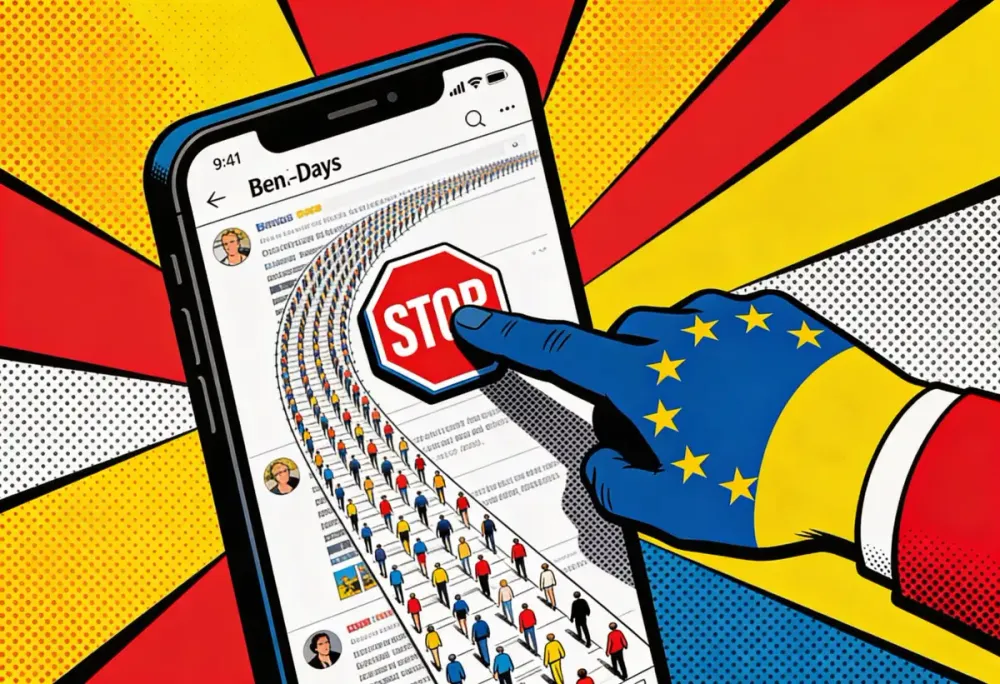
European Union regulators on Friday issued a preliminary ruling that TikTok's core design features, including infinite scroll, autoplay, and its recommendation algorithm, violate the bloc's Digital Services Act due to what officials called "addictive design." The European Commission said the platform failed to assess how those features could harm the physical and mental well-being of users, particularly children and vulnerable adults. TikTok faces potential fines of up to 6 percent of its global annual revenue if it does not overhaul its service.
No regulator anywhere has applied a legal standard for social media addictiveness before, according to a senior Commission official. The Commission's statement was blunt. "TikTok needs to change the basic design of its service." Read that again. The features that built a billion-user platform are the ones Brussels wants dismantled.
The features under fire
What regulators went after was the architecture, not the content. Infinite scroll. Autoplay. Push notifications. The recommendation engine that learns what you linger on and feeds you more of it. Commission officials said these features shift users' brains into "autopilot mode," fuel compulsive scrolling, and reduce self-control.
What Changed
• EU issued first-ever preliminary ruling declaring social media "addictive design" illegal under the Digital Services Act
• TikTok told to disable infinite scroll, add screen time breaks, and rebuild its recommendation algorithm
• Potential fines up to 6% of global revenue, estimated at roughly $2.1 billion
• Meta faces similar DSA investigation over Facebook and Instagram algorithms
Regulators accused TikTok of ignoring its own data. The company had access to metrics showing how long minors spent on the platform at night and how frequently users reopened the app. It knew. Knowing and not acting, in the Commission's reading, constitutes a breach of the DSA's risk-assessment obligations.
Existing safeguards got picked apart too. Screen time management tools were "easy to dismiss," regulators said, including by young users who could bypass them without effort. Parental controls required so much setup time and technical knowledge that few parents bothered. A parent trying to set restrictions would need to install a separate app, link accounts, and configure individual limits, a process that assumed both technical fluency and the kind of free time most parents of teenagers do not have. Safety theater. The tools looked like protection. They did not protect.
TikTok's response came fast. "Categorically false and entirely meritless," the company called the findings, promising to challenge them "through every means available to us." Spokesperson Paolo Ganino left it there. No specifics on what TikTok might actually change. The tone read defensive, not confident.
What the new architecture looks like
Commission officials laid out specific demands. Disable infinite scroll. Implement screen time breaks that actually work, including during nighttime hours. And rebuild the recommendation engine so it stops treating engagement as the only metric that matters.
When a final decision comes is anyone's guess. TikTok gets to respond first and examine the evidence. This investigation has been running for two years already, and the Commission accused TikTok of breaking DSA advertising transparency rules last May. But EU tech chief Henna Virkkunen told reporters that if TikTok wanted to avoid fines, it would have to "change the design of their service in Europe to protect our minors and their wellbeing."
Stay ahead of the curve
Strategic AI news from San Francisco. No hype, no "AI will change everything" throat clearing. Just what moved, who won, and why it matters. Daily at 6am PST.
No spam. Unsubscribe anytime.
Financial exposure is real. TikTok does not publish revenue figures, but the World Advertising Research Centre estimates the platform will post roughly $35 billion in revenue this year. Six percent of that comes to about $2.1 billion, more than enough to make executives in ByteDance's Beijing headquarters reach for the speakerphone. That number focuses the mind.
Virkkunen also pushed back on the idea that age bans are the answer. "Platforms should be so safe by design that we shouldn't have that kind of very high age restriction," she said. Her position was plain: fix the product, don't just lock out the youngest users and call it done.
A legal precedent with global reach
This is not a fine. Not yet. But it sets a standard that other regulators will study. Brussels has declared that addictive design itself can constitute a legal violation, an approach that American courts have not tried.
Americans have gone after this problem differently. They sue. Families and attorneys general across the country have hauled TikTok, Meta, YouTube, and Snap into court. Autoplay wrecked our kids, the lawsuits say. Personalized feeds kept them scrolling at 2 AM. One of those cases against TikTok, filed in Los Angeles, settled last month. The company agreed to pay just days before a jury would have weighed in. More trials are coming.
Lawsuits are retrospective, though. They ask whether harm occurred. Brussels is being prescriptive. It says the design is the violation, whether or not regulators can tie it to a specific teenager who stopped sleeping. Sixteen percent of American teenagers told Pew Research Center last year that they were on TikTok "almost constantly." Brussels does not need that stat to make its legal case. But it tells you something about the size of the problem.
If you run a social media platform with infinite scroll, you are watching this case. Meta is under its own DSA investigation over whether Facebook and Instagram use addictive algorithms. Whatever framework Brussels applies to TikTok will almost certainly be applied to Menlo Park next. If infinite scroll is illegal for TikTok, it is hard to argue that Instagram Reels or YouTube Shorts deserve different treatment. Nobody in Silicon Valley is saying much about this publicly. The nervousness is quiet. It is real.
The transatlantic fight over who regulates tech
This ruling lands in the middle of an ugly fight between Washington and Brussels. The White House says Europe picks on American companies. There is some truth to that complaint, but it falls apart here. TikTok is not American. ByteDance runs it out of Beijing. Brussels has been happy to remind Washington of this fact, and the reminder lands.
But political pressure within Europe is building in the same direction, and it is not coming from Brussels alone. Spain's Prime Minister Pedro Sanchez this week called social media "a failed state" and vowed to ban platforms for children under 16 while holding tech executives criminally liable for illicit content. France, Denmark, and Malaysia have moved toward similar age restrictions.
Two months ago, the Commission fined Elon Musk's X platform 120 million euros for violating DSA transparency rules, including its "deceptive" blue-tick verification system. First fine ever issued under the law. TikTok's case could produce a much larger one.
On top of all this, TikTok is still sorting out its American future. ByteDance agreed last month to let non-Chinese investors take over a U.S. version of the app, a concession forced by years of wrangling in Washington over whether Beijing could use TikTok to spy on Americans. The company is now defending its basic architecture on two continents simultaneously, cornered on national security grounds in Washington and on public health grounds in Brussels. Infinite scroll built the machine that got TikTok to a billion users. Whether it gets to keep that piece of the architecture may now depend on regulators in a building in Brussels that most of those users have never heard of.
Frequently Asked Questions
Q: What is the EU's Digital Services Act?
A: The DSA is an EU law that took effect in 2024 requiring large online platforms to assess and mitigate risks to users, including mental health harms. It covers content moderation, algorithmic transparency, and platform design. Violations can trigger fines of up to 6% of a company's global annual revenue.
Q: What specific TikTok features did the EU target?
A: The European Commission targeted infinite scroll, autoplay, push notifications, and TikTok's recommendation algorithm. Regulators said these features shift users into "autopilot mode" and fuel compulsive behavior. The Commission also found TikTok's screen time tools and parental controls were too easy to bypass.
Q: How much could TikTok be fined?
A: TikTok faces potential fines of up to 6% of its total worldwide annual revenue. The World Advertising Research Centre estimates TikTok's 2026 revenue at roughly $35 billion, putting the maximum fine at about $2.1 billion.
Q: Does this ruling affect other social media platforms?
A: Not directly, but the precedent matters. Meta is under a separate DSA investigation over whether Facebook and Instagram use addictive algorithms. Any legal framework Brussels applies to TikTok's design will likely be applied to competing platforms with similar features like Instagram Reels and YouTube Shorts.
Q: Is TikTok banned in Europe?
A: No. The ruling does not ban TikTok. It requires the company to change specific design features, including infinite scroll and its recommendation system, or face fines. TikTok has the opportunity to respond to the findings before any final decision is made.


Harkaram Grewal
Maps the India–Germany–U.S. AI triangle from New Delhi. Background in cross-market operations and business development. Writes about supply chains, enterprise adoption, and talent—the unsexy forces that actually move global AI.