Implicator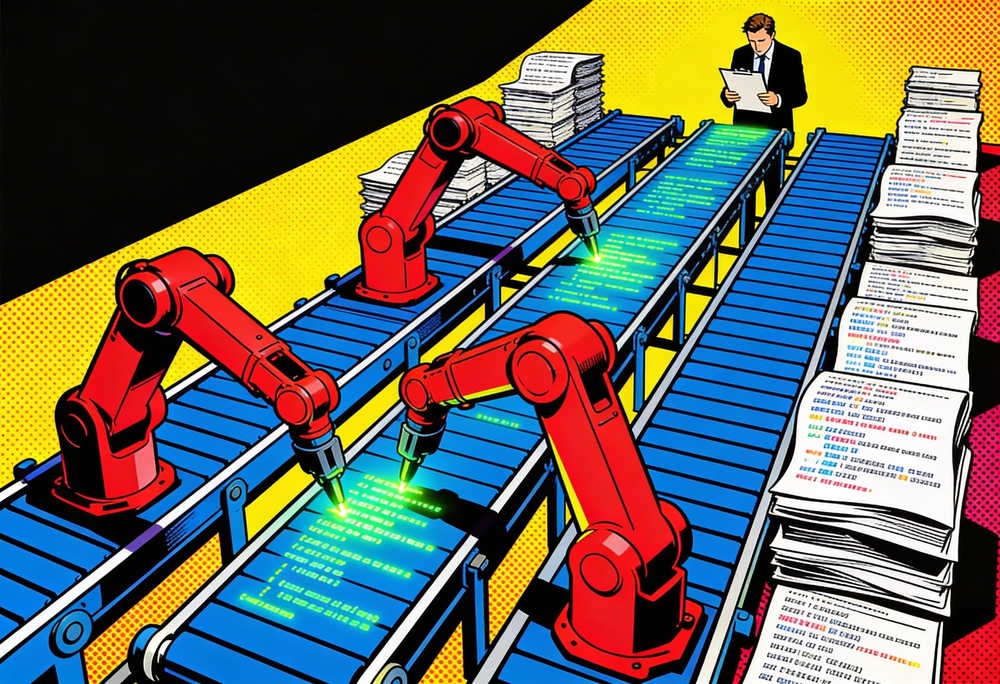
Thomas Dohmke, who stepped down as CEO of Microsoft's GitHub in August 2025, came out of stealth on Tuesday with Entire, a new developer platform built for the age of AI coding agents. The startup raised $60 million in what lead investor Felicis called the largest seed round ever for a developer tools company, valuing Entire at $300 million.
Existing developer infrastructure was designed for humans writing code line by line. Entire wants to rebuild it for a world where AI agents produce most of the software and humans manage the output. "We are not training models or building agents, we are integrating with them," Dohmke told Axios.
In late December, weeks before Tuesday's announcement, Dohmke sat down with Implicator.ai in Napa Valley for an interview conducted under embargo.
The Breakdown
• Former GitHub CEO Thomas Dohmke launched Entire with a record $60M seed round at a $300M valuation, led by Felicis
• First product Checkpoints records the reasoning behind AI-generated code, shipping with Claude Code and Gemini CLI support
• Entire's three-layer architecture sits on top of existing platforms like GitHub, not competing with them for repo hosting
• Dohmke told Implicator.ai in a December interview that 90% of some projects are already AI-written
What Entire actually builds
Think of modern software development as an assembly line that runs without a foreman. AI agents write the code. They ship it fast. But nobody on the floor can tell you why a particular part was built the way it was, or which instructions the machine followed to produce it.
Entire's first product, Checkpoints, is an open-source command-line tool that records the reasoning behind AI-generated code. Say an agent rewrites your authentication module at 2 a.m. Checkpoints would log the prompt that triggered the rewrite, the reasoning steps the agent followed, every fork in its decision tree. Six months from now, a reviewer pulling up that file can read the full transcript of why the code looks the way it does, not just the diff.
Checkpoints ships with support for Anthropic's Claude Code and Google's Gemini CLI. More agents will follow.
Behind Checkpoints sits a three-layer architecture: a Git-compatible database for storing AI-produced code, a semantic reasoning layer that tracks decision trails across the software lifecycle, and an AI-native interface designed for human-agent collaboration. GitHub repositories store what software does. Entire's reasoning layer stores why it was built that way.
Dohmke framed the distinction in an interview with The New Stack as a shift from engineering as craft to engineering as specification and intent. Entire, in that framing, is not competing with GitHub for repository hosting. It is building a management layer that sits on top of GitHub, GitLab, or whatever else a team already uses.
The interview: "The decision had ripened"
The following interview was conducted in German and has been translated and condensed for clarity. At the time, Dohmke's company was still in stealth mode. References to "the company" have been updated to reflect its public name, Entire.
You ran GitHub for four years. Then you left. What happened?
There was no stress at all. Of course there was a lot of work at GitHub in recent years, especially with AI and Copilot. But for me, the time had simply come. After more than ten years at Microsoft. I left Germany at the end of 2014 and moved to Seattle for a job at Microsoft, then shifted over to GitHub in 2018 when the acquisition went through. By the time they handed me the CEO role in 2021, I'd already been inside the machine for seven years, and at Microsoft for close to a decade. The decision had ripened: now is the time to do something new.
I saw a good opportunity to build a company myself, rather than working in one founded by others, whether it's Bill Gates with Microsoft or the GitHub founders.
Entire is still in stealth at the time of this conversation. What can you tell us?
We want to build a new developer platform. We're building the company as a global, fully remote operation from day one. Employees in the US, Germany, across Europe, Australia. What's special right now is that every company being founded today already has AI baked in.
Kevin Weil at OpenAI recently said that every company founded in the last ten years is a pre-AI company. They all have to transform themselves. Companies founded now are post-AI. AI is already embedded, and that gives them a competitive advantage because they can build products much faster.
This is your first company founded in the US. You started businesses in Germany before. Any surprises?
The biggest difference compared to Germany: you don't have to go to a notary. I founded a UG in Germany in 2009, then a GmbH. Everything runs through a notary there. Here, company formation happens almost entirely online. It's much faster to set up a company and a bank account. Many things happen just over email or Slack.
The other thing is venture capital. It's probably easier for me than for many others because VCs know me from my time at GitHub and reached out on their own. But the amounts of capital available here are significantly larger than what's possible in Germany or Europe. We have European funds in our seed round too, but it's a different world. After two VC meetings, you walk into a coffee shop and suddenly you're at a table with three other founders who just closed their own rounds. Nobody planned it. That kind of collision just doesn't happen in Berlin or Munich.
Some software projects are already 90 percent written by AI. What does that mean for developers?
It doesn't necessarily mean humans write less code. It means they can write ten times as much. My one share plus the nine shares from the AI. That's where we'll see the biggest progress: more and more software built with AI, incorporating AI to make tasks easier.
You've talked about AI as a kind of collaborator with infinite patience. What does that look like?
At HockeyApp, we used to joke that when you can't solve a problem, you just explain it to someone else. And in the process of putting it in your own words, you arrive at the solution yourself, before the other person can even respond.
AI fills that role now. You've got this assistant that never gets tired, never gets annoyed. Real colleagues have their own deadlines, their own fires. I'd sit there thinking, is this question worth pulling someone out of their work? AI kills that hesitation. It's not going to sit there the next morning like my boss asking why I keep asking. Having a system permanently available as a thinking partner is incredibly liberating.
Join 10,000+ AI professionals
Strategic AI news from San Francisco. No hype, no "AI will change everything" throat clearing. Just what moved, who won, and why it matters. Daily at 6am PST.
No spam. Unsubscribe anytime.
The review bottleneck
GitHub reported 180 million developers on its platform as of October 2025. Eighty percent of new GitHub developers now use Copilot in their first week. AI-assisted coding is no longer an experiment. It is the default.
Pull requests still assume a human wrote every line and can explain every decision. Security policies still require human sign-off before code reaches production. If you run a development team in 2026, your reviewers are almost certainly the slowest part of the assembly line, squinting at machine-written output they had no hand in producing.
"Soon, developers won't look at the code anymore, as agents will write way more than humans can review," Dohmke told Axios. "We have to rethink the entire system of software production from the ground up."
Engineering leaders are nervous about a new budget line, too. Token costs. AI agents consume API tokens with every operation, and some engineers report spending thousands of dollars per month on inference alone. You cannot scale agent capacity the way you scale headcount. Token costs fluctuate with workload, turning what used to be a fixed engineering expense into a variable one that no spreadsheet from last year anticipated.
A crowded field
Entire enters a market that is filling fast. Google, OpenAI, Anthropic, Microsoft, and Cursor all offer their own AI coding platforms and services. GitHub itself launched Agent HQ at its Universe conference in October 2025, a platform designed to bring coding agents from multiple providers under one roof. None of them, so far, have focused on the assembly line itself, the management layer that tracks what the agents did and why.
Dohmke is betting that gap stays open. "Our platform will be open-source, independent, and scalable for every developer and agent to host their code and agent context," he told Axios. "If you build with Claude Code, Cursor, Codex, you name it, you will have a home with us."
Felicis led the round. Madrona and Basis Set joined the round alongside M12, Microsoft's corporate venture fund. The angel roster leans heavily on people who built or bankrolled developer tools before: Jerry Yang (Yahoo co-founder), Garry Tan (Y Combinator CEO), Olivier Pomel (Datadog CEO), Gergely Orosz (whose Pragmatic Engineer newsletter has become required reading for senior engineers), and Theo Browne, a prominent JavaScript content creator. That M12 showed up is no accident. Dohmke told WinBuzzer he walked Satya Nadella through his plans before leaving GitHub, and Nadella signaled openness to working together down the road.
Entire has 15 employees, all remote. Team members come from GitHub and Atlassian. A broader platform launch is planned for later this year, adding the full three-layer architecture: distributed database, semantic reasoning layer, and AI-native interface. The database layer is designed to be globally distributed and queryable by both humans and AI agents, a piece of plumbing that does not exist in the current Git ecosystem.
Dohmke sold his first startup, the crash-reporting tool HockeyApp, to Microsoft in 2015 and moved from Germany to the United States. He took over GitHub in 2021 and spent four years scaling it from a code repository into a platform for AI-assisted development. Now he is building the infrastructure he thinks GitHub was never designed to provide.
Whether Entire can carve out a durable position between the platforms it aims to serve and the agents it aims to manage depends on how fast the review bottleneck becomes painful enough to pay for. Dohmke is gambling the pain is already here. "We are living through an agent boom," he said, "and massive volumes of code are being generated faster than any human could reasonably understand."
Fifteen employees. $60 million. A bet that the assembly line, not the factory floor, is the part that needs rebuilding.
Frequently Asked Questions
Q: What is Entire and what does it do?
A: Entire is a developer platform founded by former GitHub CEO Thomas Dohmke. It builds tools for managing AI coding agents, starting with Checkpoints, an open-source CLI that records the reasoning and prompts behind AI-generated code. The company raised $60 million in seed funding at a $300 million valuation.
Q: What is Checkpoints and how does it work?
A: Checkpoints is Entire's first open-source product. It captures the original prompt, reasoning steps, and decisions behind every AI-generated code change, storing that context alongside the code itself. It currently supports Anthropic's Claude Code and Google's Gemini CLI.
Q: How does Entire differ from GitHub?
A: GitHub stores code and tracks what software does. Entire adds a reasoning layer that tracks why code was built a certain way. It sits on top of GitHub, GitLab, or other platforms rather than replacing them. Dohmke describes it as a shift from engineering as craft to engineering as specification and intent.
Q: Who invested in Entire's seed round?
A: Felicis led the $60 million round. Other institutional investors include Madrona, Microsoft's M12, and Basis Set. Individual backers include Yahoo co-founder Jerry Yang, Y Combinator CEO Garry Tan, Datadog CEO Olivier Pomel, Gergely Orosz, and Theo Browne.
Q: Why does Dohmke think existing developer tools are inadequate?
A: AI agents now generate code faster than humans can review it. Pull requests and code review processes still assume human authorship. Dohmke argues developers need tools that track agent reasoning and decisions, not just the code output. He calls for rebuilding the software production system from the ground up.

Marcus Schuler
Tech translator with German roots who fled to Silicon Valley chaos. Decodes startup noise from San Francisco. Launched implicator.ai to slice through AI's daily madness—crisp, clear, with Teutonic precision and sarcasm. E-Mail: [email protected]