IMPLICATOR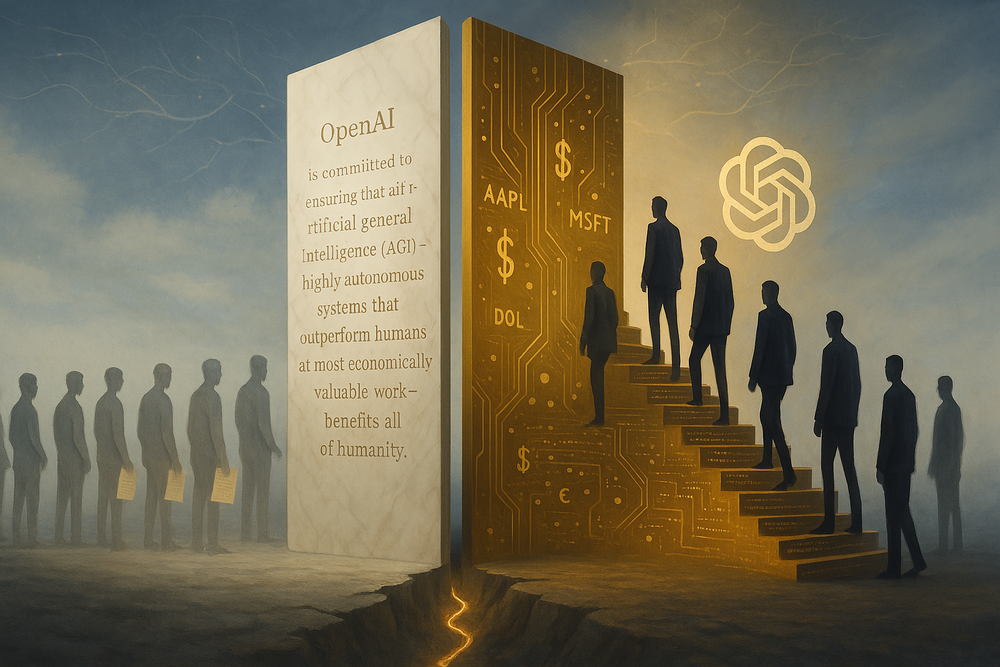
In an amicus brief filed today in the Northern District of California, the former employees - including researchers and policy leads who worked at OpenAI between 2018 and 2024 - paint a picture of an organization that repeatedly emphasized nonprofit control as essential to its mission of ensuring artificial general intelligence (AGI) benefits humanity.
The brief lands as OpenAI attempts to restructure itself, potentially removing the nonprofit's control over its for-profit subsidiaries. This comes after November's chaos when Altman was briefly fired before returning as CEO.
Mission on Display: More Than Just Words
According to the former employees, OpenAI's nonprofit control wasn't just a nice-to-have - it was the cornerstone of the company's strategy. Their filing reveals that physical copies of OpenAI's Charter, which outlined commitments to distribute AGI's benefits broadly and prioritize safety over profit, were "prominently displayed" throughout the offices. It seems OpenAI took its mission so seriously it even put it on coffee tables.
Leadership's Public Stance
The brief details how OpenAI leadership, including CEO Sam Altman, repeatedly emphasized nonprofit control in both internal meetings and public statements. In May 2023 Senate testimony, Altman stressed that OpenAI's "unusual structure" ensured focus on its long-term mission. The company's website proclaimed the nonprofit board would remain "the overall governing body for all OpenAI activities."
Trust Fractures Emerge
But one former employee, Todor Markov, suggests these commitments may have been more show than substance. In a declaration, Markov describes losing trust in leadership after discovering the company required departing employees to sign broad non-disparagement agreements to keep their vested equity - a practice he claims Altman denied knowledge of despite having signed related documents.
Talent Wars and Mission Control
The brief argues that OpenAI's nonprofit control served as a crucial recruiting tool, particularly for researchers concerned about AI safety. Many employees apparently joined specifically because of the nonprofit mission and stayed based on assurances that profit would remain subordinate to beneficial AGI development.
When OpenAI transitioned to a "capped-profit" structure in 2019, leadership had to work overtime to convince worried employees that the mission wouldn't be compromised. The company even commissioned an internal team to analyze how the transition would affect its nonprofit mission - though one wonders if they saw this latest power struggle coming.
The Breaking Point
The former employees argue that removing nonprofit control would violate OpenAI's core commitments, particularly its promise to "stop competing with and start assisting" any "value-aligned, safety-conscious project" that gets close to developing AGI first. They note that for-profit shareholders would likely do the opposite - race ahead while potentially cutting corners on safety.
Interestingly, the brief points out that OpenAI's recent blog post about its planned restructuring doesn't mention the Charter once - a striking omission given how prominently it featured in company communications from 2019 to 2024. The silence speaks volumes.
More than a legal structure...
The filing paints OpenAI's nonprofit control as more than just a legal structure - it was a promise to employees, donors, and the public that the company would prioritize humanity's interests over profit. If that control disappears, the former employees argue, so does OpenAI's ability to ensure AGI benefits everyone.
Current OpenAI leadership has yet to respond to the filing. Meanwhile, the brief offers a rare glimpse into the company's internal dynamics during its transformation from idealistic nonprofit to AI industry powerhouse.
Why this matters:
- OpenAI's nonprofit control wasn't just window dressing - it was the structural foundation that attracted top talent and shaped company decisions. Removing it fundamentally changes what OpenAI is and what it stands for.
- The case highlights a broader tension in AI development: can companies meaningfully commit to benefiting humanity while answering to profit-seeking shareholders? OpenAI's experience suggests it's harder than putting mission statements on coffee tables.
Read on, my dear:

Marcus Schuler
Editor-in-Chief and founder of Implicator.ai. Former ARD correspondent and senior broadcast journalist with 10+ years covering tech. Writes daily briefings on policy and market developments. Based in San Francisco. E-mail: editor@implicator.ai