IMPLICATOR
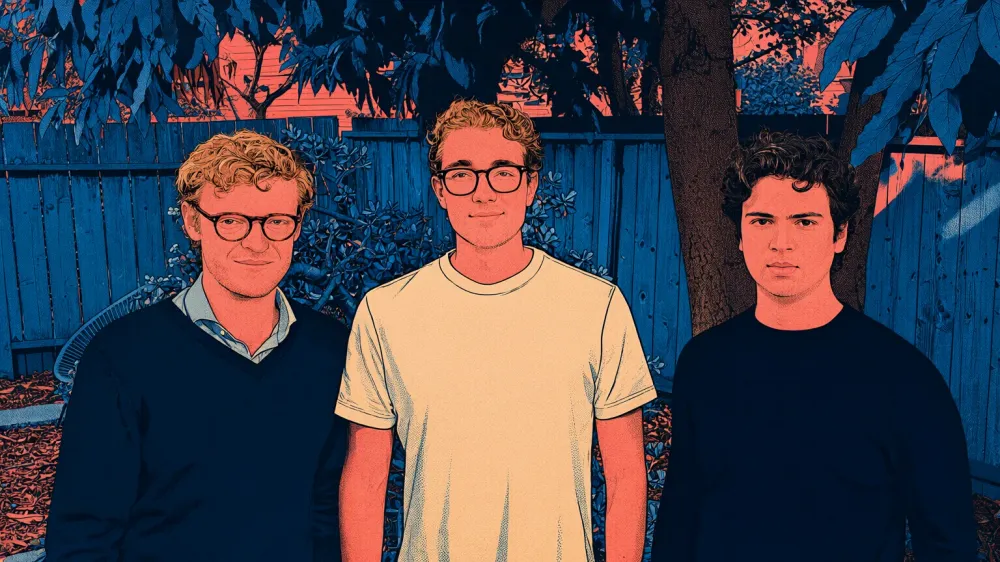
At two in the morning, Paul von Redecker was still on the phone with a manufacturer in Germany. He is 23, and he takes these calls from the upper floor of a rented house on San Francisco's Potrero Hill, because the people he needs are starting their workday nine hours ahead of him. The companies on the other end make things like nails and car parts. Some have been making them for a hundred years.
He was not selling them software. He was asking for their old drawings.
Von Redecker is one of three founders of The General Data Company, a start-up that licenses decades-old engineering drawings and computer-aided design files from family-owned German manufacturers, turns them into training tasks and, the founders say, sells those tasks to the large AI labs. The labs have read the public internet. What they are paying for now is the material that was never on it.
The company has not announced itself or its funding round. Its three founders described the business in an exclusive interview with Implicator.ai on November 6, and this is the first published account of it. Much of what follows rests on their word. General Data names none of its lab customers and none of the manufacturers it buys from, and it has not disclosed how much money it has raised.
The Breakdown
- The General Data Company, run by three Europeans from a rented house on San Francisco's Potrero Hill, licenses decades-old engineering drawings and CAD files from German family manufacturers and builds AI training tasks from them.
- OpenAI said on November 3, 2026 that its model did not consistently account for production limits, tolerances or assembly details when designing a device.
- Labs typically paid $200 to $2,000 per training task, according to Epoch AI interviews published in January 2026, and micro1 committed $1 billion over twelve months in October 2026.
- The company names no lab customers or sellers, and skeptics note that labs are moving this work in-house.
AI-generated summary, reviewed by an editor. More on our AI guidelines.
What the labs cannot find online
OpenAI described the gap itself on November 3, 2026. In a post about engineering work, the company said two employees had used its GPT-6 Astra model to design a small device, enclosure and circuit board included, in under a week. Getting it built took several more rounds of review. The model, OpenAI wrote, "did not consistently account for the manufacturer's production limits, tolerances, or details required for assembly."
The company's own scores point the same way. On BenchCAD 2.0, a test of whether a model can reconstruct three-dimensional parts and assemblies, Astra averaged 0.594 at its highest reasoning setting, against 0.875 for a newer internal model. Both numbers are OpenAI's, and no outside group has re-graded them.
The founders' bet is that this kind of knowledge sits in finished drawing sets and almost nowhere else. Von Redecker's example in the interview with Implicator.ai was a nail maker that has been producing for a century and keeps ninety of those years in its archive. Language models were trained on the open web, he said, and have never seen records like that, which leaves them close to useless for engineers at the point where it counts.
For a single training task of any kind, labs typically paid $200 to $2,000, according to 18 interviews the research group Epoch AI conducted with suppliers and lab staff and published in January 2026. Exclusive rights cost roughly four to five times as much, two suppliers told the group. Anthropic's leadership was reported in the autumn of 2025 to have discussed spending more than $1 billion on such material over the following year. That was a reported internal discussion, never an announced budget.
A market that prefers Americans
San Francisco is full of companies chasing the same supply. On October 9, 2026, micro1 said it would spend $1 billion over twelve months buying company records, with financing from Citi and Hercules Capital. Its program wants companies with more than thirty employees, gives American firms priority and requires the material to be in English.
The pitch has reached American design firms too. Nyne.ai, which calls itself "the data factory for AI," has been advertising to architects: "You've got 3 years of CAD files doing nothing. We'll pay you six figures for them."
FREE · ABOUT FIVE MINUTES
Follow who sells what to the AI labs.
Implicator cuts the flood to the developments worth your attention, with concise reporting on what changed and why it matters. Delivered every weekday at 4:45 a.m. Pacific, 7:45 a.m. Eastern.
From San Francisco. No spam. Unsubscribe anytime.
A German family firm that keeps its records in German, in file formats older than some of its engineers, does not match micro1's description. That is the opening the three Europeans on Potrero Hill are working.
The house on the hill
The neighborhood sits next to Mission Bay, where OpenAI has had its headquarters since 2023, and real estate agents have taken to calling the district "Area AI." Single-family homes on the hill sold for a median of more than $2 million as of July 2026, and founders rent them as dormitories.
General Data's is an Airbnb the founders call their "hacker house." At the time of the interview, von Redecker and Levin Schwab, the 22-year-old chief technology officer, were upstairs, Schwab under a stucco ceiling and a smoke detector that had not been installed. Nicholas Torabi, the chief executive, was working one floor down. The first employees live in the house with them. "All Germans," von Redecker said, then corrected himself: one is Swiss, one is Polish, and Torabi holds British, Irish and Norwegian passports. "But they all speak German."
Von Redecker grew up in Warsaw, Bosnia, Washington and Berlin and spent about a year as an investment banker. He met Schwab when the two sat next to each other for a summer at Barclays in London. Schwab comes from Weil der Stadt, a town in Swabia, the manufacturing region around Stuttgart. He studied mathematics in Mannheim and traded for Optiver in Amsterdam, where he said he picked up "this mindset of almost ruthless expected-value maximization." Torabi was born in Tokyo, raised in Berlin, left university and at 19 co-founded Qorelo, a start-up building AI agents for SAP projects that raised $3.5 million in June 2026.
They had been in San Francisco less than two months.
From a scanned drawing to a graded task
No lab can do anything with an old scanned PDF, Schwab said. His team strips identifying details from the files while keeping their structure and geometry, then builds tasks from them. A task has two parts: an instruction to the model, such as producing a CAD model from a written description or reading a technical drawing, and a rule that checks whether the model got it right. A large set of such tasks is what the industry calls a reinforcement-learning environment. Torabi calls it a school for language models. The labs receive the tasks, and the raw files stay behind.
Schwab tunes each task so that the model "just barely cannot do it yet," because that is where it learns the most.
The checking rule is the hard part. Models are good at finding ways to satisfy a rule without doing the work. Ross Taylor, who led AI research at Meta before co-founding General Reasoning, warned about this in September 2025. "Even the best publicly available [RL environments] typically don't work without serious modification," he said.
General Data has not shown how its own rules hold up against that problem, or a worked example that follows one archive drawing through to a task and its rule.
The Beetle, not the Passat
The founders said their partners are mostly in Swabia and in North Rhine-Westphalia, among the small and mid-sized family manufacturers Germans call the Mittelstand, and that speaking Swabian dialect has helped with some of them. Payments start in the five figures and reach several million in large cases, they said. A family firm with twenty employees in its third generation, von Redecker said, sometimes delivers better material than an American shop with two hundred.
Know someone who'd find this useful? ✉️ Email it to a friend in one click, or they can subscribe free here.
Off limits are personnel records, anything under a confidentiality agreement, the core business and the newest files. "Volkswagen would probably never give up the engine files of the VW Passat, but maybe those of the VW Beetle from 50 years ago," von Redecker said.
Schwab reads the creation dates in the file metadata, a 2007 stamp for instance, and said anything drawn before the 2020s is certain to be free of machine-generated content.
The pitch reaches an industry under pressure. The credit agency Creditreform counted 12,900 corporate insolvencies in Germany in the first half of 2026, up 7.8 percent from a year earlier and the most for a first half since 2013. "What is the alternative?" von Redecker said. "The companies go insolvent, more of them every year. They are sitting on old data that is of no use to them anymore."
Who owns a drawing
When the Nyne advertisement reached Simon Ha, an adjunct professor of architecture at the University of Southern California, he reposted it with a warning, Archinect reported on November 9. "Just because a firm possesses these files doesn't necessarily mean it has the right to sell them for AI training," Ha wrote. "Removing client names doesn't necessarily resolve those issues."
General Data's answer is procedural. The manufacturer grants a license to parts of its archive, lawyers on both sides negotiate which files leave, and the start-up sees nothing until the company has reviewed it. Responsibility lies "always with the company," von Redecker said, which leaves the legal risk with the seller. The license terms have not been made public.
The sellers are paid up front, the founders said, and the labs are to pay later by subscription. Computing and model access cost the company five to six figures in dollars a month, the founders said. A funding round covers the gap, one von Redecker called "fairly large" without giving a figure. Y Combinator holds a small part of it, Torabi said, and the Zurich venture firm Redalpine is an investor. Implicator.ai has learned that Christian Lindner is another. Lindner is one of Germany's best-known politicians, a former finance minister who led the liberal Free Democratic Party, the FDP, until its defeat in the February 2025 election, and who now backs start-ups through his own holding company. General Data has not confirmed his stake.
How long the demand lasts
Benjamin Anderson, a software developer, made the case against the whole category in a September 2025 essay titled "Don't Build an RL Environment Startup." Once a model has mastered a skill, he argued, the tasks that taught it are worth close to nothing, and the companies that built them are "useful for now, disposable later." His advice to founders: "Don't sell blood to vampires."
The Epoch AI interviews found a second pressure. Labs are moving substantially more of this work in-house, to save the supplier's margin and to keep their training priorities to themselves. OpenAI's November post ends with an invitation to engineering firms and software vendors to work with it directly.
Torabi's reply is that work inside companies changes so fast the models will need a steady flow of fresh records. "We are not a data broker," he said. "That is very, very important."
The founders say the trade will eventually run both ways. Nearly every call with a manufacturer ends with the same question, von Redecker said: whether the firm can share in the research. The second step they promise is a subscription that would let a manufacturer tune a small model of its own on its drawings. Von Redecker's example is Coinbase, which said in October 2026 that it trained a compact open model for less than $100 and cut fraudulent transactions by 30 percent in its own test. That model outputs a risk grade, not a drawing.
Frequently Asked Questions
What does The General Data Company do?
It licenses old engineering drawings and CAD files from family-owned German manufacturers, strips identifying details, and builds training tasks from them. Each task pairs an instruction to an AI model with a rule that checks the result. The founders say the labs receive the tasks, not the raw files.
Who founded the company?
Paul von Redecker, 23, who runs operations; Levin Schwab, 22, the chief technology officer; and Nicholas Torabi, the chief executive, who co-founded the Berlin start-up Qorelo at 19. They work from a rented house on San Francisco's Potrero Hill.
Who has invested in The General Data Company?
Y Combinator holds a small part of the round, and the Zurich venture firm Redalpine is an investor. Implicator.ai has learned that former German finance minister Christian Lindner is another; the company has not confirmed his stake. The size of the round is undisclosed.
Why do AI labs want old engineering drawings?
Models were trained on the public web, where finished drawing sets with tolerances and production limits rarely appear. OpenAI said on November 3, 2026 that its model did not consistently account for a manufacturer's production limits, tolerances or assembly details.
What are the main doubts about this business?
Developer Benjamin Anderson argues that once a model masters a skill, the tasks that taught it lose their value. Epoch AI found labs moving more of this work in-house. USC's Simon Ha has questioned whether firms holding design files have the right to sell them for AI training.
AI-generated summary, reviewed by an editor. More on our AI guidelines.


Marcus Schuler
Editor-in-Chief and founder of Implicator.ai. Former ARD correspondent and senior broadcast journalist with 10+ years covering tech. Writes daily briefings on policy and market developments. Based in San Francisco. E-mail: editor@implicator.ai