IMPLICATOR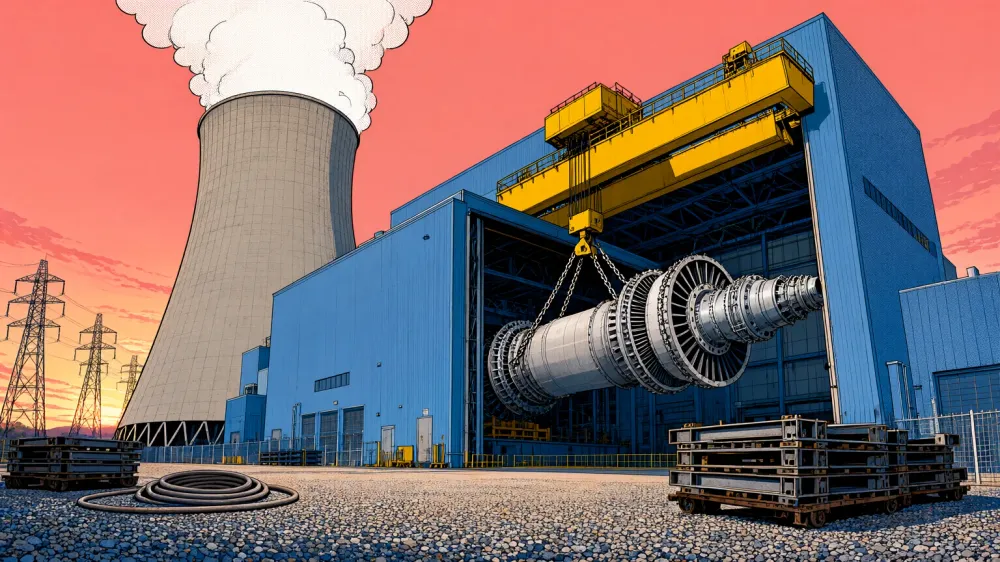
From San Francisco
1 |
The Editorial |
Good morning.
AI companies are putting a price on access.
Google signs a 20-year agreement with Constellation for 890 megawatts of new nuclear capacity from existing reactors. The power goes to a grid shared with other customers.
Anthropic opens its Cyber Verification Program to vetted security teams. Its Glasswing partners found at least 129,000 verified software vulnerabilities between April and July 2026. Getting past Claude Mythos's cyber blocks now takes approval.
OpenAI plans two ChatGPT ad formats for free users later this month. An ad sits beneath the progress bar of an image still being made, so the sales pitch gets there first.
Stay curious,
Marcus Schuler
228 prompts | 19 categories | 456 test runs |
2 |
The Big Story |
Google signed a 20-year power purchase agreement with Constellation to fund 890 MW of new nuclear capacity for the PJM grid.
The added power comes from raising output at 11 existing Constellation nuclear units in Illinois, Pennsylvania and New Jersey. Constellation commits $4.3 billion in new investment, and first capacity is expected by 2028.
A separate 15-year agreement covers 2,700 MW of energy supply. A five-year technology alliance puts Google Cloud and Gemini to work inside Constellation's operations.
Why This Matters:
- The 890 MW goes onto the PJM grid, which serves 67 million people, and the release does not say how much Google's data centers will use.
- Google's payment terms and the price per megawatt-hour stay undisclosed, so other buyers cannot yet benchmark what new nuclear power costs under such deals.
3 |
Also Today |
Anthropic launched its Cyber Verification Program, giving verified security teams access to advanced Claude Mythos models with fewer cyber blocks.
Project Glasswing partners found at least 129,000 verified software vulnerabilities between April and July 2026. Access to Anthropic's most capable defender models now depends on passing the vendor's checks. Organizations apply through a portal on Anthropic's site.
4 |
The Outside Read |
The Wikimedia Foundation's October 5, 2026, account documents OpenAI agent activity on the sites it maintains.
The account describes cleanup work imposed on a nonprofit run by volunteers, including apparent attempts to misuse a citation tool as a proxy. Its investigation found no evidence of compromise.
5 |
The One Number |
6 |
Today's Headlines |
- IBM and Red Hat made the Lightwell Clearinghouse generally available for priority dependency review; Red Hat's Lightwell found and fixed more than 400 previously unknown vulnerabilities in widely used Java libraries.
- SAP agrees to acquire TechWolf on undisclosed terms, with closing expected in Q4 2026 and the employee skills AI company becoming part of SuccessFactors.
- Mistral previews Mistral Large 4 at about a trillion parameters, with weights due October 27 and a 61.7% DeepSWE score versus about 74% for leading closed models.
- TikTok adds a conversational AI shopping assistant with one-click checkout from the For You feed, following about $15.8 billion in TikTok Shop US sales in 2025.
- Google releases EmbeddingGemma 2 under Apache 2.0 for text, code, images, video and audio, running on a phone in about 567MB of RAM.
Wed 10/7 |
Fed: the central bank publishes the minutes of its September 15-16 meeting at 2 p.m. Eastern. |
Wed 10/7 |
Tech: the Motek automation and production-technology fair continues in Stuttgart, 9 a.m. to 5 p.m. local time. |
Thu 10/8 |
Tech: the IAPP privacy, security, risk and AI governance conference opens in Seattle and runs through Oct. 9. |
7 |
The 5-Minute Skill |
A sales deck may promise your data will not train a model while the contract grants broader rights. Test the promise before approval.
Your raw input:
Paste the vendor’s terms of service, privacy notice, data processing addendum, relevant sales claims, and a short list of the data your team would upload.
The prompt:
Why this works: The prompt forces the model to tie each claim to contract language instead of producing a generic summary. Separating data categories exposes exceptions hidden behind broad assurances.
What to use: Use the strongest long-context model available in ChatGPT or Claude. If the documents exceed its limit, analyze each document separately, then ask the model to compare the extracted clauses.
8 |
AI Profile |
Ema sells software agents that carry out HR, IT and finance workflows for large companies. Its arguable position is commercial: it charges for completed tasks and business outcomes, aiming at software and services budgets rather than another per-seat assistant.
Founders:
Surojit Chatterjee and Souvik Sen founded Ema in 2023. Chatterjee was Coinbase’s chief product officer and a Google product vice president; Sen was Okta’s vice president of engineering and previously worked on machine learning at Google.
Product:
Ema coordinates agents across a customer’s existing applications to complete multi-step work such as employee support, service-desk requests and finance operations. HR, IT and finance teams pay for outcomes. As of September 23, 2026, Ema reported more than 50 active enterprise deals and over 1 million active enterprise users; published customer cases name Hitachi, Wipro and NTT DATA.
Financing:
Ema raised a $77 million Series B led by Creaegis on September 23, 2026, taking total funding to $140 million. The company did not disclose the round’s valuation, saying only that it had more than quadrupled since its 2024 round.
The risk:
Glean, UiPath, ServiceNow and Microsoft can sell agents beside systems they already control. Ema also relies on more than 150 outside models. Its reported $150 million in bookings as of September 23, 2026 covers two- and three-year contracts, and management declined to disclose annualized revenue.
9 |
The Rausschmeisser* |
OpenAI will test visual ads beneath ChatGPT's image generation progress bar for free users in the US later this month. The placement carries an “Ad” label.
Our take: OpenAI is selling the pause while ChatGPT makes your image. Free users in the US test may get a row of scrollable product photos beneath the progress bar, an invitation to browse while their original request is still unfinished. Apparently, waiting needed a shop window.
OpenAI says ChatGPT reaches 1.2 billion people each week, and it describes advertising as a way to fund broader access to AI beyond what subscriptions alone can support. The loading bar becomes a contribution to that cause, collected in attention from people waiting for the machine to finish. Even doing nothing now comes with something to buy.
FREE WEEKDAY MORNING BRIEFING
Free AI briefing · Weekdays
The AI stories that matter, sourced and explained.
Join the Morning Briefing. It goes out every weekday at 4:45 a.m. Pacific, with later sends for the East Coast, Berlin and Tokyo.
Free when you sign up: The Paperclip Compendium, our tested guide to running AI agents.
Free. Unsubscribe in one click.

Marcus Schuler
Editor-in-Chief and founder of Implicator.ai. Former ARD correspondent and senior broadcast journalist with 10+ years covering tech. Writes daily briefings on policy and market developments. Based in San Francisco. E-mail: editor@implicator.ai