Implicator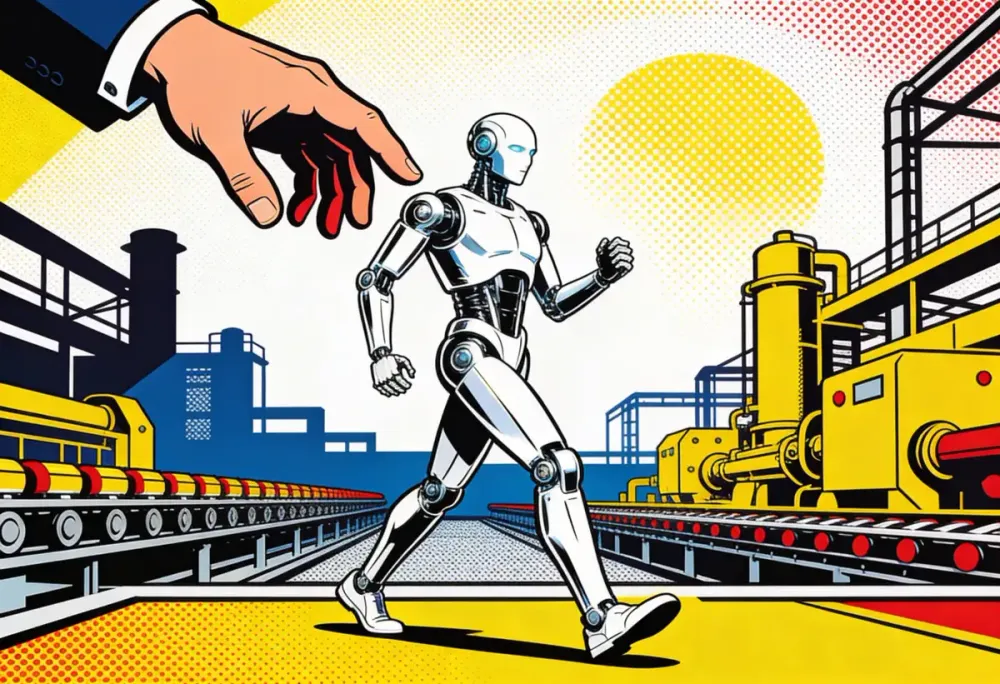
In 2017, Alphabet dumped Boston Dynamics on SoftBank. The robotics company had YouTube gold—backflipping humanoids, dog-bots that opened doors—but the financials were a mess. Viral views don't pay server costs. Google walked away.
Now they want back in.
At CES 2026, Boston Dynamics walked Atlas onto a Las Vegas stage and announced the robot would run on Google DeepMind's Gemini Robotics foundation models. Nine years after Google decided it couldn't make money from machines that impressed engineers but unnerved everyone else, the two companies are partners again.
Hyundai showed up with projections. They paid $880 million for Boston Dynamics back in 2020. Now they're planning factory capacity to build 30,000 humanoid robots a year by 2028. Atlas will start work at Hyundai's Savannah EV plant that same year. Investment banks are tripping over each other with market forecasts—Goldman sees $38 billion by 2035, Morgan Stanley throws out $5 trillion by 2050.
Look past the slide decks and the picture changes. Last year, Boston Dynamics shipped maybe 500 robots total. Not 500 Atlas units. Five hundred robots across everything they make—the Spot quadrupeds, the Stretch warehouse systems, the occasional humanoid. Revenue came in around $130 million. And here's the part that doesn't make the press release: every Atlas scheduled for production this year already has a home. Hyundai's training center gets some. Google DeepMind gets the rest. If you're an outside customer hoping to buy one, you're waiting until 2027. At least.
So what changed since Google decided robots weren't worth the headache?
The Breakdown
• Google DeepMind will integrate Gemini AI into Boston Dynamics' Atlas humanoid—reuniting nine years after Google sold the company to SoftBank
• Hyundai plans capacity for 30,000 robots annually by 2028; Boston Dynamics shipped just 500 units total last year with $130 million revenue
• First deployment targets Hyundai's Savannah plant—the same Georgia facility that lost hundreds of workers to immigration raids in 2025
• Boston Dynamics admits home robots remain twenty years out; industrial applications in controlled factory environments come first
The reunion nobody expected
Andy Rubin built Android. In 2013, he talked Google into buying Boston Dynamics as part of a robotics acquisition binge—eight companies in six months. The pitch never got specific. Robots in everyday life. That kind of thing. By 2016, Rubin had left. Google had gutted the robotics division. Boston Dynamics was hunting for someone willing to take it off their hands.
The robots themselves worked fine. These machines could absorb a kick and stay standing. They handled stairs, snow, construction debris. Moved with something close to biological fluidity. The problem was commercial. Nobody could figure out what product to sell. Corporate buyers watched the demos and got uncomfortable. Try explaining to a warehouse crew that the new robot can recover from being shoved.
SoftBank bought the company in 2017. Hyundai took over three years later. Ownership changed. The pattern didn't. Boston Dynamics kept producing research breakthroughs, kept uploading videos, kept burning through cash looking for customers willing to pay real money.
Two things made this partnership possible. Transformer architectures—the technical foundation behind ChatGPT—got good enough at processing visual and sensor data that robots can now adapt on the fly instead of just running pre-programmed routines. And labor economics shifted. Manufacturing wages went up. Immigration enforcement got stricter. The automation math that didn't work in 2017 pencils out differently now.
Get Implicator.ai in your inbox
Strategic AI news from San Francisco. No hype, no "AI will change everything" throat clearing. Just what moved, who won, and why it matters. Daily at 6am PST.
No spam. Unsubscribe anytime.
There's also the talent signal to consider. Aaron Saunders spent nearly twenty years as Boston Dynamics' chief technology officer. He left last November. Took a job at Google DeepMind running robotics hardware engineering. When your longtime CTO crosses over to your new partner, the relationship goes deeper than any press release admits.
The 500-to-30,000 problem
Look hard at what Hyundai is promising. Thirty thousand humanoid robots a year by 2028. That's the factory capacity they're building toward. Meanwhile, the company that's supposed to fill those orders shipped around 500 robots last year. Total. Across all product lines. Mostly Spot quadrupeds and Stretch warehouse bots. Atlas humanoids? A handful.
That gap matters. Scaling up like this requires supply chains that haven't been built, quality systems that don't exist, service networks spanning multiple continents, and applications compelling enough to justify the capital. Boston Dynamics says the new Atlas uses fewer unique parts and works with automotive supply chains. Clever engineering. But going from research prototype to high-volume manufacturing in under three years means cracking problems that have buried robotics companies for decades.
Do the revenue math yourself. Boston Dynamics brought in around $130 million last year. Hyundai has committed $26 billion to U.S. investment through 2028. They've pledged another 125 trillion won—call it $86 billion—for AI and robotics development in South Korea. That's an enormous pile of capital chasing a commercial model that still hasn't proven it works.
CEO Robert Playter isn't pretending the path is clear. At CES he acknowledged that commercial maturity separates survivors from casualties. "We have a team for integration, service, and repair," he said. "Most other companies are doing demos or selling robots as platforms, hoping someone else solves the applications. That's not how we do it."
Fair enough. But Boston Dynamics has been working on this for thirty years. Applications remain perpetually incoming.
Savannah's other story
Atlas starts its working life at Hyundai's Savannah, Georgia electric vehicle plant. The assignment: parts sequencing. Arranging components in installation order. Repetitive work that currently needs human hands.
Hyundai's press materials leave out some context about that location. Last year, federal agents raided the Georgia facility and arrested hundreds of workers. More than 300 turned out to be South Korean nationals. Operations got disrupted. International press picked up the story. Questions about who actually works at Hyundai's American plants suddenly had uncomfortable answers.
Putting humanoid robots at a site that just lost hundreds of employees to immigration enforcement tells a story whether Hyundai planned it that way or not. The company says Atlas will "reduce physical strain on workers by taking on higher-risk and repetitive tasks." Standard automation language. But run the timeline yourself. Raid in 2025. Robots in 2028. The sequence makes its own argument.
Vice chair Jaehoon Chang addressed the labor question directly at CES. "The company understands concerns about job losses, but people will be needed to maintain and train the robots, and additional personnel will be required." Executives have made similar promises during previous automation waves. Sometimes new jobs appeared. Sometimes they didn't.
Kia's labor union—Hyundai affiliate—called last year for a new body to address AI-era labor rights. Workers on the shop floor can read where this is heading even when executives stick to capability metrics.
Why Google wants another shot
Google DeepMind offers something Boston Dynamics never had: foundation models trained on enough data to transfer learning between tasks. For years, these robots were all reflex and no reflection. Atlas could catch a falling box. Atlas had no idea why it was catching the box. Google is essentially grafting on a frontal cortex—wiring cognition into a machine that previously ran on pure motor control.
Old-school robot programming meant engineers had to code every movement. The new approach lets robots learn from demonstration, simulation, real-world practice. Once one Atlas learns a task, the skill propagates across the entire fleet.
Carolina Parada, senior director of robotics at Google DeepMind, described the current limits at CES: "Tasks that require certain sensors the robot doesn't have are still limited. But the robot can learn almost anything you can consistently demonstrate through teleoperation."
The training works like this. A human operator wears a VR headset and guides Atlas through a task. That demonstration generates data. Boston Dynamics then runs thousands of simulated variations—slippery floors, bad lighting, equipment that fails mid-task. The system identifies what works best. Uploads the results to every Atlas unit at once.
This is why Google came back. Not because Boston Dynamics figured out how to make money. Because AI finally caught up with the hardware. Google's first robotics bet failed partly because the software wasn't ready to make capable machines actually useful. That bottleneck has loosened.
Google also has a competitive problem. Nvidia dominates AI hardware. OpenAI and Anthropic lead in language models. Google keeps falling behind in areas where it once set the pace. Robotics is a race still early enough to win. DeepMind's research combined with Boston Dynamics' mechanical expertise could build a position harder to replicate than yet another chatbot.
And there's more at play. Hyundai announced a $3 billion physical AI development cluster with Nvidia in South Korea. The partnership stacks capabilities: Hyundai brings manufacturing scale, Boston Dynamics contributes the hardware, Google provides the AI, Nvidia supplies the chips. Not many competitors can assemble that combination. Tesla has Optimus. Xpeng has Iron. Chinese state-backed programs have resources and government support. But this alliance is the most integrated humanoid bet from established players anywhere.
The home robot hedge
Consumer applications don't appear on Hyundai's roadmap. Playter was direct about why.
"Some companies are saying they want to deploy humanoids in the home first. We think that's the wrong strategy for multiple reasons." He ticked through the obstacles: costs too high, capabilities too limited, safety standards nonexistent. Then he got personal. "I can't wait for the day a robot helps lift me out of bed. That's twenty years away. We do want to go into homes, just not now."
That admission cuts against the vision everyone's been sold. The dream was never robots sorting car parts. It was robots folding laundry, helping elderly parents, handling the domestic grind that eats up evenings and weekends. Boston Dynamics is saying out loud that the dream stays distant—too distant to build a business around.
The industrial focus makes commercial sense. Factories have controlled environments, defined tasks, and employers who can absorb six-figure unit costs. Homes have unpredictable layouts, changing light, curious kids, nervous pets, and consumers who won't spend $50,000 for help with dishes. Playter's team admits Atlas still can't reliably pour coffee or help someone get dressed. "There are no humanoids that do that nearly as well as a person," said Scott Kuindersma, head of robotics research.
Factory capability and home capability aren't close. That distance explains why Hyundai's timeline puts complex assembly work at 2030. Parts sequencing—picking things up, putting them in order—is achievable now. Anything requiring real dexterity or adaptation to surprise is years away.
The race beneath the race
Playter went geopolitical at CES. "The Chinese government has a mission to win the robotics race. Technically I believe we remain in the lead. But there's a real threat there that, simply through the scale of investment, we could fall behind."
This framing does work for Boston Dynamics. It justifies government support for domestic robotics. It positions the company as a strategic asset rather than a struggling hardware maker. It generates urgency that current revenue numbers can't support on their own.
China does have major humanoid programs. But the framing also obscures closer competition. Tesla's Optimus has Elon Musk's promotional machine behind it. Musk claims Optimus will eventually represent 80% of Tesla's value. Sounds like hype. But his predictions about Tesla and SpaceX sounded like hype too—until they came true.
CES positioned Boston Dynamics for a multi-year fight where capital, technical chops, manufacturing capacity, and actual deployments will sort winners from losers. The company has robotics credibility that Tesla lacks. It has robotics revenue that Tesla lacks. Tesla has resources and appetite for risk that Boston Dynamics lacks.
What CES revealed wasn't a finished product ready to remake manufacturing. It was opening moves in a race that runs through the 2030s. Google is betting AI finally makes robots commercially viable. Hyundai is betting that manufacturing scale and expertise matter more than software. Boston Dynamics is betting that three decades of hardware development creates advantages money alone can't buy.
Atlas units walked across the CES stage. The crowd went quiet. Everyone waiting for the stumble. The locked joint. The fall that usually wrecks live robotics demos. None of it happened. Whether these machines will walk across factory floors—and eventually into homes—depends on whether those bets pay off. Google tried this once before and quit. Hyundai is pouring billions into a market that barely exists. But that silence in the room mattered. Twenty minutes where skepticism softened into something else. Not quite belief. Something closer to possibility.
❓ Frequently Asked Questions
Q: Who owns Boston Dynamics now?
A: Hyundai Motor Group bought Boston Dynamics for $880 million in 2020. Before that, SoftBank owned the company from 2017 to 2020. Google's parent company Alphabet originally acquired Boston Dynamics in 2013 but sold it after failing to find commercial applications for the robots.
Q: How much does an Atlas robot cost?
A: Boston Dynamics hasn't disclosed Atlas pricing, but the article references "six-figure unit costs" for humanoid robots. For context, their Spot quadruped robot sells for around $75,000. Atlas, with its advanced humanoid capabilities, likely costs significantly more—potentially several hundred thousand dollars per unit.
Q: What's the difference between Atlas, Spot, and Stretch?
A: Atlas is Boston Dynamics' humanoid robot designed for complex tasks requiring human-like movement. Spot is a four-legged robot resembling a dog, used for industrial inspections and data collection. Stretch is a warehouse robot built specifically for moving boxes. Of the roughly 500 robots Boston Dynamics shipped in 2025, most were Spot and Stretch units.
Q: How does Google DeepMind's AI actually improve Atlas?
A: Previously, Atlas ran on pre-programmed routines—engineers had to code every movement. Google's Gemini Robotics foundation models let Atlas learn from demonstration instead. A human operator guides the robot through a task via VR, then simulations generate thousands of variations. Once one Atlas learns something, that skill uploads to every unit in the fleet.
Q: How does Atlas compare to Tesla's Optimus robot?
A: Boston Dynamics has 30+ years of robotics experience and actual revenue ($130 million in 2025). Tesla's Optimus is newer with no commercial sales yet. However, Tesla has deeper pockets and higher risk tolerance. Elon Musk claims Optimus will eventually represent 80% of Tesla's value. Both companies are targeting factory applications first.

Maria Garcia
Bilingual tech journalist slicing through AI noise at implicator.ai. Decodes digital culture with a ruthless Gen Z lens—fast, sharp, relentlessly curious. Bridges Silicon Valley's marble boardrooms, hunting who tech really serves.