



San Francisco | December 9
Sergey Brin is back with glasses that can't handle a sunny window. Google announced three tiers of Android XR eyewear for 2026, betting that platform reach beats working hardware. The prototypes failed their sunlight demo. The strategy assumes developers will build for chips that don't exist yet.
Meanwhile, Trump approved Nvidia's H200 exports to China and claimed 25% of revenue for the government. One problem: Beijing already rejected Nvidia's weaker chip over security concerns, and U.S. law prohibits charging for export licenses. Washington is taxing sales that may never happen.
Everyone's claiming victory before the other side agrees to play.
Stay curious,
Marcus Schuler
Google's Three-Tier Glasses Strategy Bets Everything on Platform Dominance

Sergey Brin admitted Google Glass failed because AI wasn't ready. Now Google is back with three product tiers launching in 2026, each designed to get Android XR onto your face at whatever price you'll pay.
Audio-only frames compete directly with Meta's Ray-Bans, which sold out "in almost every store within 48 hours" in October. Display glasses add Raxium's Micro LED screens, though prototypes couldn't handle sunlight during demos.
The real play is Project Aura: wired XR glasses from Xreal running Samsung's $1,800 Galaxy XR headset chip in a pocketable form, tethered to a belt-clipped processing puck.
The strategy inverts typical hardware launches. Instead of shipping devices and hoping developers follow, Google launched Galaxy XR with instant access to Android's existing app ecosystem. One operating system across headsets, wired glasses, and consumer frames means one developer target.
Meta leads on hardware sales but runs a fragmented, proprietary stack. Google is betting that platform reach beats product polish. The glasses still can't handle a sunny window. But the software layer is ready for chips that don't exist yet.
Why This Matters
- Developers face a platform decision in 2026: build for Google's unified ecosystem or Meta's fragmented stack
- Google's $150 million Warby Parker deal signals aggressive consumer pricing to undercut Meta's $299 entry point
 Marcus Schuler
Implicator PRO Briefing

🔒 PRO Briefing
A Fortune 500 engineer deleted 47,000 lines of code. Replaced them with 212 lines of YAML. Monthly AI bill dropped 63%. The routing layer is becoming tech's most valuable chokepoint. We break down who's winning the plumbing war.
AI Image of the Day

Prompt:
a cow wearing a bob haired wig. Photo studio lighting.
Trump's Nvidia China Deal: A 25% Cut of Sales That May Never Happen

Trump approved Nvidia's H200 chip exports to China Monday, claiming 25% of revenue for the U.S. government. The deal may be worthless.
Beijing rejected Nvidia's weaker H20 chip earlier this year over alleged "backdoor security risks," and Chinese authorities have pushed state-affiliated companies toward domestic alternatives from Huawei.
The H200 is six times more powerful than the H20, making it more attractive to Chinese AI labs but also more likely to trigger Beijing's technological self-sufficiency concerns.
The 25% fee faces its own problems. U.S. law prohibits charging for export licenses, and government lawyers have spent four months failing to create a collection mechanism. The workaround treats chips as imports during a Taiwan-to-China security review layover, a structure that may not survive legal challenge.
Jensen Huang secured the approval after a White House meeting last week, outmaneuvering bipartisan congressional opposition. The Institute for Progress estimates H200 access would let Chinese labs build supercomputers approaching American capability levels. Washington may have approved the sale. Beijing still has to let the chips in.
Why This Matters:
- Nvidia's $50 billion China opportunity hinges on Beijing's response, likely within weeks
- The fee mechanism's legality could reshape how future administrations monetize export policy
 Robert Brown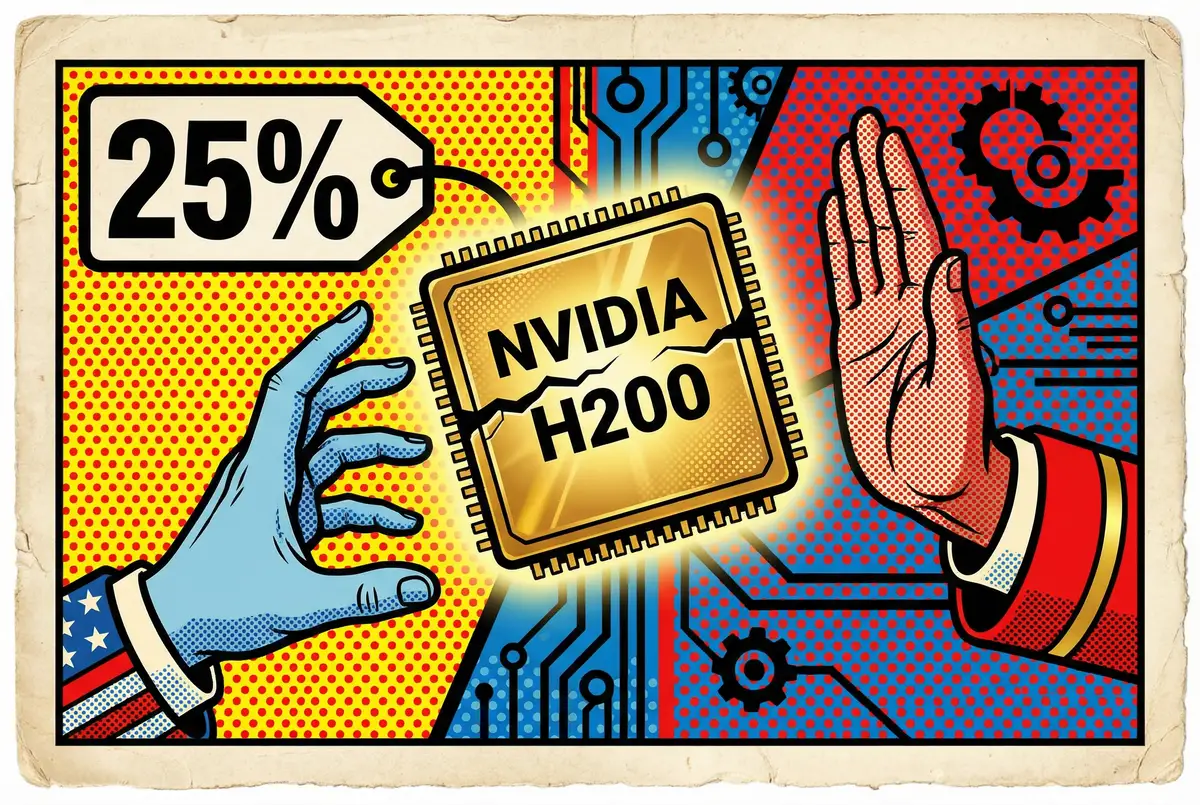
🧰 AI Toolbox
How to Create AI-Optimized Documentation That Stays Current
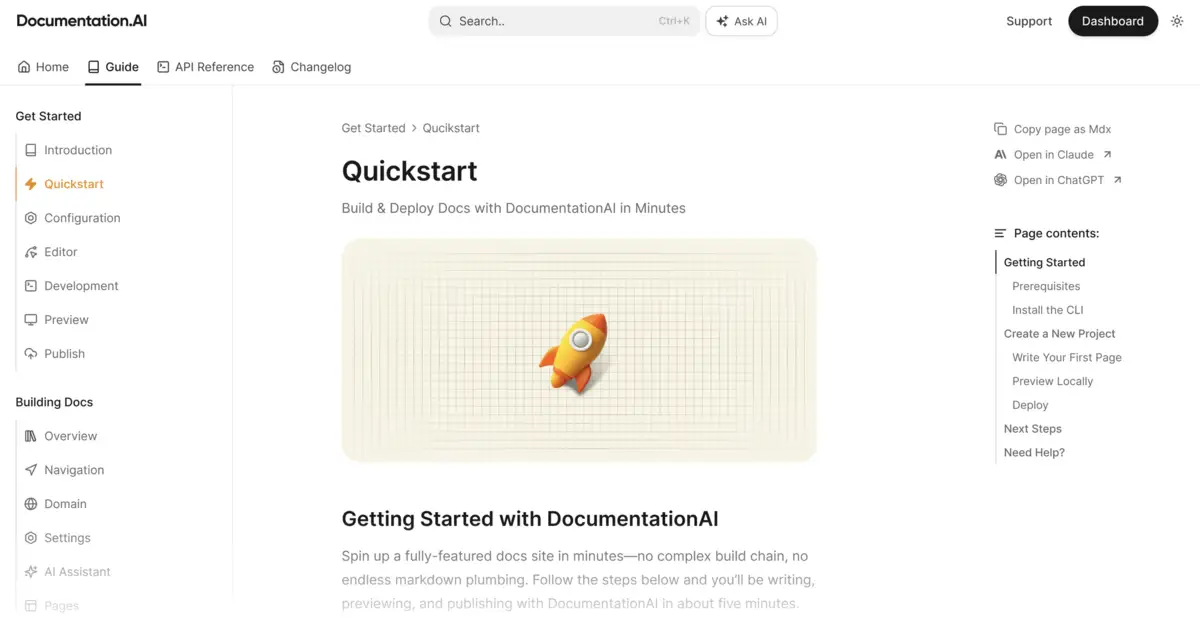
Documentation.AI builds beautiful, structured documentation and knowledge bases designed for both humans and AI agents. Its AI Documentation Agent automatically suggests updates, rewrites unclear sections, and keeps your docs in sync with product changes, reducing support tickets and accelerating user onboarding.
Tutorial:
- Go to the Documentation.AI website and sign up for free
- Create your first documentation project using the Notion-style web editor with drag-and-drop blocks
- The AI agent suggests improvements, fixes structure, and generates draft updates as you write
- Enable docs-as-code by connecting to Git and editing with Markdown/MDX in your preferred IDE
- Activate the built-in AI assistant so users can ask questions and get instant, cited answers
- Auto-generate llms.txt and MCP server integration so AI agents always access your latest docs
- Publish lightning-fast documentation that scores 100/100 on performance, accessibility, and SEO
URL: https://documentation.ai/
Better prompting...
Today: Improving Spanish Language Skills
1. VOCABULARY BUILDER
"Create a 30-day Spanish vocabulary curriculum for an intermediate learner. Structure each day around a theme (e.g., food, travel, emotions). For each of 8-10 daily words, provide: the word, IPA pronunciation, a natural example sentence, one common collocations, and a spaced-repetition quiz at days 1, 3, 7, and 14. Flag false cognates and regional variations (Latin America vs. Spain)."
2. GRAMMAR SIMPLIFIER
"Teach Spanish verb conjugations (present, preterite, imperfect, future) using the 'anchor and contrast' method: first show the English equivalent, then the Spanish pattern, then exceptions. Use only high-frequency verbs (ser, estar, tener, ir, hacer) in your examples. After each tense, give me 3 fill-in-the-blank exercises and explain why learners commonly confuse preterite with imperfect."
3. DAILY CONVERSATION DRILL
"Role-play as a friendly barista in Mexico City. Simulate a café order conversation at A2/B1 level. After each of my responses: (1) acknowledge what I said naturally, (2) gently correct any errors in brackets, (3) offer one more natural alternative phrasing, then (4) continue the scene. End with a summary of patterns I should practice."
4. LISTENING PRACTICE
"Generate two 60-80 word Spanish dialogues, one formal (job interview) and one informal (friends planning a trip). For each: write the dialogue, provide a line-by-line English translation, highlight 3 vocabulary items with definitions, and pose 4 comprehension questions (2 factual, 2 inferential). Include one idiom per dialogue and explain its usage."
5. ACCENT COACH
"I'll type a Spanish sentence using English phonetic approximations (e.g., 'Koh-moh ehs-tahs'). Identify: (1) sounds that don't exist in Spanish, (2) stress placement errors, (3) vowel sounds I'm likely mispronouncing. Give corrective drills using minimal pairs and describe tongue/mouth positioning for problem sounds."
6. IMMERSION MODE
"You are my Mexican roommate, Ana. Speak only in Spanish at a B1 level, using common colloquialisms. If I respond in English or seem stuck for 2+ turns, offer a subtle hint in parentheses. Naturally weave in cultural references. Correct me only by restating my sentence correctly within your response, never breaking character to explain."
Prompts based on https://x.com/Rixhabh__
AI & Tech News
China Prepares to Restrict Nvidia H200 Chip Access Despite US Export Approval
Beijing is preparing to limit access to Nvidia's H200 artificial intelligence chips even though President Trump has permitted their export to China, according to sources cited by the Financial Times. The move reflects China's ongoing push to achieve self-sufficiency in semiconductor production, with regulators actively discussing restrictions as part of the country's broader strategy to reduce dependence on foreign chip technology.
ASML Linked to Chinese Military Supplier Customer, Dutch Media Reports
Dutch television program Nieuwsuur reported Tuesday that ASML, the leading semiconductor equipment manufacturer, has sold parts to at least one company with ties to the Chinese military, citing Chinese import and export data. ASML has stated it cannot confirm the report, which raises questions about the flow of critical chip technology amid ongoing Western efforts to restrict China's access to advanced semiconductor equipment.
Two Men Detained for Alleged $160M Nvidia Chip Smuggling Scheme to China
The U.S. Department of Justice has detained two individuals accused of attempting to smuggle more than $160 million worth of Nvidia H100 and H200 chips to China in violation of export control laws, while a third man has pleaded guilty in connection with the case. The enforcement action targets the illegal transfer of advanced artificial intelligence hardware that is restricted from export to China under U.S. regulations designed to limit foreign access to cutting-edge semiconductor technology.
New Frontier AI Model Could Mark Shift to Proprietary Approach
Meta is developing a new artificial intelligence model codenamed "Avocado" that would serve as the successor to its Llama family of AI models, with a planned release in the first quarter of 2026, according to sources cited by CNBC. The frontier AI model could potentially be proprietary rather than open-source, representing a significant strategic shift for the company that has built its AI reputation on openly available models under CEO Mark Zuckerberg's leadership.
Anthropic and Accenture Form Major Three-Year AI Partnership
Anthropic and Accenture have announced a three-year partnership agreement to jointly sell AI services to business clients, with the consulting firm becoming one of Anthropic's top three enterprise customers. The two companies say the collaboration aims to help businesses achieve a positive return on their artificial intelligence investments by combining Anthropic's AI model technology with Accenture's consulting expertise.
OpenAI to Lift "Code Red" Status Following January 2026 Model Release
OpenAI CEO Sam Altman has indicated the company plans to conclude its internal "code red" designation after launching a new AI model in January 2026, which will feature enhanced image generation capabilities, faster performance, and improved personality traits. According to sources cited by the Wall Street Journal, Altman is shifting company priorities toward achieving widespread popularity through ChatGPT rather than focusing on ambitious long-term projects such as artificial general intelligence.
AI Development May Follow iOS-Android Rivalry Pattern, Says Tech Leader
In an opinion piece for the Financial Times, prominent AI investor and former Google China head Kai-Fu Lee suggests that the global AI landscape is evolving along similar lines to the historic smartphone operating system competition between Apple's iOS and Google's Android. Lee argues that China's approach to AI development more closely resembles Google's open and customizable Android ecosystem, with AI models functioning collaboratively—likened to "studying together to ace a test instead of relying on individual knowledge."
AI in 2025: Comprehensive Analysis Examines Model Capabilities, Safety Evaluations, and Reasoning Systems
Gavin Leech has published an extensive overview on LessWrong examining the artificial intelligence landscape in 2025, presenting balanced arguments regarding whether AI model capabilities will continue growing above historical trends while assessing the current state of safety evaluations and the security implications of reasoning models. The editorial, which serves as a companion piece to the annual "Shallow Review of AI Safety," provides a comprehensive gestalt view of where the field stands at this critical juncture in AI development.
AI Browsers Challenge Web Development Paradigm
The emergence of AI-powered browsers is creating a fundamental shift in web development, forcing developers to reconsider whether their websites should be optimized for human users or AI agents. While these new AI browsers remain far from replacing traditional browsers like Chrome, they are effectively splitting the internet into two distinct lanes and compelling the industry to rethink long-established design principles.
Square's Product Chief Discusses Block's Strategic Shifts in AI, Crypto, and Company Restructuring
In an interview with The Verge's Nilay Patel, Square product chief Willem Avé addressed Block's significant restructuring efforts in 2024, the company's approach to AI automation, and its continued investment in cryptocurrency infrastructure including the Lightning Network. The discussion provided insight into how Jack Dorsey's fintech company is positioning itself amid evolving technology trends and market conditions.
EU Opens Antitrust Probe Into Google Over AI Use of Online Content
The European Commission has launched an investigation into Google to examine whether the tech giant engaged in anticompetitive conduct in its use of online content for artificial intelligence purposes. This probe represents the EU's latest regulatory challenge to American Big Tech companies as Brussels continues to scrutinize the practices of major technology firms operating in the bloc.
Mercedes Enters Robotaxi Market with Chinese Partner in Abu Dhabi
Mercedes-Benz Group AG is making its first move into the robotaxi sector by partnering with Chinese software developer Momenta Global Ltd. to deploy Level 4 self-driving vehicles for Lumo Mobility in Abu Dhabi. The collaboration marks a significant strategic shift for the German luxury automaker as it seeks to expand beyond traditional vehicle manufacturing into autonomous mobility services in the Middle East.
Australia Set to Enforce World's First Social Media Ban for Under-16s
Australia is poised to become the first country in the world to implement a ban preventing children under 16 from subscribing to social media platforms, with the landmark legislation taking effect on December 10, 2025. The groundbreaking law has sparked widespread debate about its implications for digital rights, enforcement challenges, and the reactions of both parents and teenagers affected by the restriction.
Reddit Implements Global Teen Safety Features for Users Under 18
Reddit Inc. is rolling out new safety features worldwide for all users under the age of 18 on its online forum platform. The move comes just one day before Australia's groundbreaking social media ban for users under 16 takes effect on December 10, 2025.
🚀 AI Profiles: The Companies Defining Tomorrow

Italy's biggest research spin-off wants to build humanoids that skip the demo reel and clock into the night shift. Two decades of IIT robotics research, including a jet-powered flying humanoid, now chase factory floors instead of academic citations.
🔹 Founders
Daniele Pucci (CEO) leads five co-founders out of Genoa's Italian Institute of Technology. Founded July 2024. Around 70 engineers transferred from IIT, bringing 600+ combined years of robotics experience. Telecoms entrepreneur Davide Rota chairs. Investor Jeffrey Libshutz handles commercial strategy.
🔹 Product
No robot ships yet. The company sells a roadmap. "Physical AI" humanoids with dense tactile skin, force sensors across joints and hands, and control software battle-tested on iRonCub, a humanoid that literally flies. Target tasks: pallet stacking, machine tending, warehouse grunt work, hospital assistance. First full reveal at CES January 2026.
🔹 Competition
Crowded field. Figure just raised $1B+ at a $39B valuation. Agility's Digit runs Amazon pilots. Neura Robotics locked a €300M Schaeffler deal. China's Agibot already shipped 5,000 units. Generative Bionics differentiates with deep academic pedigree, European supply chain appeal, and focus on high-intensity industrial tasks rather than viral demos.
🔹 Financing
€70M equity round closed December 2025. CDP Venture Capital leads. AMD Ventures, Eni Next, Duferco, and Tether join. Yes, that Tether. The stablecoin giant now backs humanoids alongside brain-computer interfaces and GPU farms. Valuation undisclosed. Small by sector standards, but enough runway to build a factory and survive long validation cycles.
🔹 Future ⭐⭐⭐
Promising heritage, real money, genuine technical depth. But the company trails leaders who already test robots with paying customers. European positioning helps. Execution determines everything. If tactile skins and Italian craftsmanship beat Chinese price wars and American hype, Generative Bionics earns its shot.


