Implicator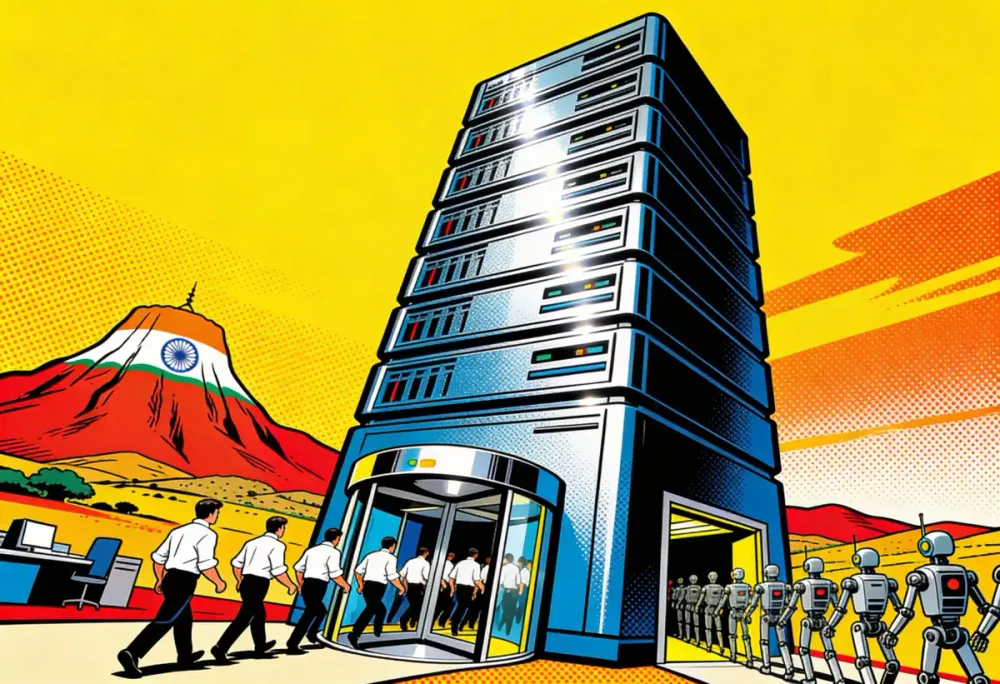
India expects to attract more than $200 billion in AI-driven investment over the next two years, Technology Minister Ashwini Vaishnaw said Tuesday at the India AI Impact Summit in New Delhi. The scale is new for India. The projection reflects a pile-up of commitments from foreign and domestic players: Adani Enterprises' $100 billion pledge for renewable-powered AI data centers by 2035, Blackstone's $1.2 billion deal backing Indian GPU cloud startup Neysa, coordinated capital pushes from at least six major global venture firms. Sam Altman, Sundar Pichai, Dario Amodei all flew to New Delhi for the four-day summit. Indian IT stocks, meanwhile, hit their worst stretch since April. The technology being celebrated could hollow out the outsourcing industry that pays their workers.
The tension running through the week is hard to miss. Billions are pouring into AI infrastructure, compute capacity, and Indian startups. At the same moment, the technology receiving all that money threatens the IT services sector that built India's modern middle class. For three decades, India constructed the world's back office. Now it is funding the technology designed to empty it. Vinod Khosla, speaking at the summit, told Hindustan Times that IT services and business process outsourcing could "almost completely disappear" within five years. He was not the only one saying it. HCL CEO Vineet Nayyar told attendees that Indian IT companies "will focus on turning profits and not being job creators."
Key Takeaways
- India targets $200 billion in AI investment over two years, led by Adani's $100 billion pledge and Blackstone's $1.2 billion Neysa deal.
- Anthropic opened its first India office in Bengaluru and partnered with Infosys to build AI agents for regulated industries.
- Six major venture firms plan $300-500 million each in AI startup commitments, potentially tripling India's 2025 funding levels.
- Indian IT stocks hit their worst stretch since April as summit speakers warned outsourcing jobs could vanish within five years.
Stacking commitments
Adani's pledge covers construction of renewable-powered AI data centers, scaling the conglomerate's existing two-gigawatt capacity to five gigawatts. The company projected the investment would trigger an additional $150 billion across server manufacturing and sovereign cloud platforms, creating what it described as a $250 billion AI infrastructure build-out over the next decade. "For decades, we imported technology," Chairman Gautam Adani posted on X. "Now we are building the backbone."
Adani's $100 billion number comes with a 2035 deadline, though. Nine years of construction. The more immediate money is arriving through private equity and venture capital.
Blackstone led a $600 million equity investment in Neysa, a three-year-old AI cloud company founded in 2023 that plans to raise another $600 million in debt and deploy over 20,000 GPUs domestically. Teachers' Venture Growth, TVS Capital, 360 ONE Assets, and Nexus Venture Partners also participated. It is the largest AI funding round in Indian history.
Venture capital commitments, while smaller per firm, may matter more for the startup pipeline. Khosla Ventures, General Catalyst, Lightspeed, Peak XV Partners, Accel India, Andreessen Horowitz, and Prosus are all expected to commit $300 million to $500 million each. "Even if five to six VC firms commit to this amount, the dry powder targeted for AI startups would run up to over $1 billion," a Bengaluru-based investor told the Economic Times. "That is more than what startups raised last year."
India's AI startups raised around $643 million across 100 deals in 2025, per Tracxn data. US AI startups raised $121 billion in the same period. That ratio has hung over every India AI conversation for the past year, and the summit is an attempt to compress it.
Hyperscaler investment is already in execution. Google pledged $15 billion for data centers in southeastern India last October. Microsoft committed $17.5 billion in December, its largest investment in Asia. Amazon pledged $35 billion across its India operations over five years the same day. Vaishnaw put data center plans already underway at roughly $70 billion, counting projects across at least four states.
Jensen Huang pulled out at the last moment. No explanation. Vaishnaw called the absence "unavoidable," adding that Nvidia was still working with Indian firms on large AI infrastructure investments.
Anthropic plants a flag
Anthropic opened its first India office in Bengaluru this week, its second in Asia after Tokyo. India is the second-largest market for Claude.ai, and nearly half of Claude usage in the country involves coding and mathematical work, not casual chatbot conversation. OpenAI's Altman put his own numbers on the table: India now accounts for more than 100 million weekly active ChatGPT users, second only to the United States.
The bigger commercial move is Anthropic's partnership with Infosys. The two companies will combine Claude models, including Claude Code, with Infosys's Topaz AI platform to build custom agents for regulated industries. Work starts in telecommunications and expands into financial services, manufacturing, and software development.
"There's a big gap between an AI model that works in a demo and one that works in a regulated industry," Amodei said. "Infosys has exactly that kind of expertise across important industries."
Infosys shares gained 4.8% on Tuesday after the announcement, a relief rally after the stock had dropped 17% this month on broader fears about AI eating into IT services revenue. Anthropic also announced that Air India is using Claude Code to ship custom software faster, that fintech firm CRED achieved 2x faster feature delivery with the tool, and that Cognizant is deploying Claude across 350,000 employees globally. Emergent, a vibe coding platform built entirely on Claude, hit $25 million in annual recurring revenue and two million users in under five months.
Indian government agencies are moving too. The Ministry of Statistics launched the country's first official government MCP server, letting AI systems query national statistics directly. Food delivery company Swiggy built its own MCP integration so customers can order groceries through Claude. Anthropic now has paying customers, government partners, and a physical office in the city where much of India's outsourcing workforce goes to work each morning.
Stay ahead of the curve
Strategic AI news from San Francisco. No hype, no "AI will change everything" throat clearing. Just what moved, who won, and why it matters. Daily at 6am PST.
No spam. Unsubscribe anytime.
The outsourcing problem nobody wants to dwell on
Every announcement at the summit carries a second, less comfortable read. If AI agents can handle compliance reviews, code testing, and customer inquiries at scale, the value proposition of India's $250 billion back office starts to weaken.
Khosla was blunt about the timeline. He said 250 million young Indians should be selling AI-based products and services to the world instead of staffing call centers and BPO operations that he believes will be automated away within half a decade. The Nifty IT Index had its worst week since April. Infosys and Tata Consultancy Services, which together employ millions, have fallen out of favor with anxious investors who see traditional outsourcing contracts shrinking as agents handle more of the work.
V. Anantha Nageswaran, India's chief economic adviser, acknowledged the discomfort at the summit. He called AI a "stress test of our state capacity" and didn't try to soften it. "Every year of delay compounds the pressure," he said. "Every year of drift narrows our options."
Twelve million Indians enter the workforce every year. Absorbing them requires 8% to 8.5% GDP growth. India last hit that pace in 2016. If AI absorbs tasks currently handled by IT workers and BPO staff, you can see where the math starts to break.
India's smaller-model strategy
India's government knows it cannot match American AI spending dollar for dollar. Four US companies alone, Meta, Amazon, Alphabet, and Microsoft, are expected to spend up to $670 billion on AI infrastructure this year. India's state-backed AI fund, approved last week, is $1.1 billion over five years.
So the approach looks different. The government is subsidizing compute access for startups and research groups at under a dollar an hour through a pool of GPUs assembled with the help of private firms. The bet is that smaller, cheaper models trained on local data and local languages can solve problems that frontier models are not built for.
Adalat AI is the showcase example. Utkarsh Saxena, a former practicing lawyer, built a set of AI tools trained on Indian case law and fluent in multiple Indian languages. The system records witness depositions and produces hearing records in thousands of courts, work that typically falls to overworked lower-court judges because there are not enough stenographers. India has 50 million pending cases. Saxena built Adalat AI using government-subsidized compute and Microsoft grants for supercomputing access, all housed domestically.
"You don't need large models," said Arghya Bhattacharya, Adalat AI's chief technology officer. "You need models that are smaller and customized for every setting."
Anthropic partnered with Adalat AI this week to launch a national WhatsApp helpline. Indian litigants can pull up case updates and document summaries in their native languages through Claude. Fifty million pending cases. One WhatsApp number.
What Modi wants from all of this
Modi has had a rough stretch. The summit gave him a stage to rewrite the narrative. Six months ago he was absorbing Trump's tariffs and managing a military standoff with Pakistan. His economy faced pointed questions. That picture has shifted. Trump cut tariffs on Indian goods to 18% earlier this month, lower than most of the country's Asian peers. After nineteen years of stalled talks, the EU signed a free trade pact with India last month. Modi swept state elections so convincingly that his weaker 2024 national result barely registers now.
AI gives him another opening. He wants India to speak for the developing world on AI governance, and the summit gave him a room full of CEOs to say it to. S. Krishnan, a senior official in India's electronics ministry, wrote in the Indian Express that Indian firms are building AI tools, from health diagnostics to crop advisory systems to digital tutors, that draw interest from countries across Southeast Asia, Africa, and the Middle East. "Through this summit, Modi is looking to focus on the Global South," said Nidhi Singh, a senior research analyst at Carnegie India.
None of these numbers mean anything without execution. Adani's deadline is 2035. That is nine years away. Venture commitments need deal flow. Data centers need power, water, land, and workers willing to staff them. And then there is the question nobody at the summit seemed eager to sit with for very long: what happens to the tens of millions of IT workers and BPO employees when the agents arrive?
New Delhi has hosted plenty of summits where large numbers got announced and then quietly slipped. The difference this time is that construction is underway. Neysa is deploying 20,000 GPUs. Infosys is building agents to handle compliance work. The workers inside Bengaluru's glass-paneled office parks, the back offices where India's middle class was built, are about to find out what the other side of automation feels like.
Frequently Asked Questions
Where is the $200 billion in AI investment coming from?
The projection combines Adani's $100 billion data center pledge through 2035, Blackstone's $1.2 billion investment in GPU cloud startup Neysa, hyperscaler commitments from Google ($15B), Microsoft ($17.5B), and Amazon ($35B), plus $300-500 million each from at least six major venture firms. Minister Vaishnaw put data center plans already underway at roughly $70 billion.
What is Anthropic doing in India?
Anthropic opened its first India office in Bengaluru and partnered with Infosys to build AI agents for regulated industries starting with telecom. Air India uses Claude Code for software development, CRED achieved 2x faster feature delivery, and Anthropic launched a WhatsApp legal helpline with Adalat AI for India's 50 million pending court cases.
Why are Indian IT stocks falling despite the investment announcements?
Investors worry that AI agents could replace compliance reviews, code testing, and customer service handled by India's $250 billion outsourcing sector. The Nifty IT Index had its worst week since April. Vinod Khosla told attendees that BPO operations could 'almost completely disappear' within five years.
What is India's strategy for competing with US AI spending?
India's $1.1 billion state AI fund cannot match the $670 billion US tech companies plan to spend. Instead, the government subsidizes GPU compute at under a dollar per hour and bets that smaller models trained on local data and languages can solve problems frontier models miss. Adalat AI, handling court records in multiple Indian languages, is the showcase.
How many workers could be displaced by AI in India?
Twelve million Indians enter the workforce annually, requiring 8-8.5% GDP growth to absorb them. Infosys and TCS together employ millions in outsourcing roles. Khosla suggested 250 million young Indians should pivot from BPO staffing to selling AI products, but no concrete transition plan exists yet.

Harkaram Grewal
Maps the India–Germany–U.S. AI triangle from New Delhi. Background in cross-market operations and business development. Writes about supply chains, enterprise adoption, and talent—the unsexy forces that actually move global AI.