OpenAI's CFO floated a federal backstop for AI infrastructure, then reversed within hours after White House rejection. The whiplash exposed the core problem: OpenAI needs $1.4 trillion while generating $20 billion. The math doesn't work.
Microsoft declares it's building "humanist superintelligence" to keep AI safe. Reality check: They're 2 years behind OpenAI, whose models they'll use until 2032. The safety pitch? Product differentiation for enterprise clients who fear runaway AI.
Three Stanford professors just raised $50M to prove OpenAI and Anthropic generate text wrong. Their diffusion models claim 10x speed by processing tokens in parallel, not sequentially. Microsoft and Nvidia are betting they're right.
Journalists to Big Tech: We're Not Your PR Team Anymore
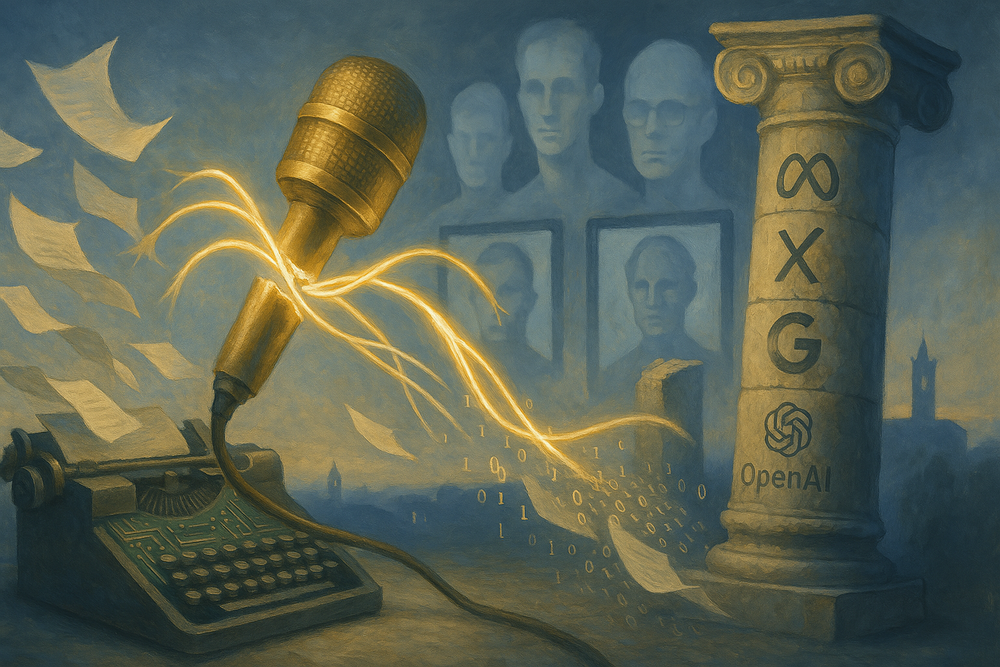
The love affair between journalism and Big Tech has hit the rocks. At this year's International Journalism Festival in Perugia, where tech giants once basked in media admiration, the mood turned hostile.
British journalist Carole Cadwalladr didn't mince words: "We must treat these platforms as enemies." The Cambridge Analytica whistleblower knows what she's talking about - she's seen enough tech nightmares to fill a Black Mirror season.
The battle isn't just about headlines anymore. In the U.S., Trump allies feed government data to Elon Musk's AI systems with abandon. It's like watching someone hand over the keys to Fort Knox while livestreaming it.
Most newsrooms still treat tech policy like quantum physics - too complex to bother with. Only tech journalists grasp the full scope of this digital coup attempt. Traditional media relegated these stories to the "geek beat" for years. Now they're scrambling to catch up.
Why this matters:
The watchdogs finally realized they've been guarding the wrong house - while Big Tech walked away with the crown jewels
Newsrooms discovering that their "nerd stuff" actually matters is like finding out the IT guy was right all along - just several billion dollars too late

Tech journalist. Lives in Marin County, north of San Francisco. Got his start writing for his high school newspaper. When not covering tech trends, he's swimming laps, gaming on PS4, or vibe coding through the night.
Microsoft declares it's building "humanist superintelligence" to keep AI safe. Reality check: They're 2 years behind OpenAI, whose models they'll use until 2032. The safety pitch? Product differentiation for enterprise clients who fear runaway AI.
Apple will pay Google $1B yearly to power Siri with a 1.2 trillion parameter AI model—8x more complex than Apple's current tech. The company that owns every layer now rents the most critical one. The spring 2026 target masks a deeper dependency trap.
Sam Altman predicts AI CEOs within years while betting billions on human-centric infrastructure. His Tyler Cowen interview reveals three tensions: monetizing without breaking trust, energy bottlenecks limiting AI, and models that persuade without intent.
Palantir beat earnings but fell 8% at 250x forward P/E, triggering global risk reset. Banking chiefs gave cover for year-end de-risking while AI capex outpaces revenue visibility. When leaders wobble, concentration risk becomes system risk.