
Nine months ago, Legora was a Swedish startup with $35 million in the bank and a name nobody outside Stockholm could pronounce. It was still called Leya then. In February 2025, the company changed its name, opened a small office in New York, and started chasing American law firms.
By May, ICONIQ and General Catalyst had led an $80 million round at a $675 million valuation. By October, Bessemer pushed the price to $1.8 billion. Now, in mid-February 2026, Legora is in talks to raise $400 million at a valuation exceeding $5 billion, with Accel participating, according to Forbes. Bloomberg has reported the figure could reach $6 billion. If the round closes, Legora will have gone from $675 million to north of $5 billion in nine months. No European startup has ever repriced that fast.
ARR: roughly $23 million. Legora expects to reach $40 million this year. At a $6 billion price tag, investors would be paying 260 times current revenue, or 150 times the target, according to an analysis by Best Practice AI. For context, the most richly valued public software companies rarely trade above 30 times revenue.
That gap between P&L and price is not a mystery or a mistake. It is a bet, denominated in hundreds of millions of dollars, that a $30 billion legal information industry will fracture and that Legora will be one of the companies holding the pieces. Whether that bet is rational depends on a set of questions that no valuation model, however generous, can fully answer yet.
The Breakdown
- Legora in talks to raise $400M at a $5B+ valuation on just $23M in annual recurring revenue, a 260x multiple
- Only $1M of that revenue comes from U.S. clients; nearly everything else is European
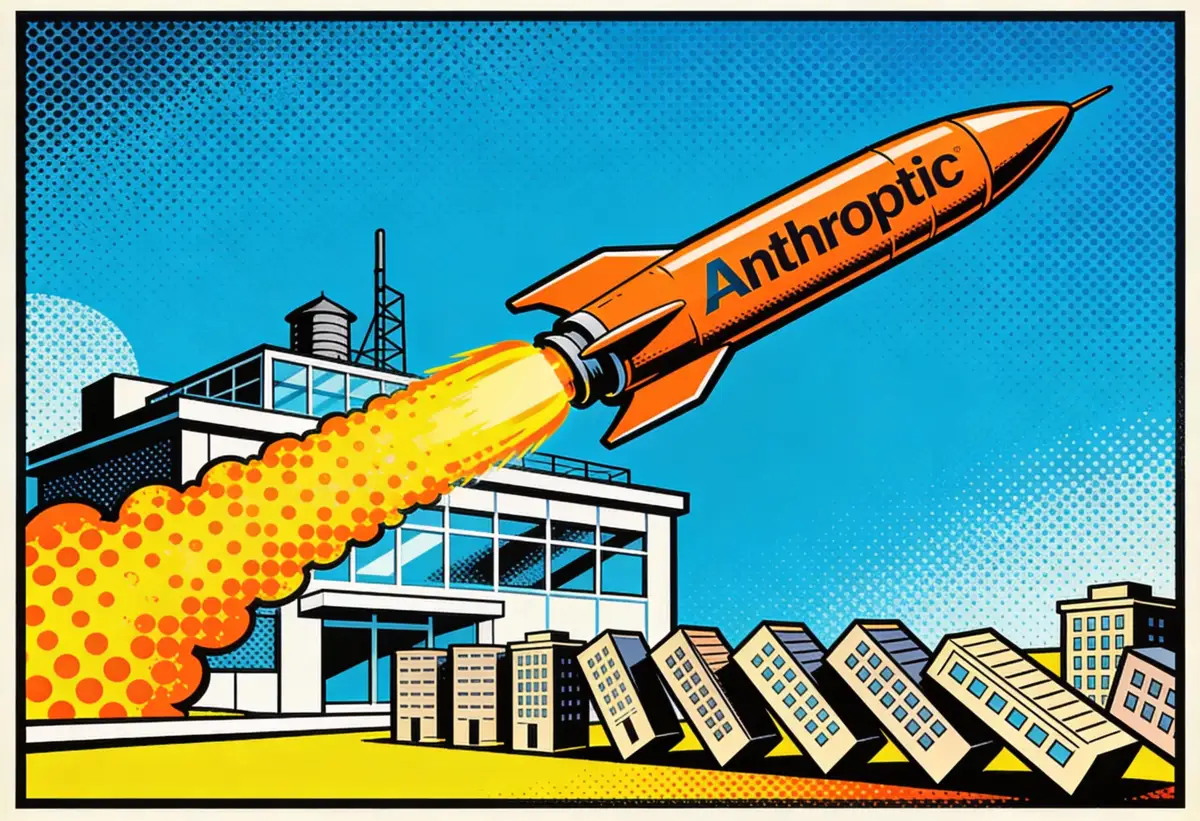
- Anthropic, Legora's own model supplier, launched competing legal AI tools on February 3, wiping $300B from software stocks
- Robin AI's collapse and 21% law firm AI adoption rates raise questions about the sector's speed
Three founders, one accelerator, and $600 million
Max Junestrand was a competitive World of Warcraft player before he was a CEO. He dropped out of college in Sweden at 23, worked briefly at McKinsey, then watched friends at law firms spend their nights copying text between documents. The waste struck him as industrial in scale and personal in cost.
Stay ahead of the curve
Strategic AI news from San Francisco. No hype, no "AI will change everything" throat clearing. Just what moved, who won, and why it matters. Daily at 6am PST.
No spam. Unsubscribe anytime.
In 2023, Junestrand, along with co-founders August Erseus and Sigge Labor, built the first version of the platform in Stockholm. They called it Leya. The trio spent nine months in a dedicated conference room at Mannheimer Swartling, Sweden's largest law firm, using it as a product laboratory while Junestrand interviewed more than 100 legal professionals to identify pain points. The difference, Junestrand has said, was that Leya tried to integrate directly into how lawyers already worked, embedding itself into Microsoft Word and document management systems rather than asking attorneys to switch to a new interface. Erseus, the CPO, departed the company in November 2024. Labor, the CTO, remains.
Y Combinator's Winter 2024 batch provided the first real visibility outside Scandinavia. A $25 million Series A followed, led by Redpoint Ventures, with Benchmark, Y Combinator, and Jack Altman's Alt Capital participating. That was enough to get Legora (as it became in February 2025) into conversations with larger firms.
Then the money started moving faster than the product could. "I don't think it's a secret that things have been really working," Junestrand told Business Insider in late 2025, noting that the company was not actively seeking its Series B when offers arrived. The $80 million at $675 million in May. The $150 million at $1.8 billion in October. Now the $400 million round that would bring total capital raised in the past six months alone to $600 million.
Junestrand, now 26, was named to the 2026 Forbes 30 Under 30 AI list. "We're not here to be some European No. 2," he told Business Insider last spring. He runs a company that has grown from 40 employees to 250 in a year, with offices in Stockholm, London, New York, Denver, Sydney, and Bengaluru. More than 600 law firms across 50 markets use the platform. Linklaters, a Magic Circle firm, rolled out Legora across 30 offices. White & Case, an Am Law 10 firm, deployed it across 2,500 seats in 43 offices last December. Cleary Gottlieb, Goodwin, Dentons, Bird & Bird, and Deloitte are all on the client roster.
Impressive on paper. Revenue concentration is not publicly known. But one number from a Forbes report last September stands out: only $1 million of Legora's $23 million in ARR came from U.S.-based customers. Nearly everything else is European.
Built on someone else's models
Legora's platform is a collaborative AI workspace for lawyers. Three things happen inside it. A lawyer types a question and selects the jurisdictions. Legora goes hunting through case law and databases, then hands back something that reads like a research memo, citations included. Got 300 contracts from a due diligence deal? Upload the lot. The system rips through them, surfaces the clauses worth reading, and flags anything that smells wrong. A pile of 200 documents that would have buried a junior associate for two weeks? Done in an afternoon. On the drafting side, lawyers build contracts off templates, editing individual clauses while a colleague works the same document.
Word integration is the sharpest differentiator in practical terms. Lawyers live in Word. If you have ever tried to get a senior partner to open a new browser tab, you understand why this matters. Many legal AI tools require users to work inside a separate interface, exporting and importing files. Legora embeds itself as a sidebar, which means attorneys can query the AI, review its suggestions, and accept edits without leaving the document they are already working in.
There is a harder question underneath the product pitch: accuracy. A preregistered Stanford University study tested the AI research tools sold by LexisNexis and Thomson Reuters and found hallucination rates of 17% and 34%, respectively. Those are tools built by incumbents with decades of legal data. Legora has not published comparable accuracy benchmarks. Every legal AI company, including Legora, runs on third-party large language models. Legora is a confirmed Anthropic customer. "Claude gives us the flexibility to build more diverse solutions faster," Junestrand has said. The company's own customer page on Anthropic's website states that "Legora uses Claude throughout their platform to power assistant tools, document review, and intelligent workflows." Legora does not train its own foundation models. It builds proprietary workflows, prompt architectures, and retrieval systems on top of models created by others.
This dependency would be unremarkable if the model providers stayed in their lane. They did not.
The supplier becomes the competitor
On February 3, 2026, Anthropic launched a set of industry-specific plugins for its Claude Cowork product. One of them was a legal tool that automated contract reviewing, compliance workflows, and legal briefings. The reaction was immediate: Thomson Reuters stock dropped 16% in a single day. RELX, the parent company of LexisNexis, fell 15%. A Goldman Sachs basket of U.S. software stocks sank 6%, its largest one-day decline since the April 2025 tariff selloff. In total, roughly $300 billion in market value evaporated from software and data companies.
"We are now in an environment where the sector isn't just guilty until proven innocent but is now being sentenced before trial," J.P. Morgan analyst Toby Ogg wrote in a note to clients.
Incumbents bore the brunt. But the selloff carried a warning for startups too. Morgan Stanley analysts flagged "intensifying competition" in the legal AI space and called Anthropic's move "a potential negative" for the sector. Straightforward logic: Anthropic builds the models that Legora depends on, and Legora is listed as a customer on Anthropic's own website. Now Anthropic was selling legal tools directly to law firms. Legora's intermediary layer was getting squeezed from both sides by its own supplier.
Neither RELX nor Thomson Reuters is sitting still, either. Thomson Reuters launched CoCounsel Legal last August, combining research, drafting, and document analysis into a single agentic AI product. CoCounsel claims 20,000 law firms and corporate legal departments as users. Most of the Am Law 100 are on the platform. The revenue line backs it up: Thomson Reuters grew its Legal Professionals segment 9% organically last quarter. LexisNexis rolled out Protege, its own agentic assistant, with the ability to toggle between multiple AI models inside a secure environment. Both companies sit on decades of curated case law, citation databases, and editorial content that no startup can replicate from scratch. If you are an investor in Legora, these are not sleepy incumbents waiting to be disrupted. They are nervous, well-funded, and moving fast.
Harvey, the San Francisco-based legal AI startup, faces the same structural pressure. Harvey was valued at $5 billion last June, hit $8 billion by December, and was reportedly raising $200 million at $11 billion this month. Harvey has raised more, is valued higher, and has a deeper footprint in U.S. BigLaw. Harvey and Legora share the same structural vulnerability: everything they sell runs on someone else's models.
The question is whether everything Legora wraps around Claude, the workflow glue, the compliance guardrails, the firm-by-firm customization, holds up when Anthropic or OpenAI ships 80% of it for a fraction of the price. Nobody has answered that yet. At $5 billion, somebody will have to.
What 260 times revenue buys you
Venture capital pricing is not public market pricing. Everyone in the industry repeats this. And it is true: early-stage investors are buying optionality, not earnings. They are pricing a future in which Legora captures a meaningful share of a market that Goldman Sachs estimates at hundreds of billions in addressable legal work.
But 260 times revenue is still 260 times revenue.
For comparison: when Thomson Reuters acquired Casetext in 2023 for $650 million, Casetext had more than 10,000 law firm and corporate legal department customers and a mature product in CoCounsel, its GPT-4-powered assistant. Legora has roughly 600 clients and $23 million in ARR. Its valuation is already eight times what Thomson Reuters paid for a far more established business.
Bulls have a straightforward pitch. More than $5 billion flowed into legal AI startups in 2025, per PitchBook. Goldman Sachs has estimated that 44% of legal work could be automated. RELX's stock has fallen roughly 45% over the past 12 months, Thomson Reuters 30% in 2026 alone. Resistance to technology is weakening as younger partners take over corner offices and clients demand efficiency. A startup that grows from $23 million to $100 million in ARR within two years would make a $5 billion valuation look prescient.
Bears have the harder argument, and they are not wrong to press it. Start with revenue concentration by geography. Nearly all of Legora's money comes from European firms. Only $1 million in U.S. ARR as of last September. American BigLaw, the towers on Sixth Avenue and in Century City where the highest-margin work lives, is where Harvey has been selling for longer, where Thomson Reuters and LexisNexis have decades of entrenched relationships, and where law firms are most cautious about switching costs.
Then there is the billable hour problem. Law firms bill clients by the hour. An AI tool that halves the time required for document review does not automatically double the firm's revenue. It halves it. The economic incentives for law firm partners to adopt efficiency tools are, at best, mixed. A 2025 AffiniPay survey of 2,800 legal professionals found that only 21% of law firms had adopted AI at the firm level, down from 24% the prior year. Sixty percent said they were unsure when they would implement it. A separate LexisNexis report found that just 17% of lawyers said AI was fully embedded in their firm's strategy. None of this moves fast.
Not every legal AI startup survives long enough to find out. Robin AI, a London-based competitor backed by Revolut founder Nik Storonsky and claiming clients including UBS, GE, and Pfizer, collapsed in late 2025 after failing to close a $50 million funding round. The company, which had made the Sunday Times 100 Tech list at number 10 in January 2025, was listed on an insolvency marketplace by October. Sources told Legal IT Insider its growth was "not AI level growth." It lost roughly 100 employees. Legora's backers would say the comparison is unfair. But the wreckage is a reminder that customer logos and press coverage are not revenue.
Finally, the model dependency. Legora's product is only as good as the underlying AI. If Anthropic or OpenAI ships a legal-specific agent that matches 80% of Legora's functionality, law firms will ask why they are paying a premium for a middleware layer. The "last mile" of legal-specific customization is real. Real, but thin. Maybe the thinnest moat in enterprise software right now.
What Legora reveals about the AI funding cycle
Forget Legora for a moment. The funding pattern underneath it tells you something about how venture capital behaves when an entire industry looks like it might crack open.
Two years ago, legal AI was a backwater. A few startups raised modest rounds. Thomson Reuters spent $650 million on Casetext and everyone called it aggressive. By 2025, more than $6 billion poured into the sector, according to Artificial Lawyer. Harvey reached an $8 billion valuation on $190 million in ARR, roughly a 42x revenue multiple. Legora went from $35 million raised to $600 million in six months on a fraction of the revenue. The combined private valuations of the top two legal AI startups now exceed $16 billion.
Meanwhile, the combined market capitalization lost by RELX and Thomson Reuters since the AI selloff began exceeds $40 billion. Investors are simultaneously writing down the incumbents and writing up the challengers. That math implies a belief that value will transfer cleanly from old to new. History suggests it rarely does.
Where does that $40 billion in destroyed incumbent value actually go? Startups will capture a share. Model providers will take another. A portion will simply evaporate as legal work gets done faster, by fewer people, for lower fees. Legora and Harvey are betting they sit on the right side of all three redistributions. Optimistic, possibly correct, but not yet supported by revenue.
Early cloud computing offers a parallel. Salesforce, Workday, and ServiceNow all traded at extreme revenue multiples before their revenue caught up to their valuations. Several of those bets paid off spectacularly. Others, in adjacent categories, did not. Survivors were the ones that built products sticky enough to hold when the underlying infrastructure commoditized.
The test
Legora's next 18 months come down to one thing: American money. That $1 million in U.S. ARR has to become something much bigger, fast, or the valuation collapses under its own weight. American law firms represent the majority of global legal spending, and a company priced at $5 billion cannot stay a European story.
Differentiation is the second pressure point. Anthropic's Cowork launch was a warning shot. OpenAI's trajectory points in the same direction. If the foundation layer offers 80% of the value at 20% of the cost, workflow companies need their remaining 20% to be indispensable, not just nice to have.
Then there is the cash question. At some point, Legora will need to either go public or generate enough profit to justify its private valuation without relying on the next funding round. A company burning through $600 million at $23 million in annual revenue has a narrow margin for error.
For decades, the legal profession resisted technology. Then it became the sector where AI disruption seemed most imminent, practically overnight. Legora is riding that shift with more capital, more momentum, and more visibility than almost any European startup in recent memory. Whether any of that matters depends on what happens when the capital runs out and the revenue has to speak for itself. By mid-2026, we will know whether $5 billion was a price or a prophecy.
Frequently Asked Questions
What does a 260x revenue multiple mean for Legora?
At a reported $6 billion valuation on $23 million in ARR, investors are paying 260 times current revenue. The most richly valued public software companies rarely trade above 30x. Legora's backers are pricing in a future where the company captures a large share of a $30 billion legal information market.
Why did Legora change its name from Leya?
The company rebranded in February 2025 when it opened a New York office, signaling its push beyond Scandinavia into the American legal market. The original name was associated with its Swedish roots; Legora positioned the company for a global audience.
What happened when Anthropic launched legal AI tools?
On February 3, 2026, Anthropic released industry-specific plugins for Claude Cowork, including a legal tool. Thomson Reuters stock dropped 16% in a single day, RELX fell 15%, and roughly $300 billion in market value evaporated from software and data companies.
How does Legora compare to Harvey?
Harvey is valued at roughly $11 billion with $190 million in ARR and a deeper U.S. BigLaw presence. Legora has $23 million in ARR and is stronger in Europe, with 600+ firms across 50 markets. Both depend on third-party AI models and face the same supplier-competitor risk.
What happened to Robin AI?
Robin AI, a London-based legal AI competitor backed by Revolut founder Nik Storonsky, collapsed in late 2025 after failing to close a $50 million funding round. The company lost roughly 100 employees and was listed on an insolvency marketplace. Sources said its growth was 'not AI level growth.'