Implicator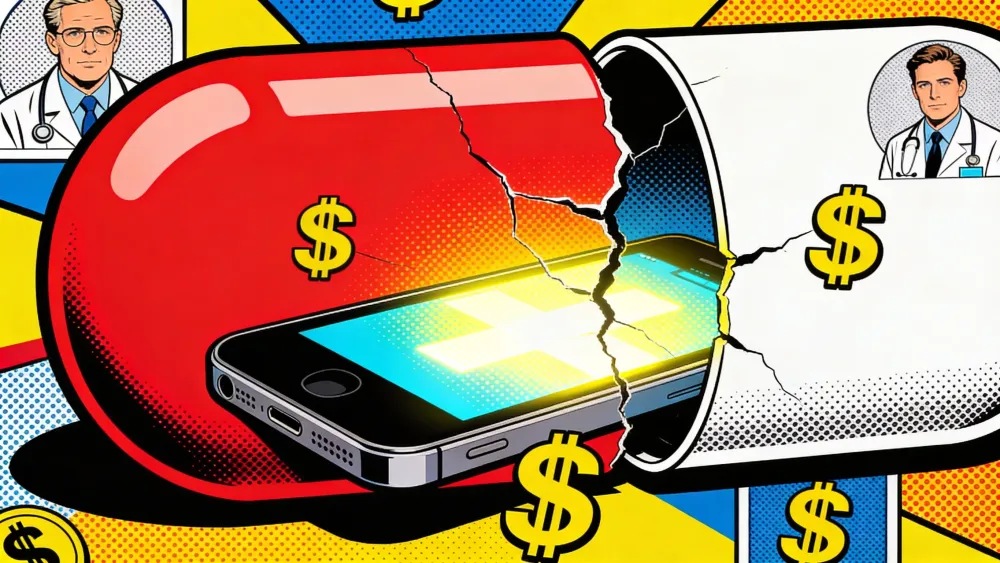
The FDA sent telehealth startup Medvi a formal warning letter on February 20 for false and misleading claims about its compounded GLP-1 drugs, according to the agency's published enforcement records. Six weeks later, the New York Times profiled the company as proof that Sam Altman's prediction had come true: AI could build a billion-dollar business with two employees, $20,000, and a house in Los Angeles. The profile did not mention the warning letter. Or the class-action lawsuit filed months earlier. Or a Futurism investigation that had documented deepfake patient photos and fabricated doctor personas on Medvi's own website.
Key Takeaways
- Medvi received an FDA warning letter for false GLP-1 drug claims six weeks before the New York Times profiled it
- Futurism documented deepfake patient photos, fabricated doctor personas, and fake media logos in May 2025
- More than 800 fake doctor accounts and 5,000 ads run on Meta under fictitious medical personas
- Medvi's clinical partner OpenLoop suffered a 1.6-million-record data breach in January 2026
AI-generated summary, reviewed by an editor. More on our AI guidelines.
What the FDA actually said
Warning letter #721455 cited two violations under the Federal Food, Drug, and Cosmetic Act. Medvi's website displayed compounded semaglutide and tirzepatide products with the Medvi name on their labels, which the FDA said falsely implied the company was the drug compounder. It is not. Medvi is a marketing operation. CareValidate and OpenLoop Health handle the doctors, pharmacies, shipping, and drug fulfillment.
The agency also flagged claims like "Same active ingredient as Wegovy and Ozempic" as misleading because they implied FDA approval that compounded products do not carry. The FDA also issued warning letters to more than 30 other telehealth companies for similar violations in March 2026, according to STAT News. Medvi had already received its own individual letter weeks earlier. It named the company directly.
Futurism had the story a year ago
None of this was new. In May 2025, Futurism reporter Maggie Harrison Dupré published an investigation that pulled apart Medvi's website piece by piece. The before-and-after weight-loss photos were deepfakes. Someone had pulled real transformation images from Reddit, run them through a face-swap tool, and posted the results as Medvi patient success stories. One supposed patient, "Michael P.," who claimed to have lost 48 pounds on Medvi's medications? A Reddit user. His 2017 transformation photos documented a sobriety journey that had nothing to do with weight-loss drugs. Semaglutide for weight loss didn't even exist yet.
At least one doctor whose name appeared on Medvi's site told Futurism he had no connection to the company. He asked to be taken off. Media logos from Bloomberg, the Times, and Forbes implied editorial coverage that did not exist. The company had merely advertised on those platforms. The Times acknowledged some of this in its April 2 profile, noting the site "featured photos of smiling models who looked AI-generated." But the reporting stopped there.
800 fake doctors, 5,000 ads
The marketing operation has scaled since Futurism's report. Venture capitalist Sheel Mohnot documented on X that Medvi runs more than 800 ad accounts on Facebook under fabricated doctor personas. Names like "Dr. Sarah Martin" and "Dr. Monica Ashford." None of them exist. A Drug Discovery & Development investigation published this week confirmed more than 5,000 active Medvi-related ads on Meta's platform, many running under fictitious medical titles.
Medvi's own website now carries a disclaimer: individuals in advertisements "may be actors or AI-generated portrayals." That line did not exist when Futurism published its investigation. If you see a doctor's face endorsing Medvi on Facebook right now, that face almost certainly belongs to nobody.
The stories behind the headlines, every morning
Strategic AI news from San Francisco. No hype, no "AI will change everything" throat clearing. Just what moved, who won, and why it matters. Daily at 6am PST.
No spam. Unsubscribe anytime.
The infrastructure is cracking
Medvi outsources its entire clinical operation to third-party platforms. OpenLoop Health, one of those partners, got breached in January 2026. A threat actor claimed 1.6 million patient records. Names, addresses, dates of birth, medical histories. The full file. OpenLoop itself confirmed at least 68,160 affected people in Texas. That was one state. Multiple class-action lawsuits followed.
A separate class-action lawsuit filed in November 2025 against OpenLoop and pharmacy partner Triad Rx alleges that compounded oral tirzepatide tablets sold through their network have "no viable absorption pathway." The lawsuit calls the pills "modern-day snake oil." Tirzepatide is a large peptide molecule that digestive enzymes destroy before it reaches the bloodstream. Rybelsus, the first FDA-approved oral GLP-1, required a specialized absorption enhancer called SNAC to achieve roughly 1% bioavailability.
STAT News found that among more than 70 telehealth companies the FDA warned, at least 30% shared clinical infrastructure with just four nationwide medical groups. OpenLoop was one of them.
What the $1.8 billion actually means
The Times verified Medvi's 2025 financials: $401 million in revenue, $65 million in net profit, 16.2% margins, 250,000 customers. Those numbers appear real. The $1.8 billion figure is Matthew Gallagher's own 2026 projection, not audited revenue. The company is a private Delaware LLC with no outside investors and no obligation to disclose anything.
The business rests on the compounding window staying open. The FDA has signaled it will restrict GLP-1 active pharmaceutical ingredients used in non-FDA-approved compounded products. Novo Nordisk has sued Hims & Hers over compounded versions of its drugs. Forbes reported that the DOJ has been referred enforcement cases. The first company held up as proof that AI can build a billion-dollar business turns out to be a marketing funnel for compounded weight-loss drugs, running through a partner network under federal scrutiny. The AI built the funnel. The drugs filled it. The FDA already has the address.
Frequently Asked Questions
What did the FDA warn Medvi about?
The FDA cited Medvi for displaying its name on drug labels, implying it compounds the drugs (it does not), and for claims like "Same active ingredient as Wegovy and Ozempic" that falsely implied FDA approval. The warning letter was issued February 20, 2026.
What did the Futurism investigation find?
Futurism found Medvi used deepfake before-and-after photos stolen from Reddit users, AI-generated patient images, fabricated media endorsement logos, and listed doctors who denied any affiliation with the company.
Why didn't the New York Times mention the FDA warning?
The Times verified Medvi's financial claims but did not mention the FDA warning letter, the class-action lawsuit, the Futurism investigation, or the OpenLoop data breach. All were publicly documented before the April 2 profile.
What happened with the OpenLoop Health data breach?
In January 2026, a threat actor claimed to have stolen 1.6 million patient records from OpenLoop Health, Medvi's clinical infrastructure partner. OpenLoop confirmed at least 68,160 affected individuals in Texas alone.
Is Medvi actually worth $1.8 billion?
The $1.8 billion is founder Matthew Gallagher's own 2026 revenue projection, not audited revenue or a valuation. The Times verified $401 million in 2025 sales. Medvi is a private LLC with no outside investors.
AI-generated summary, reviewed by an editor. More on our AI guidelines.


Maria Garcia
Bilingual tech journalist slicing through AI noise at implicator.ai. Decodes digital culture with a ruthless Gen Z lens—fast, sharp, relentlessly curious. Bridges Silicon Valley's marble boardrooms, hunting who tech really serves.