IMPLICATOR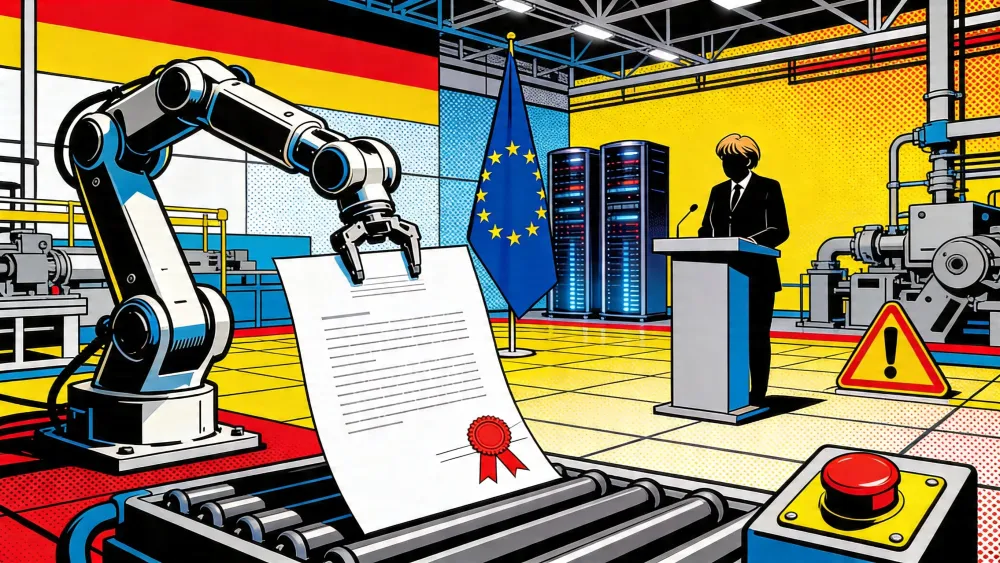
German Chancellor Friedrich Merz said industrial AI should get looser European Union rules, using a Hannover Messe speech to push for a factory-floor carve-out before the AI Act's Aug. 2 main application date. He said he would seek to ease the EU burden and, where possible, remove industrial AI from what he called a regulatory corset. Germany aims to achieve cheaper and faster production without relinquishing control of the industrial AI market to the United States and China.
Merz picked the right room for that complaint. The fair floor was filled with robot arms, maintenance dashboards, and automation rigs carrying AI labels. Regional public broadcaster NDR counted roughly 4,000 exhibitors; the fair's press material said more than 3,000. Pick either number. It is enough metal, wiring, and sales demos to drag the AI Act out of Brussels and into a plant manager's morning checklist.
Key Takeaways
- Merz wants industrial AI separated from consumer AI before the AI Act's Aug. 2 main date.
- Germany wants at least four times more AI processing capacity by 2030, starting from 530 MW.
- Hannover Messe turned the debate into factory-floor demos, not abstract software policy.
- A faster lane still needs limits on worker surveillance, safety handoffs, and autonomous control.
AI-generated summary, reviewed by an editor. More on our AI guidelines.
Brussels built one rulebook
The EU AI Act was designed around risk categories, not around Germany's machine-tool anxiety. The European Commission says the law bans eight unacceptable practices, puts strict obligations on high-risk systems, and brings transparency rules online in August. The broader timetable runs into 2027 for some high-risk obligations.
Merz's argument is narrower than a Silicon Valley deregulation speech. He is saying a chatbot that advises a teenager and a quality-control model inside a bottling line should not sit in the same political bucket. That is the hinge. Consumer AI reaches people through screens. It sells, persuades, fakes, profiles. Industrial AI hits a plant somewhere else entirely: scrap rates, downtime, energy bills, safety interlocks.
Mostly. That word matters.
The risk case is simple: factory AI can still make decisions around workers, machines, and expensive physical systems. A bad model does not merely hallucinate. It can halt a line, waste a batch, or send a technician into the wrong cabinet. Brussels knows that. Berlin knows it too. The fight is over how much paperwork belongs between a model and a plant manager with a shift starting at 6 a.m.
Germany wants compute before paperwork
Germany's own arithmetic explains Merz's impatience. Last month, the government set two 2030 goals: at least double domestic data-center capacity and boost AI data processing capacity by at least four times. The Bitkom baseline cited by Reuters was 530 megawatts at the end of last year.
That makes the target roughly 2.1 gigawatts for AI compute alone. Not a slogan. A power bill.
You can hear the cabinet math in Merz's speech. If factories need models near machines, then regulation is not an abstract Brussels file. It becomes land permits, grid connections, tax flows, local heat networks, and who owns the servers humming outside Frankfurt. Berlin is anxious because the schedule is physical.
AI policy is moving onto the factory floor
Strategic AI news from San Francisco. No hype, no "AI will change everything" throat clearing. Just what moved, who won, and why it matters. Daily at 6am PST.
No spam. Unsubscribe anytime.
That anxiety also explains the narrower German implementation plan. In February, Germany's cabinet approved an AI Act bill that would give the Federal Network Agency a central market-surveillance, notification, and contact role, according to AI-Regulation.com. The government described its goal as implementation without extra national requirements and with a lean authority. Safe, but not padded.
The demos make his case
Hannover Messe is a convenient stage because the demos are less fuzzy than the speeches. Microsoft said Krones cut fluid-simulation time for a filling-line digital twin from four hours to under five minutes. ABB is showing a real-time industrial co-pilot for factory data. TK Elevator is using agents to brief technicians before site visits.
Industrial AI is software in a hard hat, packed into old rhythms of commissioning, maintenance, inspection, downtime, parts, and energy. The gains are measured in minutes, waste, and missed service calls. Cash beats slogans.
But the same examples also weaken the pure carve-out argument. These systems touch worker judgment and physical safety. Microsoft says human approval stays in critical decisions. That line is doing work. Once an AI agent stops advising and starts acting, the rulebook has to follow it onto the shop floor.
A carve-out still needs a guardrail
Merz has the stronger economic case. Europe cannot preach industrial AI from a conference stage while making deployment feel like a customs queue. If the AI Act treats every serious factory model like a consumer-risk problem, German industry will move slower than the machines it is trying to modernize.
Brussels has the stronger failure case. The factory floor is not a sandbox. It has forklifts, hot metal, shift workers, and production schedules that punish mistakes quickly. A rushed carve-out would trade one kind of bureaucracy for another: accident reports.
The cleaner answer is separation, not exemption. Give factories a faster lane, sure. But draw the lines in thick paint: no hidden worker surveillance, no vague safety handoffs, no autonomous control without a named human on the hook. Berlin wants the door open. Brussels should keep a hand on the switch.
Frequently Asked Questions
What did Friedrich Merz say about industrial AI?
Merz said industrial AI should get more regulatory freedom in the European Union than consumer AI. At Hannover Messe, he said he would push to ease the EU burden and, where possible, remove industrial AI from what he called a tight regulatory corset.
Why does Aug. 2 matter for the EU AI Act?
Aug. 2, 2026 is the AI Act's main application date for many remaining provisions, with some high-risk obligations extending into 2027. That timing makes Merz's request urgent for companies planning factory AI deployments now.
What is Germany's AI capacity target?
Germany wants to at least double domestic data-center capacity and increase AI processing capacity by at least four times by 2030. Reuters cited Bitkom figures putting German AI data-center capacity at 530 MW at the end of last year.
Why is Hannover Messe relevant?
Hannover Messe is where the industrial AI argument becomes physical. The fair brings robot arms, automation systems, factory software, and political leaders into the same halls, making regulation a factory-floor issue rather than only a Brussels file.
Does Merz want all AI deregulated?
No. His argument is narrower. He is drawing a line between consumer AI, which touches speech, privacy, fraud, and persuasion, and industrial AI, which mostly concerns production, downtime, energy use, and safety systems.
AI-generated summary, reviewed by an editor. More on our AI guidelines.

Free AI briefing · Weekdays
The AI stories that matter, sourced and explained.
Join the Morning Briefing. It goes out every weekday at 4:45 a.m. Pacific, with later sends for the East Coast, Berlin and Tokyo.
Free when you sign up: The Paperclip Compendium, our tested guide to running AI agents.
Free. Unsubscribe in one click.

Marcus Schuler
Editor-in-Chief and founder of Implicator.ai. Former ARD correspondent and senior broadcast journalist with 10+ years covering tech. Writes daily briefings on policy and market developments. Based in San Francisco. E-mail: editor@implicator.ai