
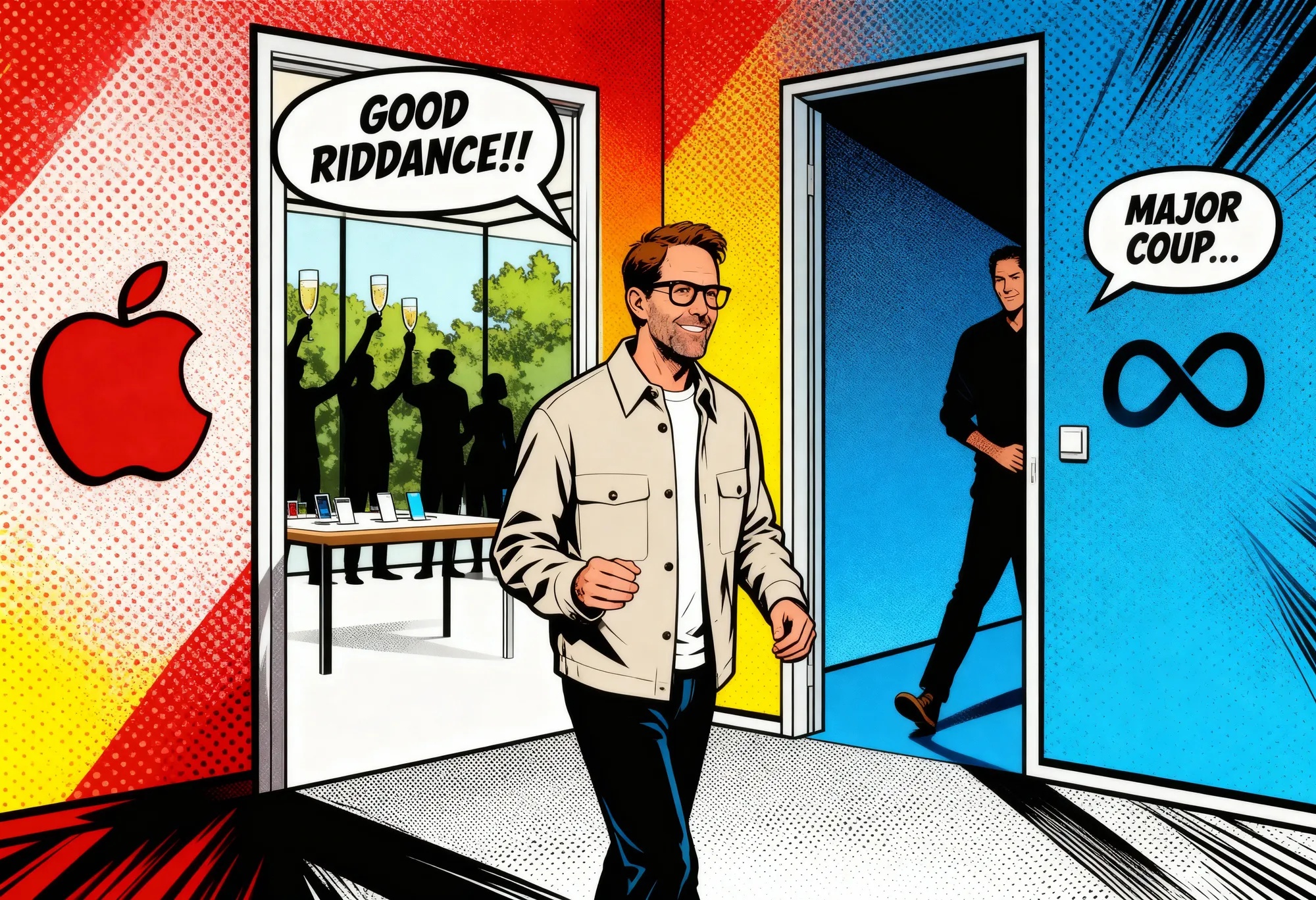
Bloomberg called it a "major coup." Mark Zuckerberg posted a five-part thread about elevating design and treating intelligence as a "new design material." Apple's stock dipped nearly 1% on the news that Alan Dye, the company's VP of Human Interface Design since 2015, was defecting to Meta as Chief Design Officer.
But inside Apple's design ranks, the mood was different. Giddy, even.
"People had given up hope that Dye would ever get squeezed out, and no one expected that he'd just up and leave on his own," wrote John Gruber at Daring Fireball, citing sources familiar with internal sentiment. One person in a position to know the replacement options called Stephen Lemay, Dye's successor, "the best choice." Designer Louie Mantia, a longtime Apple observer with deep connections to the company's design community, offered two words: "Good riddance."
This is what a victory lap looks like when your competitor poaches someone you wanted gone anyway.
Key Takeaways
• Meta hired Apple's Alan Dye as Chief Design Officer, but design practitioners widely view his decade leading Apple's UI as a failure
• Stephen Lemay, an interface design veteran at Apple since 1999, replaces Dye—a choice sources describe as the best available option
• Liquid Glass isn't going anywhere; iOS 27 development is already underway, though execution details may improve under Lemay
• Meta's last design talent acquisition—Mike Matas and the Facebook Paper team—ended with the product killed and team disbanded by 2016
The Fashion Guy in the Interface Chair
Dye's background tells the story. Kate Spade. Ogilvy. Print advertising and brand identity work. He came up through fashion, not software.
What he lacked: any real track record in user interface design. That's a specific discipline. Where do buttons go? What happens when you tap them? How does information move between screens? These questions have right and wrong answers, or at least better and worse ones. Dye hadn't spent his career answering them.
Jony Ive elevated him anyway. This was 2015, when Apple Watch launched. Bringing someone from the fashion world made a certain sense for a wearable positioned as a luxury accessory. Extending that appointment across the Mac's complex windowing system and the iPhone's daily utilities? Less obvious logic there.
For a decade, practitioners have questioned the decision. Not quietly.
"I maintain that it makes absolutely no sense that Alan Dye has the power he has, because he simply has no taste," Mantia wrote earlier this year. "But what's worse is that he wields that power so clumsily, so carelessly." Gruber's assessment was harsher: "It's rather extraordinary in today's hyper-partisan world that there's nearly universal agreement amongst actual practitioners of user-interface design that Alan Dye is a fraud who led the company deeply astray."
These aren't anonymous complaints. They're published critiques from working designers with reputations at stake.
The Jobs Quote That Haunts Everything
September's iPhone event opened with a title card. Steve Jobs, quoted: "Design is not just what it looks like and feels like. Design is how it works."
Then they handed the stage to Alan Dye.
Gruber called the moment "galling." Jobs was rebuking the notion that design means making things pretty, that designers exist to apply veneer to finished products. Dye's entire tenure represents precisely that misunderstanding. Liquid Glass, the translucent interface overhaul he unveiled at WWDC 2025, prioritizes visual effect over interaction clarity.
How badly? Apple shipped a "clear/tinted" preference toggle in the iOS 26.1 update because users couldn't read text against transparent backgrounds. That toggle exists because enough people inside Apple pushed back against Dye's direction to force a workaround into production. It's an acknowledgment, baked into system settings, that the design philosophy failed basic usability requirements.
macOS Tahoe fared worse. Windows stack with inconsistent corner radii. Elements hide beneath hamburger menus that obscure rather than organize. Focus states blur into backgrounds.
"I'm not sure there's a single thing about its UI that is better than macOS 15 Sequoia," Gruber wrote about Tahoe's interface, distinguishing carefully between the design team's work and the engineering features that make upgrading worthwhile.
Political Skill Over Craft
If Dye's design sensibility was so widely criticized, why did he survive a decade at a company that supposedly obsesses over craft?
Politics. That's the short answer.
Dye figured out how to please Apple's senior leadership even as actual designers fled the company in frustration. Gruber noted the exodus: "I'm aware of dozens of designers who've left Apple, out of frustration over the company's direction, to work at places like LoveFrom, OpenAI, and their secretive joint venture io."
That's a specific claim about talent drain, not speculation about morale. And the pattern it describes, skilled practitioners leaving while an executive with weaker credentials stays entrenched, suggests priorities that don't actually center on design quality.
One story from Gruber's sources captures the disconnect. A designer mentioned the technical term "key window." Fundamental Mac interface concept. Refers to the window receiving keyboard input. Dye's team didn't know what it meant. It's as if a cinematographer didn't recognize the term "f-stop."
But Dye got prominent segments in Apple's keynotes. His star was rising internally even as his work drew external criticism. Billy Sorrentino, a Dye deputy leaving alongside him for Meta, introduced iOS Visual Intelligence features in a two-minute-plus WWDC segment just months before defecting. These weren't people being pushed out. They were people with growing influence who chose to leave.
Meta's Design History Problem
Zuckerberg has tried this before.
In 2011, Facebook acquired Push Pop Press, the startup founded by Mike Matas, a designer who'd worked on the original iPhone's "slide to unlock" interface. Zuckerberg assembled what Gruber described as "an entire little superteam of 'Delicious' era designers and design-focused developers" around Matas.
That team shipped Facebook Paper in 2014. An iOS-exclusive alternative Facebook client. Elegant. Prioritized direct manipulation over interface chrome. Critics loved it.
Facebook killed it in 2016. Zuckerberg, in Gruber's memorable phrasing, "lost his boner for design."
The Paper episode matters because it shows what happens when Meta acquires design talent whose values conflict with the company's operational priorities. Paper's careful, considered approach to interaction couldn't survive inside a company optimized for engagement metrics and rapid iteration. The superteam disbanded. Matas eventually left for LoveFrom, Jony Ive's post-Apple studio.
Now Meta is trying again. Dye will lead a "new creative studio" focused on hardware, software, and AI integration for Reality Labs products like Ray-Ban smart glasses and Quest headsets.
Same dynamics apply, though. Meta doesn't win on design. Never has. Ray-Ban Meta glasses tripled sales last year, according to parent company EssilorLuxottica. They're functional sunglasses that happen to have cameras. Not objects of beauty. Quest headsets move units on price and content library. Interface refinement isn't the selling point.
Zuckerberg frames Apple as a major competitor. True enough. But that competition plays out through ecosystem lock-in and feature matching. Design philosophy barely enters the equation.
The Lemay Question
Stephen Lemay joined Apple in 1999 and has worked on "every major Apple interface" since, according to Tim Cook's statement confirming his promotion. He predates Dye's tenure and sat outside Dye's inner circle. Sources describe him as detail-oriented, craft-focused, and well-liked.
Why did Apple choose him?
Gruber suspects the answer isn't directional vision but political necessity. Senior leadership was apparently blindsided by Dye's departure. So blindsided they wouldn't have given him that WWDC keynote slot if they'd known he was leaving within months. They needed someone they could trust not to defect next.
Lemay, as a longtime Apple employee without ties to Dye's faction, represented safety. Whether his elevation signals a genuine shift in design philosophy or merely reflects damage control remains unclear. Both outcomes would produce the same initial result: someone with actual interaction design credentials running Apple's interface teams.
"The change in direction we may see, that many of us desperately hope to see, under Lemay's leadership might be happenstance," Gruber acknowledged. "More a factor of Lemay being politically safe... than from Tim Cook or anyone else in senior leadership seeing a need for a directional change in UI design."
Happy accidents still count. And Lemay's reputation for sweating details suggests things won't get worse.
Liquid Glass Isn't Going Anywhere
AppleInsider notes the timing problem for anyone hoping Dye's departure signals a retreat from Liquid Glass. Apple typically finalizes early internal alphas for next year's operating systems in December. iOS 27 and macOS 27 are already taking shape, built on the foundation Dye's team established.
Design systems carry momentum. Apple committed to Liquid Glass as its visual language going forward, and that commitment won't reverse because of personnel changes. The company shipped it across every platform, from iPhone to Mac to Apple Watch to Vision Pro. Rolling it back would require admitting the approach failed. Corporations rarely do that within a single product cycle.
What might change: execution details. Lemay's background suggests attention to alignment, consistency, focus states, the craft elements critics argue Liquid Glass lacks. AppleInsider quotes Daring Fireball's expectation that Lemay will "tighten things up at the edges," adding care in places most users don't consciously notice but viscerally feel.
That's the optimistic case. Liquid Glass becomes livable not through retreat but refinement.
What Zuckerberg Actually Bought
Meta didn't acquire a design visionary. It acquired a survivor. Someone skilled at navigating corporate politics while delivering work that satisfies leadership even if practitioners criticize it.
That skill set might be exactly what Meta needs. Zuckerberg's posts about "craft, creative vision, systems thinking" and "making every interaction thoughtful, intuitive, and built to serve people" describe aspirations, not requirements. Meta's hardware efforts need good-enough design. Interfaces that don't actively impede adoption. Dye can probably deliver that.
He reports to CTO Andrew Bosworth, not Zuckerberg. Design isn't getting elevated to the CEO level at Meta despite the "Chief Design Officer" title. The reporting structure tells you where design actually sits in company priorities.
And that might be fine. Meta's glasses and headsets compete on utility and price. Quest 3 succeeded by being affordable. Ray-Ban Meta succeeded by being functional sunglasses that happen to have cameras. Neither required design excellence.
Dye was an anchor at Apple, holding back a company whose brand promises design leadership. He might be perfectly adequate at Meta. Lower bar to clear.
The Deeper Pattern
Apple is bleeding senior talent. COO Jeff Williams retired in November. AI chief John Giannandrea announced his departure this week. Chips lead Johny Srouji and environment initiatives head Lisa Jackson are reportedly evaluating their futures. Cook himself approaches typical retirement age.
Dye's departure fits this pattern even if its reception inverts the usual concern. When Williams left, analysts worried about operational continuity. When Giannandrea left, questions about Apple's AI competitiveness intensified. When Dye left, designers celebrated.
That inversion reveals something about Apple's design leadership gap. The company kept someone in charge of interface design whose own community considered unqualified. For a decade. The problem wasn't just Dye's presence but the institutional judgment that kept him there.
Whether Lemay can reverse the damage depends on factors beyond his control: how much autonomy Cook grants him, whether Apple's culture actually prioritizes "how it works" over how things look, whether the talented designers who left will ever return. LoveFrom, OpenAI's hardware venture with Ive, and other destinations absorbed Apple's disaffected talent. Getting them back means proving the environment has fundamentally changed.
Why This Matters
For Apple users: Liquid Glass isn't disappearing, but the obsessive detail work that made Apple interfaces feel considered might return. Expect refinements in iOS 27 and beyond, not reversals. Small improvements to alignment, focus states, and readability that add up over time.
For Meta's hardware ambitions: Dye gives Reality Labs a senior design figurehead, but Meta's products have never competed on design taste. Success or failure will depend on AI capabilities, price points, and ecosystem integration. Interface elegance is beside the point.
For the design industry: The near-universal celebration of Dye's departure among practitioners raises uncomfortable questions about how design leaders get evaluated. If everyone in the field knew Dye was underqualified, why couldn't Apple's leadership see it?
❓ Frequently Asked Questions
Q: What is Liquid Glass?
A: Liquid Glass is Apple's visual design system introduced at WWDC 2025, featuring translucent buttons, updated app icons, and fluid animations. It shipped with iOS 26 in September 2025 and rolled out across iPhone, Mac, Apple Watch, and Vision Pro. Critics argue its emphasis on transparency created readability problems, prompting Apple to add a "clear/tinted" toggle in iOS 26.1.
Q: What products did Alan Dye design at Apple?
A: Dye oversaw Apple's user interface design from 2015 to 2025. His team shaped the Apple Watch interface, iPhone X (the first without a home button), Vision Pro's interface, and the iOS 7-era flat design through Liquid Glass. He joined Apple in 2006 after working at Kate Spade and ad agency Ogilvy.
Q: What is LoveFrom and why do ex-Apple designers go there?
A: LoveFrom is the design firm Jony Ive founded after leaving Apple in 2019. It has become a destination for designers frustrated with Apple's direction under Dye. The firm partnered with OpenAI on a secretive AI hardware venture called "io," which Gruber notes is staffed almost entirely by former Apple experience designers.
Q: When does Dye start at Meta and who does he report to?
A: Dye officially joins Meta on December 31, 2025, as Chief Design Officer. Despite the C-suite title, he reports to CTO Andrew Bosworth, not CEO Mark Zuckerberg. Bosworth oversees Reality Labs, the division building Quest headsets and Ray-Ban Meta smart glasses. Billy Sorrentino, a senior Apple design director, is joining Dye at Meta.
Q: What was Facebook Paper and why does it matter?
A: Facebook Paper was an iOS app launched in 2014 by a team of designers Zuckerberg poached from Apple, led by Mike Matas. It prioritized elegant, gesture-based interactions over Facebook's standard interface. Critics loved it, but Facebook killed it in 2016. The episode shows Meta's pattern of acquiring design talent whose values clash with company priorities.
 Marcus Schuler