 IMPLICATOR
Andrew Cunningham, a senior technology reporter at Ars Technica who lives in Philadelphia, had been typing figures from bank statements into a spreadsheet for years. He handles the accounting for Overdue, the weekly book podcast he co-hosts. During a September review of an M5 Ultra Mac Studio, he used a local model to build a converter called Bankee Doodle. It turned bank-statement PDFs into spreadsheets, keeping the financial records on his computer. Cunningham, who says he generally loathes generative AI, had found a use for it.
“I probably could have solved this problem in an afternoon with a few dollars’ worth of tokens, but sending years of financial data to Anthropic or whoever is something I just couldn’t countenance.”
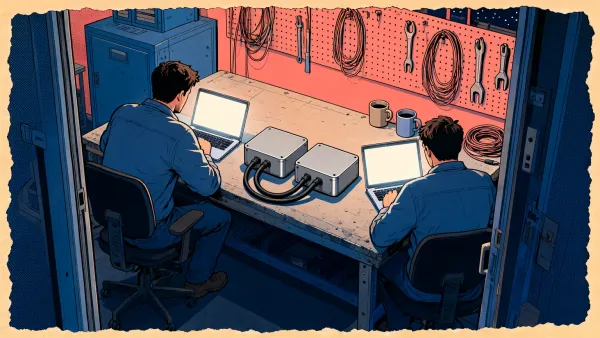
Meta and Apple are now pitching that bargain at far larger scale: the 816-billion-parameter Muse Spark Open running on two linked M5 Ultra Mac Studios. Their October 15 launch puts an estimated five-figure hardware bill against cloud tokens costing a few dollars per million.
The Breakdown
- Meta's 816-billion-parameter Muse Spark Open runs locally on two linked M5 Ultra Mac Studios with 512GB each, or four with 256GB, using Apple's MLX framework.
- Apple measured 24.99 output tokens per second on two machines and 36.73 on four at an 8,192-token context, one request at a time.
- Apple has not priced the 512GB Mac Studio due in late October. Estimates put a pair at $30,000 to $40,000, while hosted access costs $4.25 per million output tokens.
- On Meta's own coding benchmarks, Muse Spark Open scores 76.4 on Terminal-Bench 2.1 against 85.0 for Moonshot's Kimi K3.
AI-generated summary, reviewed by an editor. More on our AI guidelines.
What two Mac Studios run
Muse Spark Open accepts text, images, video and audio, returning text. Its downloadable weights hold the trained model, with a context window of about a million tokens, the pieces of text it processes. Its mixture-of-experts design activates 42 billion parameters per token, though the entire model still needs storage in memory.

Marcus Schuler
Editor-in-Chief and founder of Implicator.ai. Former ARD correspondent and senior broadcast journalist with 10+ years covering tech. Writes daily briefings on policy and market developments. Based in San Francisco. E-mail: editor@implicator.ai