Implicator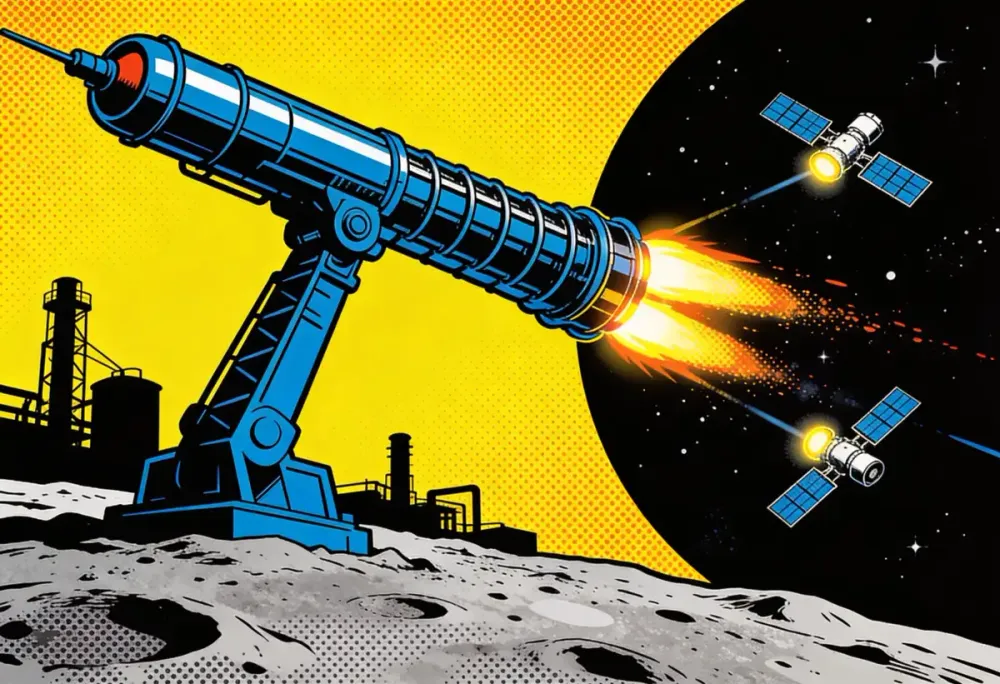
Elon Musk told employees at xAI, his artificial intelligence company, that the company needs to build a factory on the moon to manufacture AI satellites and a giant catapult to launch them into space, according to The New York Times, which heard the all-hands meeting on Tuesday evening. He called it a "mass driver." Science fiction term, but the physics are real: use electromagnetic force to launch payloads off the moon and into orbit. How the factory gets built, what the satellites actually do, when any of this happens, he didn't say.
The announcement came hours after xAI lost its sixth co-founder out of an original twelve. It was also the first detailed look at what the newly merged xAI-SpaceX entity actually plans to do with the moon.
"You have to go to the moon"
Musk framed the lunar factory as a prerequisite for building intelligence at a scale no earthbound operation could match. "You have to go to the moon," he said during the hourlong meeting, per the Times. "It's difficult to imagine what an intelligence of that scale would think about, but it's going to be incredibly exciting to see it happen."
Key Takeaways
• Musk told xAI staff about a lunar factory and electromagnetic catapult to launch AI satellites into orbit.
• Six of xAI's twelve co-founders have now left, with two departing in a single week.
• SpaceX reversed its 24-year Mars-first strategy in a Sunday social media post, pivoting to the moon.
• The merged xAI-SpaceX entity targets a $1.5 trillion IPO, possibly this summer.
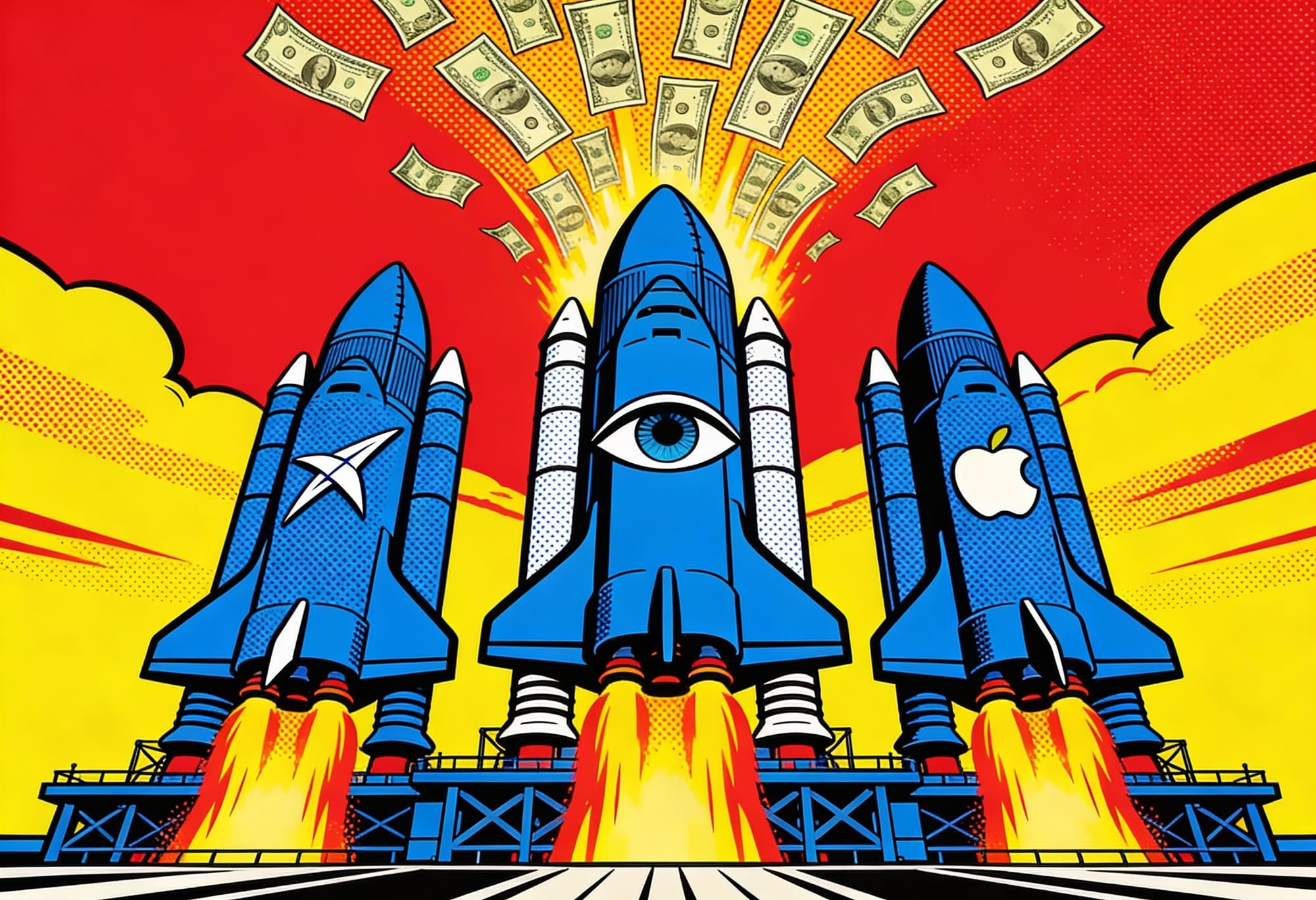
The pitch builds on his announcement last week that he was merging xAI with SpaceX to put AI data centers in orbit. That deal combined the rocket company's launch infrastructure with xAI's models and computing clusters, creating a combined entity now preparing for what could be the largest initial public offering in U.S. history. SpaceX is targeting a valuation around $1.5 trillion, with a listing possible as early as this summer.
Musk used the meeting to lay out a sequence. Build "a self-sustaining city on the moon" first. Then Mars. Then star systems, in search of alien life. The entire arc of human civilization, compressed into a corporate roadmap and delivered in an hourlong meeting that also covered chat app features and a banking product. Enormous in scope, almost entirely absent on specifics.
Gerard O'Neill, the Princeton physicist, proposed this same kind of launcher for the moon in the 1970s. Catapult material off the surface, sling it into orbit. NASA spent real money studying it during Apollo. Then everybody moved on. Nobody has built one. Musk, whose other company SpaceX has never sent a payload to the moon, did not address the engineering gap between concept and construction.
A representative for xAI did not respond to a request for comment from The New York Times.
The co-founders keep leaving
The all-hands took place against a week of rapid departures. On Monday night, xAI co-founder Tony Wu announced he was leaving the company. Less than a day later, another co-founder, Jimmy Ba, who reported directly to Musk, said he was gone too. That brought the total to six of xAI's twelve founding members who have now left the young company. More than half a dozen other researchers have also departed in recent weeks, the Financial Times reported.
Every exit has been described publicly as friendly. The SpaceX IPO could create enormous payouts, so there's every reason to leave quietly and cash out later. But half the people who started this company have already walked, and the biggest product is still vaporware. xAI is less than three years old. That kind of turnover, at a startup this young, is hard to spin no matter how big the IPO payouts get. The public posture is confidence. The attrition rate says something else.
Musk tried anyway. "Because we've reached a certain scale, we're organizing the company to be more effective at this scale," he told employees, per the Times. "And actually, when this happens, there's some people who are better suited for the early stages of a company and less suited for the later stages."
Stay ahead of the curve
Strategic AI news from San Francisco. No hype, no "AI will change everything" throat clearing. Just what moved, who won, and why it matters. Daily at 6am PST.
No spam. Unsubscribe anytime.
A polite way to sort people into boxes. Whether the departing co-founders agree with their assigned box is another matter.
A 24-year Mars fixation, reversed in a post
For most of SpaceX's existence, Mars was the destination and the entire point. Musk founded the company in 2002 to make humanity multiplanetary, starting with a colony on the Red Planet. He repeated some version of that pitch at nearly every major SpaceX event for two decades.
On Sunday, just before the Super Bowl, he reversed course. In a post on X, Musk wrote that SpaceX had "shifted focus to building a self-growing city on the Moon," arguing that a Mars colony would take "20+ years" while a lunar base could happen in under a decade. The math, he said, was simple: launch windows to the moon open every ten days, with a two-day trip. Mars windows come every 26 months, with a six-month transit. You iterate faster when you can try again in two weeks instead of two years.
"The overriding priority is securing the future of civilization, and the Moon is faster," Musk wrote. SpaceX would still "strive to build a Mars city" in five to seven years, he added. How one company builds a moon city and a Mars city at the same time, he skipped.
Two former SpaceX executives, talking to the Times anonymously, said the moon had never really been on the company's radar. SpaceX has never sent a single mission there. The company's entire identity for 24 years was Mars. That identity changed in a social media post on a Sunday afternoon.
Musk has done this before. Grand promise, missed deadline, pivot to something bigger. Cargo to Mars by 2018 was the pitch back in 2016. Never happened. Four years after that, he called himself "highly confident" of putting humans on Mars by 2026. The company is now designing a catapult for the moon instead.
There's also the politics. Trump's space priority is boots on the moon by 2028, and Musk lining up behind that, right as SpaceX prepares to go public, is about as surprising as the sunrise.
The trillion-dollar thesis
Not everyone sees the moon pitch as disconnected from xAI's core mission. One venture backer with a stake in xAI described the logic to TechCrunch's editor-in-chief last year: Musk has spent two decades assembling companies that each generate a different type of proprietary real-world data. Tesla feeds in road topology and energy systems. Neuralink, brain-interface readings. SpaceX provides the orbital mechanics, and even The Boring Company contributes subsurface mapping nobody else has. Put a factory on the moon and you get sensor streams from an environment only one company can reach.
It's a tidy thesis. Holding it together requires engineers and researchers who know how to build at this scale, and that roster keeps shrinking.
A billion users, eventually
The all-hands was not all lunar ambition. Musk also discussed X, the social network he merged with xAI last year. Musk put X's monthly active user count at 600 million. The Times couldn't verify that. When he bought Twitter in 2022, its own filings showed 237.8 million monetizable daily active users, a completely different measurement that only counted people who saw ads and logged in every single day. Comparing the two numbers is almost meaningless, but with no outside data, 600 million is just Musk talking to his own employees.
Musk told staff he expected to push past one billion daily active users through new features, including a banking product called X Money and a standalone chat app. That target would make X larger than every social network except YouTube. No date attached.
Where the law meets the regolith
One detail that didn't come up in the all-hands: nobody can legally own the moon. International law settled that in 1967. But the U.S. punched a loophole through it in 2015, letting Americans keep whatever resources they pull off the surface. You can't own the ground. You can own what's in it. That distinction matters less than it sounds.
"It's more like saying you can't own the house, but you can have the floorboards and the beams," Mary-Jane Rubenstein, a Wesleyan professor who studies space ethics, told TechCrunch last month. "The stuff that is in the moon is the moon." She has a point.
China and Russia have refused to sign the American playbook for who gets to mine what. They've got their own lunar plans. NASA hasn't even gotten a crew past low orbit since 1972, though Artemis II is supposed to change that in the coming weeks. Musk's factory would drop right into this mess. No permits exist for what he's proposing. He's already shopping for lots.
Musk got up in front of his team Tuesday night. Moon catapults. AI satellites. Cities that build themselves. He provided no blueprints and no timeline. Half the people who were supposed to build it have already left.
Frequently Asked Questions
Q: What is a mass driver and has one ever been built?
A: An electromagnetic launcher that uses magnetic force to accelerate payloads off the moon's surface into orbit. Princeton physicist Gerard O'Neill proposed the concept in the 1970s. NASA studied it during Apollo. Nobody has built one, and SpaceX has never sent a payload to the moon.
Q: Which xAI co-founders have left and why?
A: Six of the original twelve co-founders have departed, including Tony Wu and Jimmy Ba, who both left within 24 hours of each other. Every exit has been described publicly as friendly. Musk framed the departures as people better suited for early-stage work. The SpaceX IPO could create large payouts, giving departing founders financial incentive to leave quietly.
Q: Why did SpaceX shift focus from Mars to the moon?
A: Musk argued lunar missions iterate faster. Launch windows to the moon open every ten days with a two-day trip, versus every 26 months with a six-month transit for Mars. He said a moon base could happen in under a decade, while a Mars colony would take 20-plus years.
Q: Can anyone legally build a factory on the moon?
A: The 1967 Outer Space Treaty bars national sovereignty claims on the moon. A 2015 U.S. law lets Americans keep resources extracted from celestial bodies, but no permits or regulatory framework exists for lunar manufacturing. China and Russia have refused to sign the U.S.-led Artemis Accords governing lunar resource rights.
Q: What is the xAI-SpaceX merger and how big is the planned IPO?
A: Musk merged xAI with SpaceX to combine rocket launch infrastructure with AI models and computing clusters. The combined entity is preparing for what could be the largest U.S. IPO in history, targeting a valuation around $1.5 trillion, with a listing possible as early as this summer.


Maria Garcia
Bilingual tech journalist slicing through AI noise at implicator.ai. Decodes digital culture with a ruthless Gen Z lens—fast, sharp, relentlessly curious. Bridges Silicon Valley's marble boardrooms, hunting who tech really serves.