IMPLICATOR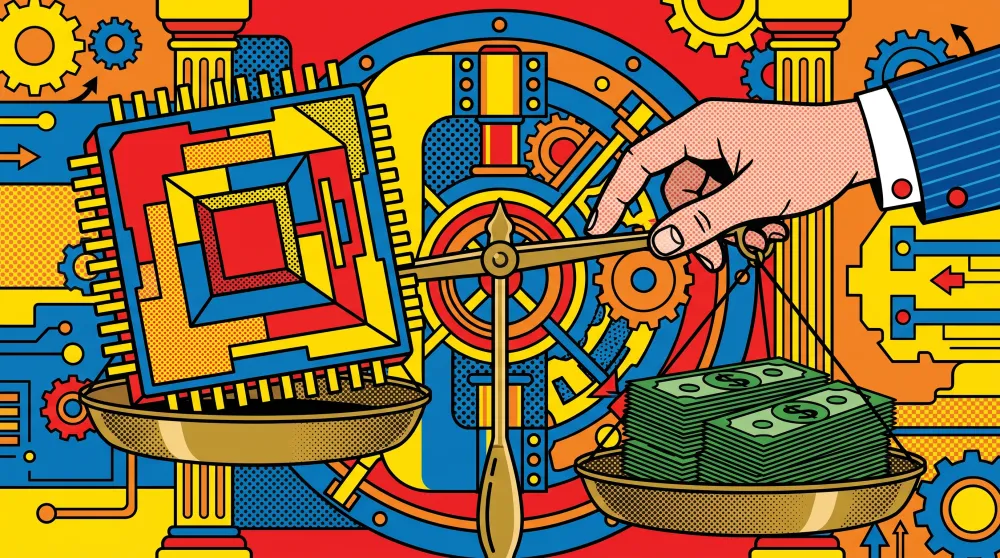

From San Francisco
1 |
The Editorial |
Good morning.
Nvidia lined up six Wall Street firms to raise more than $500 billion for AI compute, with the compute itself as collateral. The memorandums name no rate, no maturity and no first project. Intel raised its $20 billion by selling 210 million new shares at $95, below Monday's close. Only one of them paid with its own equity.
Below: what the $500 billion actually finances, why Intel will not say what its money buys, and a July revenue number from TSMC that answers both.
Stay curious,
Marcus Schuler
2 |
The Big Story |
Nvidia signed preliminary agreements Monday with Apollo, BlackRock, Blackstone, Brookfield, Goldman Sachs and KKR to build financing platforms targeting more than $500 billion in outside capital for AI infrastructure.
Compute is the collateral. Special-purpose entities would issue debt through private offerings and bonds, then lease the hardware to Nvidia customers, who could buy Nvidia systems without touching their own balance sheets. Jensen Huang said he approached only the six firms and none declined.
Huang wrote on X that Nvidia might provide residual-value support for up to 25% of an opportunity, decided case by case. Against the full target that ceiling reaches $125 billion.
Why This Matters:
- AI buyers could add Nvidia capacity without capital expenditure on their own books, moving the buildout's debt onto separate entities.
- Nvidia's obligation grows when used systems lose value, the same condition that would weaken demand for new ones.
3 |
Also Today |
Intel priced its stock offering at $95 a share and upsized it to $20 billion, above the $15 billion announced Monday.
The 210.5 million new shares equal about 4% of Intel's count outstanding, and the stock closed Monday at $97.52. The filing names no project and no customer. Intel Foundry booked $5.77 billion in second-quarter revenue and just $293 million of it from external customers, the business this capacity is meant to serve.
4 |
The Outside Read |
Terence Tao's personal site distills his evolving view of AI into an unusually clear guide to using unreliable models without surrendering judgment.
Tao treats a model as a probability kernel rather than deterministic software and asks users to judge tasks by comparative advantage and acceptable failure rate. His hardest rule is simple: rely on AI only when you can independently red-team its output.
5 |
The One Number |
6 |
Today's Headlines |
- CME Group and Silicon Data will list two compute futures contracts on October 5, tracking hourly H100 and B200 rental prices on NYMEX, pending regulatory review.
- River AI, founded in June by former xAI co-founder Igor Babuschkin, raised $1.1 billion led by General Catalyst and AMP, with Nvidia, AMD Ventures, Y Combinator and Temasek joining.
- IBM signed a $240 million multi-year agreement to run Together AI's open-model inference on Nvidia HGX B300 systems in IBM Cloud, available in the first quarter of 2027.
- Anthropic will embed watermarks in text from new Claude models and apply the European rule to users worldwide rather than only inside the EU.
- SpaceXAI opened an early beta of Grok Bot, a cloud agent that works inside apps a customer is already signed into, at $120 per seat monthly through Cursor Premium Teams.
- Nvidia says its pre-alpha NeMo Switchyard router cut a benchmark agent workload from about $180 to $72 by picking a model per step, against an Opus-4.8-everywhere baseline.
Wed 8/12 |
Economy: the Bureau of Labor Statistics releases July CPI at 8:30 a.m. Eastern. |
Wed 8/12 |
Markets: Intel's $20 billion stock sale is expected to close. |
Wed 8/12 |
Tech: Made by Google in New York at 6 p.m. Eastern, with the Pixel 11 line and Pixel Watch 5; pre-orders open the same day. |
Thu 8/13 |
Economy: July PPI follows at 8:30 a.m. Eastern. |
7 |
The 5-Minute Skill |
Teams often hear an objection and then ask customers to confirm the explanation they already prefer. Use the model to write questions that can prove that explanation wrong.
Your raw input:
The prompt:
Why this works: Questions about past behavior produce better evidence than predictions. Defining the disconfirming answers in advance stops the team from reading every response as support.
What to use: Claude Opus 4.7 is good at interview wording that must not lead the answer. A fast general model is enough for a short list of objections.
8 |
AI Profile |
Fish Audio sells text-to-speech, voice-cloning and voice-agent models through hosted APIs and on-premises deployments. Its position is an open-model funnel that, by July 2026, had produced a company-reported $21 million in annual recurring revenue and more than 8 million users, with developers and enterprises supplying two-thirds of revenue.
Founders: Rissa Cao, chief executive, previously worked on voice AI at Amazon Alexa and Meta; Shijia Liao, chief scientist, was a video research engineer at Nvidia. The company dates its first year to July 2025.
Product: Its models generate speech in more than 83 languages, clone voices from samples and let developers control pacing and emotion. Avatar maker HeyGen and voice-agent platforms LiveKit and Retell use its technology; enterprises also pay for uptime commitments, on-premises installation and zero-data-retention options.
Financing: Fish Audio says it had taken no outside capital before the $52 million seed announced July 28, 2026. Coreline Ventures and Capital Today led the round, bringing total disclosed funding to $52 million; no valuation was disclosed.
The risk: Fish Audio must police a community library holding more than 2 million voice models while open-weight copies can sit outside its takedown system. Consent failures could repel enterprise buyers, and ElevenLabs has much greater revenue and capital.
9 |
The Rausschmeisser* |
From mid-September, Spotify will mark artist profiles that represent AI-generated identities with an AI Persona badge in banners, search results and track rows, and will keep those profiles out of editorial and algorithmic recommendations unless a listener follows them. Artists can self-disclose through Spotify for Artists now; Spotify will also review profiles that clear defined audience thresholds and badge the ones that look like photorealistic AI identities (Spotify, August 11, 2026).
Our take: The stated reason is worth quoting. Listeners "don't like seeing an artist profile that seems human, only to find out that the persona is AI-generated." Fair enough. Spotify spent a decade teaching people to treat music as a temperature setting, and now it needs a badge to tell you a person was involved.
The rule also has a tell. AI Personas lose recommendation slots by default, the only sanction that costs anything on a platform where discovery is the whole product. Synthetic artists stay on Spotify; they pay in reach, and Spotify keeps the right to decide which faces look photorealistic enough to owe it.

Marcus Schuler
Editor-in-Chief and founder of Implicator.ai. Former ARD correspondent and senior broadcast journalist with 10+ years covering tech. Writes daily briefings on policy and market developments. Based in San Francisco. E-mail: editor@implicator.ai