Implicator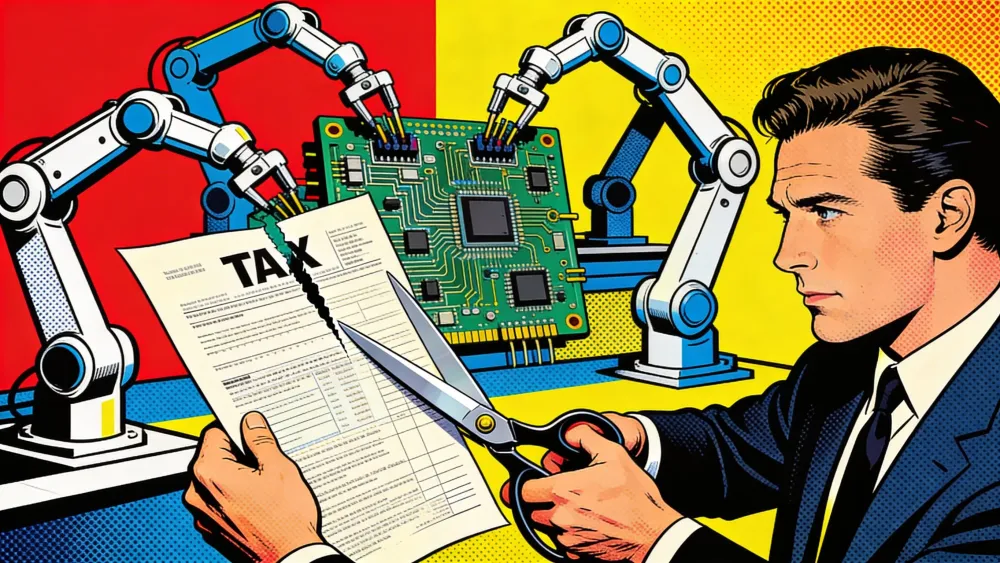
Venture capitalist Vinod Khosla, OpenAI's first institutional investor, told the Financial Times this week that the U.S. should eliminate federal income tax for anyone earning less than $100,000 a year. The billionaire says equalizing capital gains taxes with ordinary income rates would generate enough revenue to remove 125 million Americans from the tax rolls without hurting government revenue. Khosla made the comments at the Hill & Valley Forum in Washington, where Silicon Valley executives and federal lawmakers gathered to debate AI's growing pressure on the labor market.
Key Takeaways
- Khosla proposes ending income tax for anyone earning under $100K by equalizing capital gains with ordinary income rates
- He calls "fear of AI" the defining issue of the 2028 election, with 80% of jobs at risk by 2030
- Worker anxiety about AI displacement nearly doubled since 2024, from 28% to 40%
- Competing proposals from BlackRock's Fink, Gina Raimondo, and Andrew Yang signal growing urgency in Washington
The arithmetic behind the pitch
Khosla's plan targets one of the most lopsided features of the U.S. tax system. The top 1% of earners, those making at least $650,000 a year, account for roughly 45% of all capital gains. The top 10% pay over three-quarters.
A recent IRS- and academic-based study found that households accumulated about $116 trillion in capital gains from 1954 to 2021. Less than a fifth ever showed up on a tax return as a realized gain. In 2021 alone, capital gains hit $16.2 trillion, equivalent to 94% of net national income. More than total wages, dividends, and interest combined.
"Fundamentally, we ought to eliminate the notion of capital gains," Khosla told Fortune. "All income is ordinary income. Everybody pays the same tax." He also wants to close what he calls "special interest goodies" inserted by lobbyists: tax-loss carryovers, master limited partnerships, and borrowing against unrealized gains without triggering a tax event.
Fear as the political accelerant
Khosla framed the tax overhaul as political necessity, not economic theory. He told the FT he sees one issue dominating the next presidential cycle. "The single biggest issue I believe in the 2028 presidential election will be fear of AI." He pins the number at 80% of all jobs, AI-capable, by decade's end.
Ask American workers and the answer is consistent. A little over one in four feared AI would take their job in 2024, according to surveys. Now the number sits at four in ten. Double in two years. Campaigns notice.
GDP kept climbing through 2025. Employers, somehow, created only 584,000 new positions across those twelve months. Weakest pace in years. Output up, hiring flat.
Get Implicator.ai in your inbox
Strategic AI news from San Francisco. No hype, no "AI will change everything" throat clearing. Just what moved, who won, and why it matters. Daily at 6am PST.
No spam. Unsubscribe anytime.
At the forum, Khosla praised the Trump administration's AI policy as "generally doing a pretty good job" but called Trump himself a man with a "complete lack of values of any sort." He has not picked a 2028 candidate. Dismissed Vance and Rubio, criticized Democrats for "going too far left," and said he wants a "surprise" to emerge.
Sen. Maria Cantwell, his co-panelist, pushed back gently on the tax idea. Congress is "a little better at the near term," she said, pointing to the CHIPS Act's nearly $53 billion commitment as the kind of thing lawmakers can actually deliver.
Washington grasps for a framework
Khosla is not alone in his anxiety. BlackRock CEO Larry Fink warned in his annual shareholder letter of the "real risk" that AI widens wealth inequality. Former Commerce Secretary Gina Raimondo called for a "new grand bargain between the public and private sectors." Andrew Yang proposed shifting the entire tax burden from human labor to AI agents.
And proposals are getting granular. AI investor Alap Shah, who co-authored Citrini Research's paper on AI-driven displacement that spooked financial markets last month, published a framework that ties corporate tax rates to displacement metrics. Companies whose margins expand while headcounts collapse would pay higher rates. His plan also includes "circuit breakers," automatic stabilizers triggered when labor's share of GDP drops below a set threshold.
Not everyone wants a new invention. Martha Gimbel at the Budget Lab at Yale argued that unemployment insurance already does the job. "It's flexible, automatic, and responsive to a range of shocks," she wrote. Fix what exists before building something new.
A smaller experiment is already running. A nonprofit called AI Dividend started sending $1,000 monthly payments to between 25 and 50 displaced workers this week, with $300,000 in seed funding.
The investor who wants to pay more
Khosla's position stands out because he would pay more under his own plan. Forty percent of capital gains taxes come from individuals earning more than $10 million a year. He is asking the investor class to absorb a larger burden so 125 million workers get relief.
That separates him from peers who are heading for the exits. Google cofounder Larry Page moved to Florida as California's wealth tax proposal gained momentum; Peter Thiel expanded his presence in Miami. Khosla told Yahoo Finance he has "no plans to leave California."
The federal math is a different story. Fiscal 2026 already carries a $1.9 trillion deficit, per the CBO, before anyone touches the tax code. Tax unrealized gains, and some portfolios get liquidated involuntarily. Markets don't like that. And the people who pay 40% of all capital gains taxes have the lawyers and lobbyists to keep the current structure exactly where it is.
But Khosla is betting on a simpler calculation. If you earn under $100,000 and someone offers to zero out your tax bill, you vote for that person. A hundred and twenty-five million Americans is a bloc that can rewrite tax law whether the policy wonks approve or not.
Frequently Asked Questions
What is Vinod Khosla's income tax proposal?
Khosla wants to eliminate federal income tax for anyone earning less than $100,000 a year. He proposes funding this by taxing capital gains at the same rate as ordinary income, which he says would remove 125 million Americans from the tax rolls while keeping government revenue steady.
How would equalizing capital gains and income taxes generate enough revenue?
The top 1% of earners account for 45% of all capital gains, and 40% of capital gains taxes come from those earning over $10 million. An IRS study found households accumulated $116 trillion in capital gains from 1954 to 2021, but less than a fifth was ever reported as realized gains.
Why does Khosla say AI is driving this proposal?
He argues AI is shifting wealth from labor to capital and that 80% of jobs will be AI-capable by 2030. Worker anxiety about AI job loss jumped from 28% in 2024 to 40% in 2026, making it what he calls the single biggest issue heading into the 2028 presidential election.
What other AI-related safety net proposals are being discussed?
BlackRock CEO Larry Fink warned about AI widening inequality. Former Commerce Secretary Raimondo called for a public-private grand bargain. Citrini Research proposed corporate tax rates tied to AI displacement metrics. Andrew Yang wants to shift taxes from human labor to AI agents.
Is Khosla's proposal economically feasible?
The CBO projects a $1.9 trillion deficit for fiscal 2026, raising questions about revenue neutrality. Critics warn that taxing unrealized gains could force portfolio liquidations and market volatility. Capital gains lobbying interests also present a political obstacle.


Marcus Schuler
Tech translator with German roots who fled to Silicon Valley chaos. Decodes startup noise from San Francisco. Launched implicator.ai to slice through AI's daily madness—crisp, clear, with Teutonic precision and sarcasm. E-Mail: [email protected]