Implicator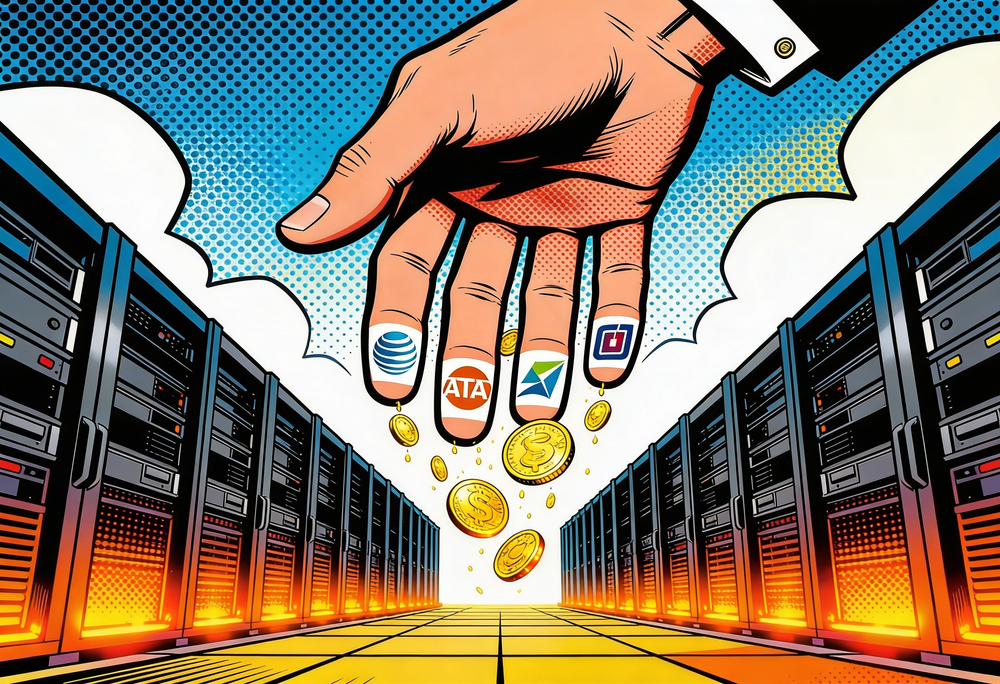
OpenAI is close to finalizing the first phase of a funding round expected to raise more than $100 billion, Bloomberg reported on Thursday. Strategic investors Amazon, SoftBank, Nvidia and Microsoft should lock in their commitments by the end of this month, with the overall valuation now projected above $850 billion. That figure exceeds the $830 billion target set earlier in the negotiations, according to people familiar with the matter.
If completed, it would be the largest private financing deal in history, eclipsing OpenAI's own $41 billion raise from last March. And the investor list reads less like a cap table than a supply chain manifest. Amazon sells OpenAI its cloud. Nvidia sells the chips. Microsoft provides both. SoftBank bankrolls the data center buildout through its Stargate venture. Every big check comes with a commercial obligation attached.
The Breakdown
- OpenAI nears $100 billion round with Amazon ($50B), SoftBank ($30B), Nvidia ($20B) and Microsoft as lead investors.
- Post-money valuation could exceed $850 billion, making it the largest private financing deal in history.
- Every major investor doubles as a supplier, turning the funding round into a procurement deal with equity attached.
- OpenAI won't be profitable until 2029 but plans trillions in infrastructure spending and a potential IPO this year.
Four companies, one hundred billion dollars
Amazon's share could reach $50 billion, the single largest commitment in the round. SoftBank is in talks for as much as $30 billion, building on the roughly 11% stake it already held as of December. Nvidia has discussed a $20 billion investment, Bloomberg previously reported. Microsoft, OpenAI's longest-running partner, would round out the first tranche.
If all four invest at the high end of their discussed ranges, the combined capital alone approaches $100 billion. The money won't arrive as a single wire transfer. Corporate investors will send funds in several installments over the course of 2026, according to people familiar with the structure.
A second close follows. Venture capital firms, sovereign wealth funds and other financial investors will participate in a later phase that could push the total well past the initial target. SoftBank shares climbed as much as 4% in early Tokyo trading on Thursday morning.
But the commercial strings deserve close reading. As part of its deepening partnership with Amazon, OpenAI will expand its use of Amazon's proprietary Trainium and Inferentia chips alongside AWS cloud services, according to one person familiar with the arrangement. Put bluntly, Amazon isn't just buying a stake in OpenAI. It's buying a customer. Nvidia's equity position follows the same logic, cementing its role as OpenAI's primary GPU supplier at a moment when Blackwell chips remain in fierce demand. For a company raising money from its own vendors, the line between investor and supplier no longer exists.
The pitch behind closed doors
CEO Sam Altman and CFO Sarah Friar have spent recent weeks selling potential backers on the growth story. In private meetings, the executives highlighted OpenAI's consumer base, its expanding enterprise contracts and its access to compute, CNBC reported earlier this month.
Altman sounded bullish internally, too. In a Slack message to employees earlier this month, he wrote that ChatGPT was "back to exceeding 10% monthly growth." More than 800 million people used the chatbot each week as of early February. Google and Anthropic have been gaining ground in both consumer and developer markets, though. OpenAI grew anxious enough to declare a "code red" in December, temporarily sidelining other projects to focus engineering resources on product improvements.
The timing of the investor push coincided with an unusually public rivalry. An emboldened Anthropic ran Super Bowl ads earlier this month that mocked OpenAI's decision to introduce advertising inside ChatGPT. Altman called the commercials "deceptive" in a post on X. Days later, OpenAI officially began testing ads within the chatbot, a revenue stream the company expects will account for less than half of its long-term income, according to a person familiar with the plans.
One chart in particular has been circulating in investor meetings. It shows OpenAI's coding tool Codex eating into the market share of Anthropic's Claude Code, based on internal data, according to a screenshot reviewed by CNBC. Altman described Codex's week-over-week growth of roughly 50% as "insane" in the same Slack message. OpenAI had just shipped GPT-5.3-Codex and a standalone desktop app for Mac users.
Growth numbers like that matter when you're asking for one hundred billion dollars. They also cover for a harder reality. OpenAI won't turn a profit until 2029 at the earliest. Its roughly 4,000 employees averaged $1.5 million each in stock comp last year, the Wall Street Journal reported. Altman himself owns no equity in the company and took home $76,001 in 2024. Cash flows out at a rate that requires constant resupply.
OpenAI is also pushing toward an initial public offering later this year, giving employees and early investors a path to liquidate at least some of their holdings. For backers now circling the $100 billion round, the IPO represents the exit. Getting in at a $730 billion pre-money valuation and selling at whatever the public markets decide could produce returns measured in tens of billions, or it could lock in losses if the stock opens below the private price. SoftBank booked a $4.2 billion gain on its OpenAI stake last quarter. It's betting the trajectory holds.
Where one hundred billion dollars goes
Ask where the money goes and the answer is physical. In Texas and Arizona, data centers are going up that draw enough electricity to power a small city. Each one needs cooling systems running thousands of gallons of water per minute through the racks. Then you bolt in millions of processors, floor to ceiling, and hope the grid holds.
Join 10,000+ AI professionals
Strategic AI news from San Francisco. No hype, no "AI will change everything" throat clearing. Just what moved, who won, and why it matters. Daily at 6am PST.
No spam. Unsubscribe anytime.
Altman told investors last August that OpenAI would spend trillions on infrastructure. Not billions. Trillions. Training one frontier model burns through more compute than some countries use in a year. Running it for hundreds of millions of daily users compounds that bill every month. A single training run eats tens of thousands of GPUs for weeks. Each chip pulls hundreds of watts nonstop. Then multiply by the inference load. Electricity bills alone hit hundreds of millions a year. GPT-5 ran up a bigger tab than GPT-4 did. Whatever follows will cost more than that.
Amazon's investment adds a wrinkle. Expanding onto AWS means long-term usage contracts and Amazon's custom silicon, a diversification play away from near-total dependence on Microsoft Azure. Amazon, in turn, locks in a cloud customer that might otherwise wander to a competitor. Every hyperscaler wants to own AI workloads for the next decade. Google alone plans to spend $185 billion on capital expenditures this year. Most of that goes toward the same fight.
Nvidia's $20 billion reinforces a different part of the chain. OpenAI buys more Nvidia GPUs than almost anyone on the planet. An equity stake means Nvidia profits directly when OpenAI orders more chips. And OpenAI gets preferential access to hardware that everyone else in the industry is scrambling for.
SoftBank's $30 billion feeds into a bigger play. The company co-announced Stargate with OpenAI last January, a $500 billion initiative to build AI data centers across the United States. The new investment goes straight into that pipeline.
The funding arms race
OpenAI isn't raising in isolation. Anthropic closed a $30 billion Series G last week, valuing the company at $380 billion, the second-largest private tech financing on record. Abu Dhabi's MGX fund has pledged $10 billion a year for AI investments alone, hedging across both OpenAI and Anthropic.
The money isn't just flowing to the top two. TechCrunch counted 17 U.S.-based AI companies that raised rounds of $100 million or more in the first seven weeks of 2026. Three crossed $1 billion. American AI startups pulled in more than $76 billion through mega-rounds in 2025. At the current pace, 2026 will blow past that before summer.
The entire U.S. venture capital industry invested about $100 billion across all sectors in 2023. All of it, every sector, every stage. One company is now raising that in a single round.
Competitive pressure gives the fundraise a defensive quality. Lose the compute race and you lose the ability to train the next generation of models. Lose that and 800 million weekly users start to drift. Altman's "code red" in December showed OpenAI already felt pressure from Anthropic's rapid gains in developer tools. One hundred billion dollars doesn't just fund expansion. It buys time.
Previous tech spending booms left different wreckage. When dot-com companies imploded in 2001, the wreckage sat mostly in stock prices and abandoned office leases. If the AI spending cycle corrects, the remains are concrete and silicon, data centers and GPU clusters that took years to build and can't easily find another use.
OpenAI's pre-money valuation sits at $730 billion. Post-money, once the round completes, it would exceed $850 billion. A company valued at three-quarters of a trillion dollars that won't turn a profit for at least three more years. The investors writing these checks aren't modeling next quarter's earnings. They're modeling infrastructure lock-in, the conviction that whoever builds the most compute capacity today captures the AI workloads of the next decade. Amazon gets a cloud customer, Nvidia locks in its biggest chip buyer, and SoftBank gets the centerpiece of its data center network.
OpenAI closed its last round in March 2025. Less than a year later, it needs more than double. The concrete is already being poured.
Frequently Asked Questions
How much is each company investing in OpenAI?
Amazon could invest up to $50 billion, SoftBank as much as $30 billion, and Nvidia roughly $20 billion, according to Bloomberg. Microsoft would round out the first tranche. The funds will arrive in installments throughout 2026, not as a single payment.
What is OpenAI's current valuation?
OpenAI's pre-money valuation sits at $730 billion. Including the new funding, the post-money valuation could exceed $850 billion, up from the $830 billion initially expected. That would make it the most valuable private company in history.
Why does OpenAI need $100 billion?
The money funds AI infrastructure: data centers, GPUs and cloud computing contracts. CEO Sam Altman has said OpenAI expects to spend trillions on infrastructure over time. Training frontier models and serving hundreds of millions of daily users requires massive and growing compute capacity.
When will OpenAI become profitable?
Not until at least 2029, by most estimates. The company's roughly 4,000 employees averaged $1.5 million each in stock-based compensation in 2025. OpenAI is also pursuing an IPO later this year, which could provide an exit for early investors.
How does this compare to other AI funding rounds?
Anthropic closed a $30 billion Series G last week at a $380 billion valuation. In total, 17 U.S.-based AI companies raised rounds of $100 million or more in the first seven weeks of 2026 alone. The $100 billion figure matches what the entire U.S. venture capital industry invested across all sectors in 2023.


Maria Garcia
Bilingual tech journalist slicing through AI noise at implicator.ai. Decodes digital culture with a ruthless Gen Z lens—fast, sharp, relentlessly curious. Bridges Silicon Valley's marble boardrooms, hunting who tech really serves.