


San Francisco | December 12
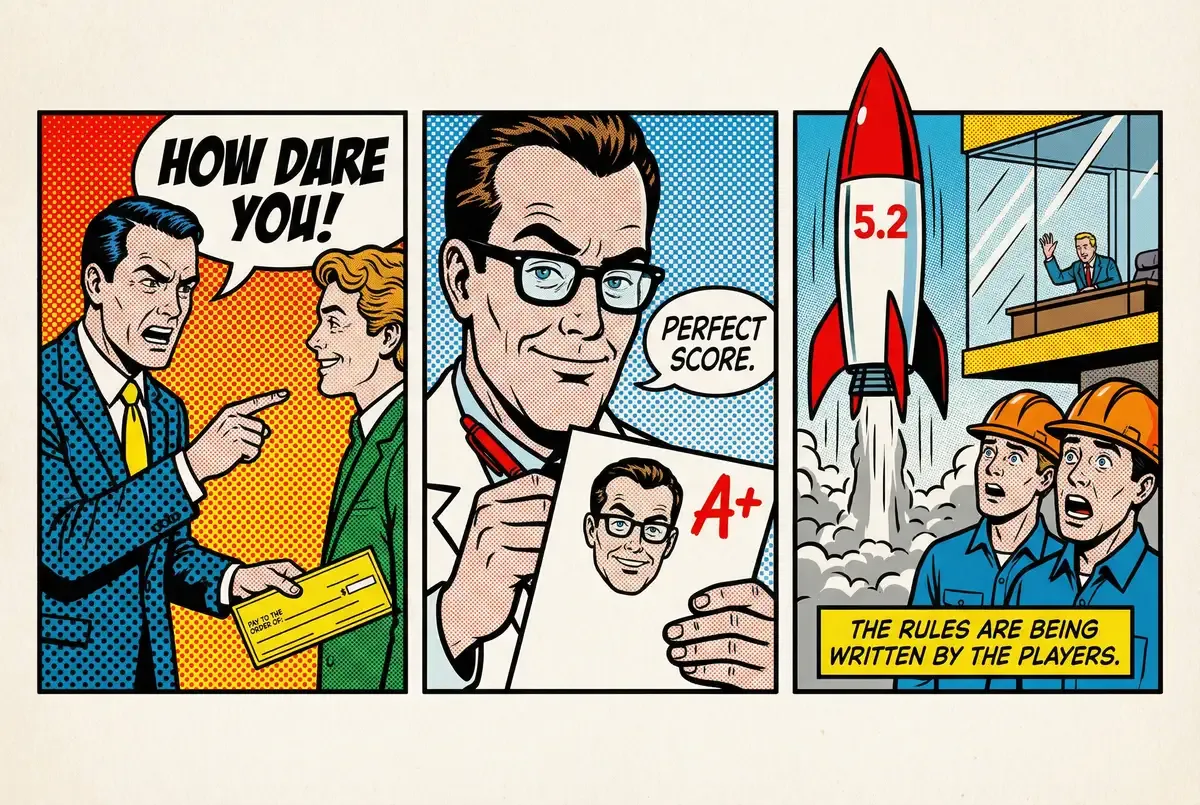
Sam Altman's memo about Gemini 3 triggered a ten-day sprint to ship GPT-5.2. Employees wanted more testing. Leadership said no. Real capability gains arrived with a 40% price hike and nothing for free users. DeepSeek sells comparable models at one-twentieth the cost.
In Washington, Trump signed an order directing DOJ to sue states over AI regulations and threatening $42 billion in rural broadband funding. Congress rejected preemption 99-1 in July. The legal arguments are weak. The chilling effect is the point.
Google built a benchmark to measure research agents, then topped its own leaderboard. Claude scored 24%. Competitors without Google's search infrastructure fail by design.
And Disney? Suing Google for copyright infringement while writing OpenAI a billion-dollar check. Sue the laggard, license the leader, set the rates before everyone else drowns. Everyone is racing to write the rules before someone else writes them first.
Stay curious,
Marcus Schuler
OpenAI's Code Red: GPT-5.2 Ships Fast, Costs More, Questions Linger
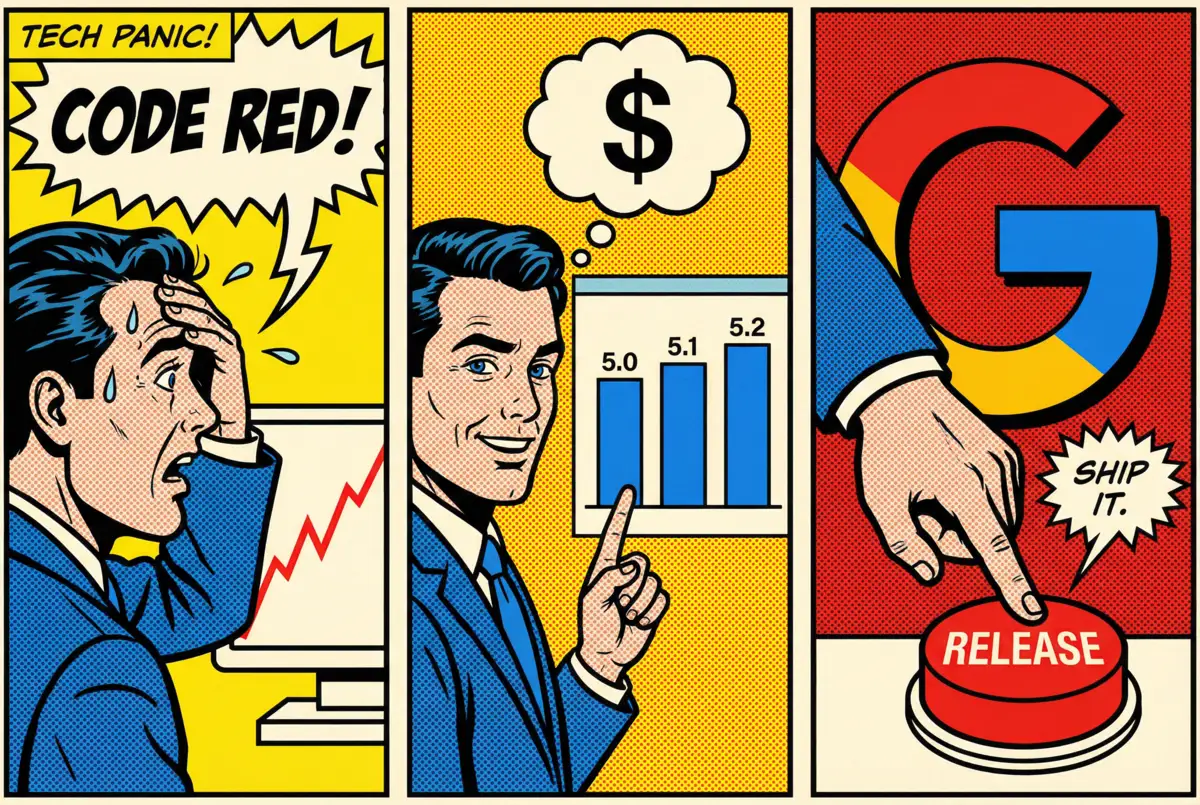
Sam Altman's December 1 memo warning about Google's Gemini 3 triggered OpenAI's fastest major release ever.
Ten days later, GPT-5.2 arrived with professional task performance nearly doubling to 70.9% expert-level and coding benchmarks hitting 55.6% on SWE-Bench Pro. Hallucinations dropped 38%. The capability gains are real, but so are the costs: API pricing jumped 40% to $1.75/$14 per million tokens, with Pro tier commanding $21/$168. Free users got nothing.
The competitive pressure shows in the timeline. Some employees pushed for delay to allow more testing. Leadership overruled them. Meanwhile, DeepSeek shipped comparable open-source models at $0.70 per million tokens, and Mistral undercuts OpenAI by an order of magnitude. The comfortable lead OpenAI enjoyed eighteen months ago has evaporated. GPT-5.2 represents territory defense, not expansion.
Why This Matters:
• Enterprise buyers now have credible alternatives at a fraction of OpenAI's pricing, shifting negotiating leverage
• The rushed timeline raises questions about whether safety testing kept pace with competitive urgency
 Marcus Schuler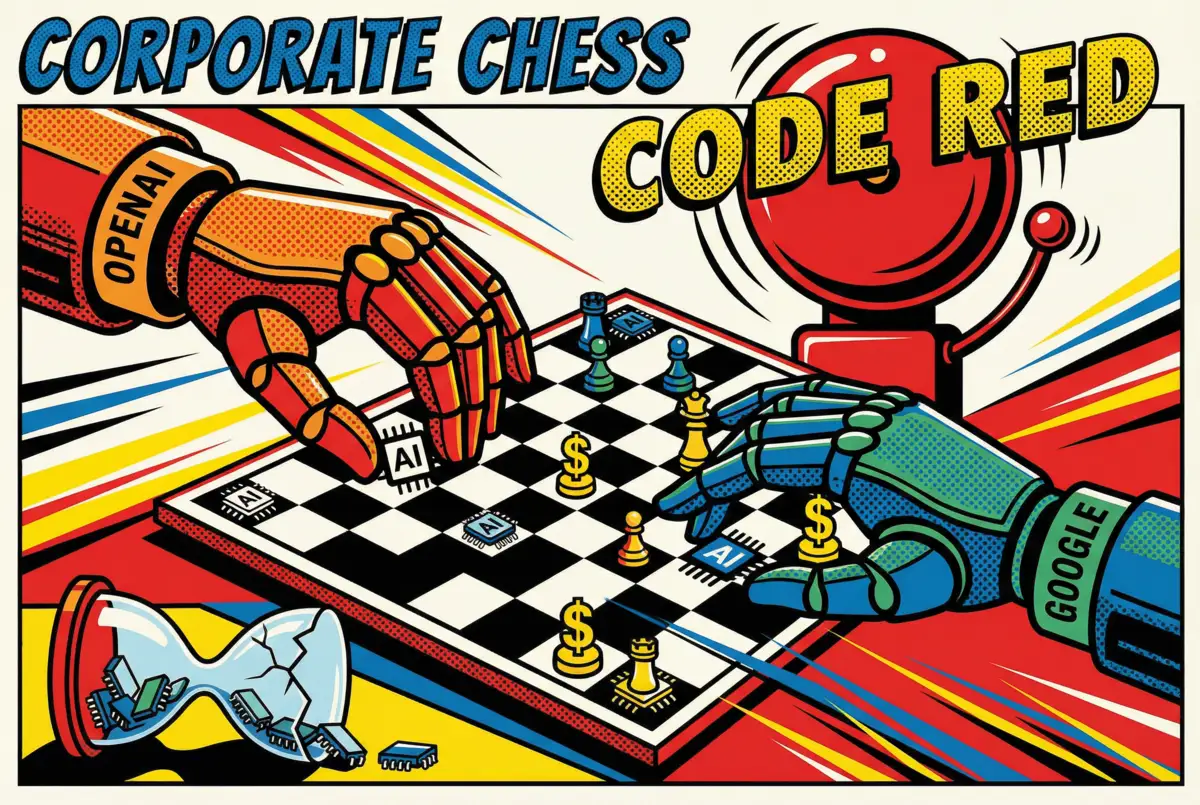
Sign up for Implicator.ai
Strategic AI news from San Francisco. Clear reporting on power, money, and policy. Delivered daily at 6am PST.
No spam. Unsubscribe anytime.
AI Image of the Day

Prompt:
Man and woman, 21, kissing, casual style, room
Trump's AI order threatens funding over laws he can't preempt

Trump signed an executive order Thursday directing the Justice Department to sue states over AI regulations and threatening to withhold $42 billion in rural broadband funding from those deemed "onerous."
The constitutional problem: only Congress can preempt state law, and Congress rejected AI preemption 99-1 in July. The order singles out Colorado's anti-discrimination law as "ideological bias," framing requirements for fair AI outputs as government-mandated falsehoods.
Republican governors are already pushing back. DeSantis called it "an AI amnesty" for tech companies. Bannon labeled it "a massive giveaway to Big Tech."
Yet Andreessen Horowitz celebrated, having lobbied for exactly this after congressional efforts failed twice. AI-linked super PACs have banked $100 million for the 2026 midterms.
Attorney General Pam Bondi has 30 days to create the litigation task force. The legal arguments are weak and courts will likely agree. But the chilling effect on state legislators is the real objective.
Rural broadband projects in Montana now depend on how Sacramento votes on AI.
Why this satisfies:
- State legislators face DOJ lawsuits and funding cuts if they pass AI safety laws through 2026
- AI companies gain critical deployment runway while constitutional challenges work through the courts
 Maria Garcia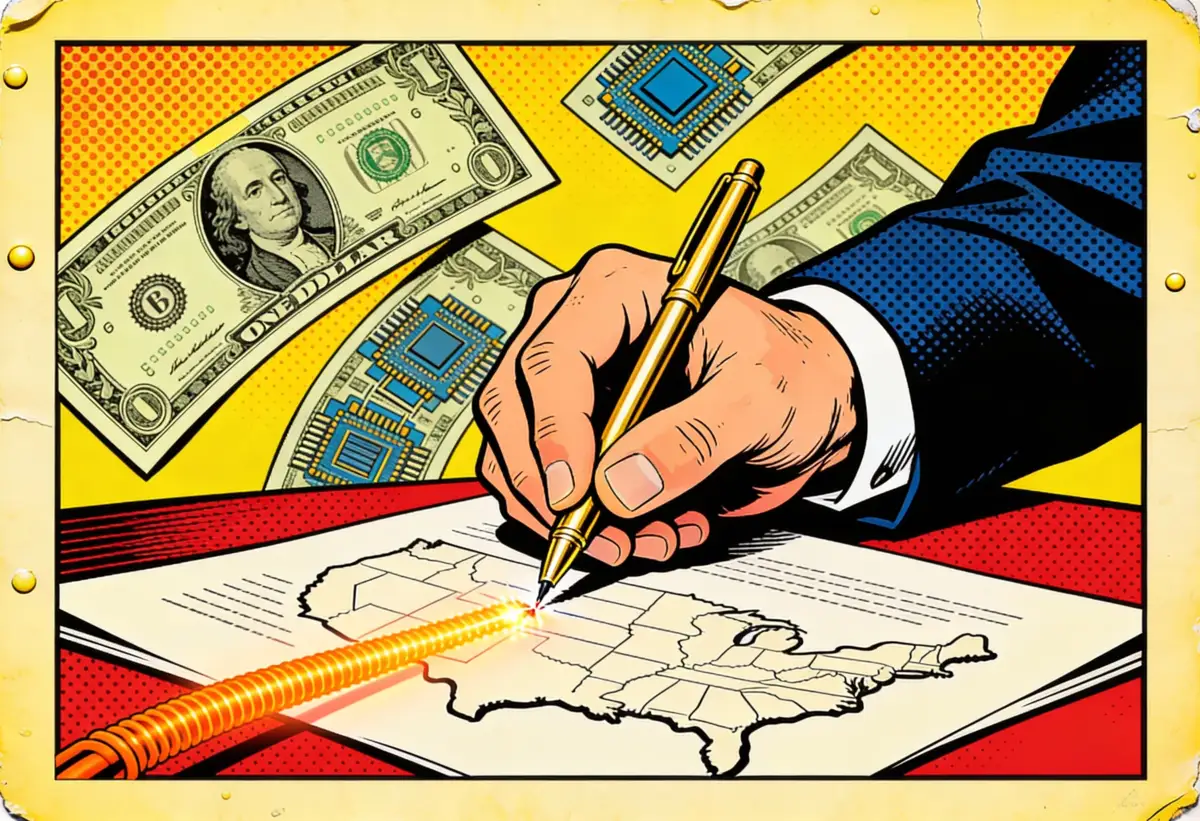
Google Builds Research Agent, Writes the Test, Tops the Leaderboard

Google released Gemini Deep Research through its new Interactions API on Thursday, giving developers access to autonomous research capabilities for the first time.
The company also open-sourced DeepSearchQA, a 900-task benchmark designed to evaluate multi-step web research. Gemini Deep Research leads that benchmark at 66.1% accuracy. GPT-5 Pro trails at 65.2%. Claude Opus 4.5 scores just 24.0%, fully incorrect on half its attempts.
The benchmark rewards exactly what Google built: tight integration between models and search infrastructure. Agents without native access to Google's search stack struggle by design.
Meanwhile, Google's own FACTS Benchmark shows Gemini 3 Pro achieving only 68.8% factuality overall, meaning roughly one-third of outputs fail accuracy checks. The Interactions API bundles models, agents, and file storage into a unified platform, with Deep Research coming soon to Search, NotebookLM, and Google Finance. Each integration deepens dependency.
Why This Matters:
- Competitors must build billion-dollar search infrastructure or accept permanent disadvantage on web research tasks
- Enterprise developers adopting the Interactions API face compounding switching costs as Google expands agent offerings
 Robert Brown
Disney Pays $1 Billion to Join the Company Disrupting It
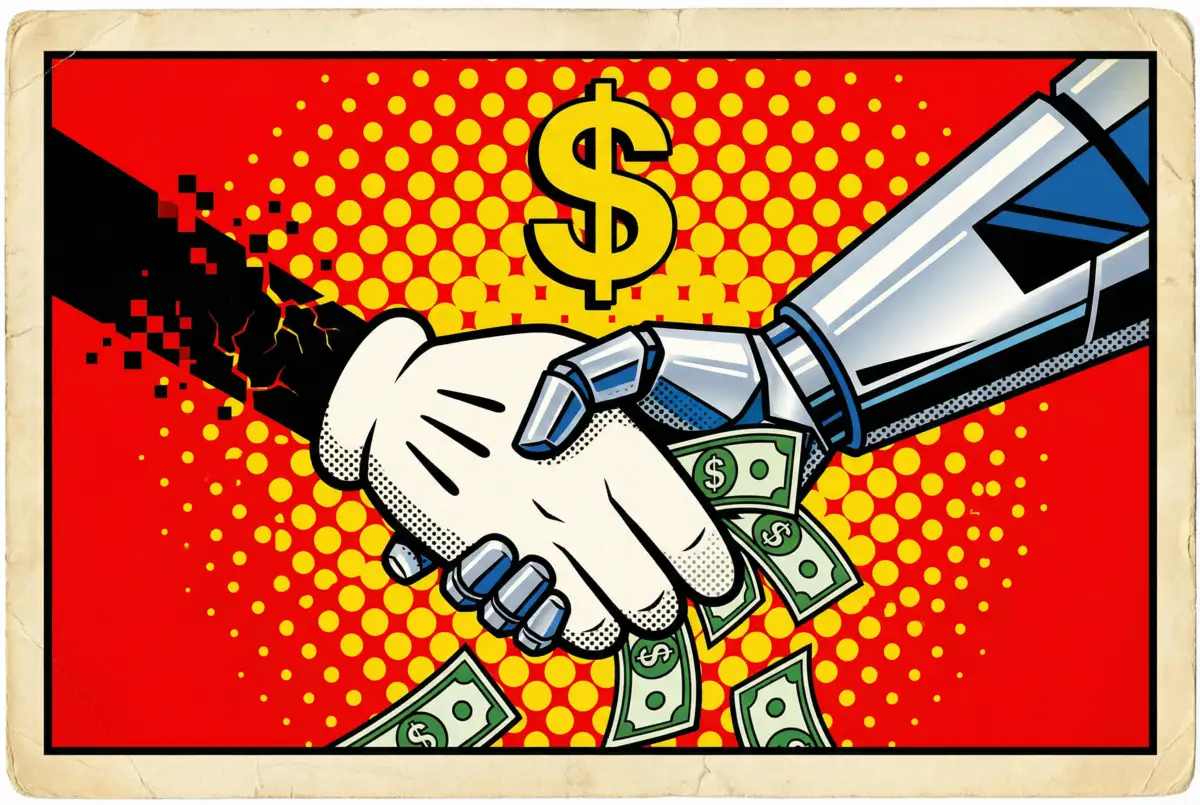
Hours after sending Google a cease-and-desist for AI copyright infringement on a "massive scale," Disney announced a $1 billion investment in OpenAI and a three-year deal licensing more than 200 characters to Sora.
The billion buys roughly 0.6% of OpenAI at its $157 billion valuation, while Disney gains the legitimacy of being the first major studio to opt in rather than fight. Starting in early 2026, users can generate videos featuring Mickey Mouse, Darth Vader, and the Frozen princesses, with "curated selections" appearing on Disney+ alongside professionally produced Pixar features.
Actor likenesses stay off the table, the one boundary preventing a SAG-AFTRA grievance. The strategy reads clearly: sue Google to set a legal floor, partner with OpenAI to capture licensing upside, establish market rates before competitors do. Other studios now face an ugly choice between matching Disney's terms or watching the flood hit without compensation. The panic that broke the music labels has returned wearing a different mask.
Why This Matters:
- Studios face pressure to match Disney's terms within months, accelerating AI licensing deals across Hollywood
- Concept artists and animators now compete against users generating character content in seconds for free
 Marcus Schuler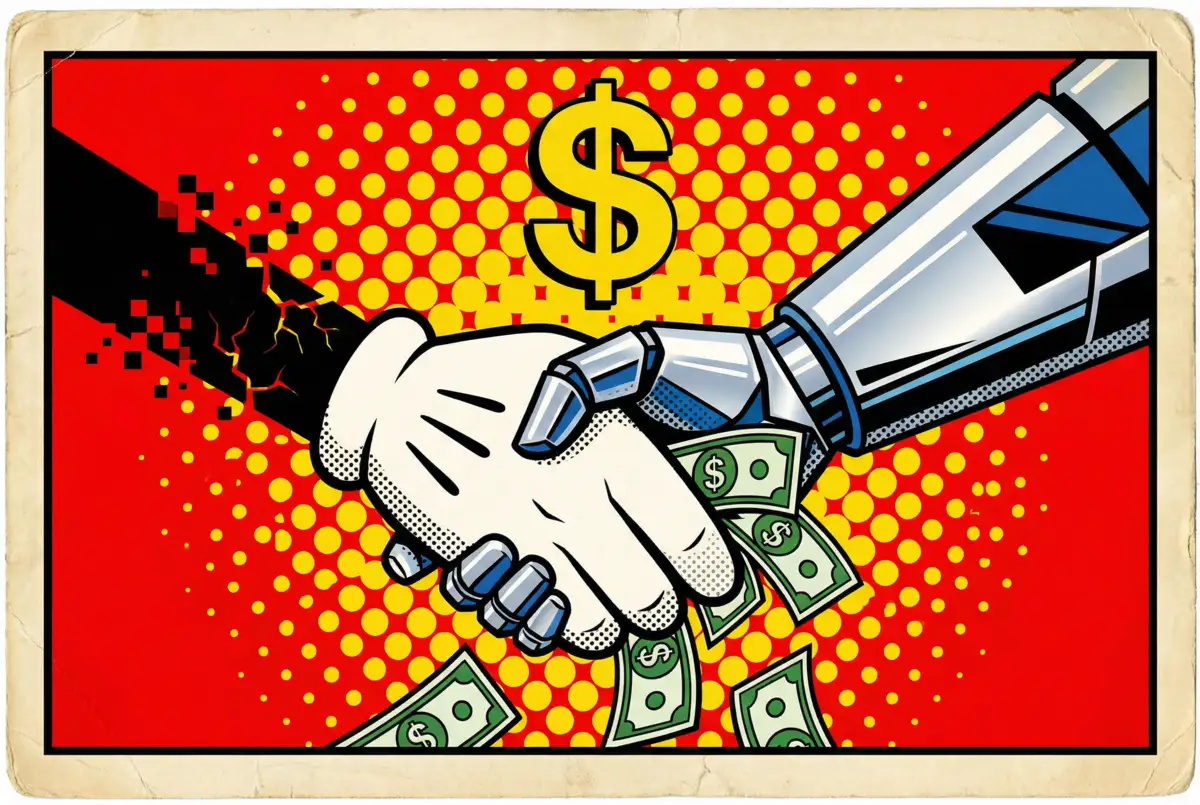
🧰 AI Toolbox
How to Generate SEO Blog Briefs in Minutes
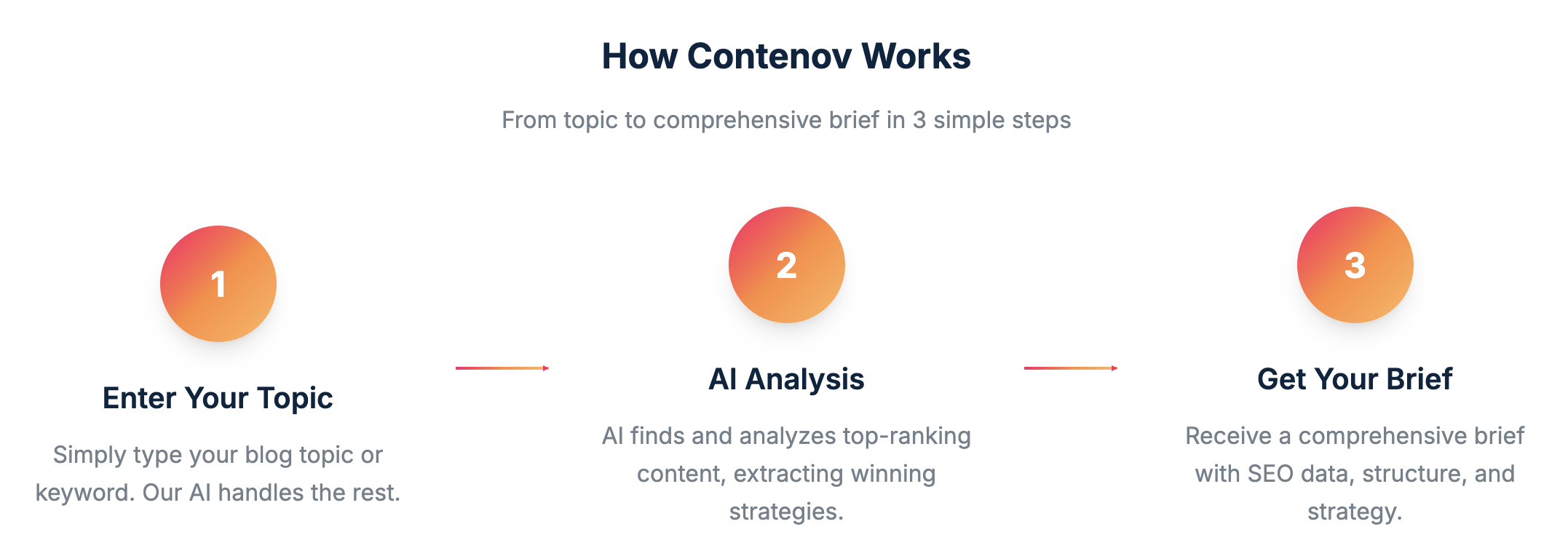
Contenov transforms any keyword or topic into a comprehensive, data-backed SEO blog brief using AI. It scrapes and analyzes top-ranking Google results, extracting structure, keywords, and winning strategies from competitor content to give you optimized outlines ready for writers.
Tutorial:
- Go to the Contenov website
- Enter your target keyword or blog topic
- The AI scrapes the top 10 Google results and analyzes the 5 most relevant pages
- Review the extracted headings, structure, and keyword recommendations
- Explore competitor insights and content patterns that drive rankings
- Download your complete, data-driven brief ready for your writing team
- Skip hours of manual research and create briefs that match what actually ranks
URL: https://www.contenov.com/
Better prompting...
Today: Daily Habit for Long-Term Growth
Recommend one micro-habit (under 10 minutes daily) that compounds toward financial stability, wealth building, productivity, and personal growth.
Requirements:
- Friction-free to start. No new tools, apps, or purchases required.
- Has a clear trigger. Tell me when and where to do it.
- Compounds measurably. Explain the mechanism. How does day 30 differ from day 1?
For your recommendation, include:
- The habit in one sentence
- Exact implementation (time of day, duration, steps)
- Why it works. Connect it to at least two of my four goals.
- One leading indicator I can track to know it's working
AI & Tech News
Reddit Sues Australia Over Social Media Ban for Minors
Reddit has filed a lawsuit in Australia's High Court seeking to overturn the country's recently enacted social media ban for users under 16 years old, arguing that the legislation violates the implied constitutional freedom of political communication. The legal challenge marks a significant escalation in tensions between tech companies and Australian regulators over youth online safety measures.
Intel Tests Chipmaking Tools From Company With Sanctioned China Units
Intel has tested chipmaking tools this year from California-based ACM Research, a company with deep ties to China whose two overseas units have been targeted by U.S. sanctions. The development highlights the complex supply chain relationships in the semiconductor industry as American companies navigate equipment sourcing while U.S.-China trade restrictions continue to tighten.
China Weighs Massive New Chip Industry Incentives Package
China is considering a substantial new incentives package ranging from $28 billion to $70 billion to support its domestic semiconductor manufacturing industry, according to sources cited by Bloomberg. This new funding initiative would operate independently from the already established $50 billion Big Fund III, signaling Beijing's intensified commitment to achieving self-sufficiency in chip production amid ongoing technology restrictions from the United States.
Nvidia Considers Expanding H200 Chip Production Amid Strong Chinese Demand
Nvidia has informed its Chinese clients that the company is evaluating an expansion of production capacity for its H200 artificial intelligence chips after demand exceeded current output levels. The move comes as robust orders from the Chinese market continue to drive strong interest in the chipmaker's advanced AI processors despite ongoing U.S.-China trade tensions.
China's Huawei Achieves Chip Breakthrough with New Kirin 9030 Processor
Huawei Technologies has unveiled its Kirin 9030 processor in the Mate 80 Pro Max smartphone, which analysis firm TechInsights has identified as China's most advanced semiconductor to date. The chip was manufactured by Semiconductor Manufacturing International Corp. (SMIC) using an updated 7nm process technology, demonstrating continued progress by China's leading chipmakers despite ongoing international trade restrictions on advanced semiconductor equipment.
X's New Product Chief Aims to Win Back Journalists with Algorithm Overhaul
X's product chief Nikita Bier has outlined plans to rebuild the platform's recommendation algorithm, eliminating keyword suppression and manual downranking in an effort to regain the trust of journalists who have left the platform. In an interview with Alex Heath at Sources, Bier acknowledged that X must "earn their trust" to bring back media professionals who departed following changes under Elon Musk's ownership.
AI Startup Serval Reaches Unicorn Status with $75M Funding Round
AI-powered IT support startup Serval has secured $75 million in Series B funding led by Sequoia Capital, propelling the company to a $1 billion valuation and unicorn status. The latest round brings Serval's total funding to $127 million as the company expands its AI-driven IT automation solutions.
Taiwan Launches Largest AI Supercomputing Center
Taiwan has inaugurated its largest AI supercomputing data center in Tainan, equipped with Nvidia's cutting-edge Blackwell chips, marking a significant milestone in the island's pursuit of technological independence. The facility represents a major investment in Taiwan's sovereign AI capabilities and reinforces its position as a global leader in semiconductor innovation and advanced computing infrastructure.
Substack Reverses Controversial Feature That Forced Mobile Users to Download App
Substack has rolled back a quietly implemented feature that prevented paid subscribers from reading full newsletters on mobile devices without downloading the company's app, following complaints from prominent creators. Tech writer Gergely Orosz publicly criticized the change, stating it "broke email" for his paid subscribers and threatened to leave the platform if the restriction remained in place.
Epic Games CEO Celebrates Appeals Court Victory Against Apple
Epic Games CEO Tim Sweeney has declared that the Ninth Circuit Court of Appeals' decision in the ongoing Epic v. Apple contempt ruling appeal effectively eliminates Apple's ability to collect what he termed "junk fees" through its App Store rules. In an interview with The Verge, Sweeney praised the ruling as "really awesome for all developers," signaling a potentially significant shift in how Apple can monetize its App Store platform.
EU Imposes New €3 Customs Duty on Low-Value Parcels to Target Chinese E-Commerce Giants
European Union finance ministers have approved a new €3 ($3.52) customs duty on low-value parcels entering the bloc, set to take effect in July 2026. The measure is designed to crack down on the influx of cheap imports from Chinese e-commerce brands such as Shein, which have benefited from existing exemptions on low-value goods shipped directly to European consumers.
Get Implicator.ai in your inbox
Strategic AI news from San Francisco. No hype, no “AI will change everything” throat clearing. Just what moved, who won, and why it matters. Daily at 6am PST.
No spam. Unsubscribe anytime.
🚀 AI Profiles: The Companies Defining Tomorrow
Worktrace AI watches how your employees actually work, then turns those patterns into AI automations you can deploy. It's task mining meets agent building, minus the six-month consulting engagement. 🔍
• Founders
Angela Jiang (OpenAI alum, shipped GPT-4) and Deepak Vasisht (UIUC professor, Microsoft research vet) founded Worktrace in San Francisco after meeting at South Park Commons. Built the product in eight months. Classic "builder meets researcher" origin story with a twist. They didn't share an employer. They shared a thesis.
• Product
Desktop agent observes employee workflows in real time. Identifies repetitive tasks. Ranks automation candidates by hours saved. Spits out code-friendly files you can plug into OpenAI, Anthropic, or Microsoft agent builders. Then monitors performance and improves. HIPAA and SOC 2 compliant. The pitch: replace stale SOPs with observed truth. No more interviewing teams for months.
• Competition
Crowded space. UiPath, Microsoft Power Automate, and Celonis all do task/process mining. SAP plays here too. Big consultancies sell the same transformation, just slower and pricier. Worktrace bets it can move faster than incumbents and cheaper than Accenture. The risk? Frontier labs add native discovery and Worktrace becomes a feature.
• Financing
$9.3M seed led by Conviction and 8VC. OpenAI Startup Fund participated. Angel roster reads like an OpenAI reunion: Mira Murati, Jason Kwon, Logan Kilpatrick. Business Insider reported a $50M valuation target. Dense insider backing signals credibility in the AI talent wars. 💰
• Future ⭐⭐⭐⭐
Right founders, right moment, right investor list. The product thesis matches enterprise pain. But Worktrace lives or dies on trust. Watching employees work triggers nerves no algorithm can soothe. Win that cultural battle and they own the observation layer. Lose it and they're stuck in pilot purgatory forever.


