Implicator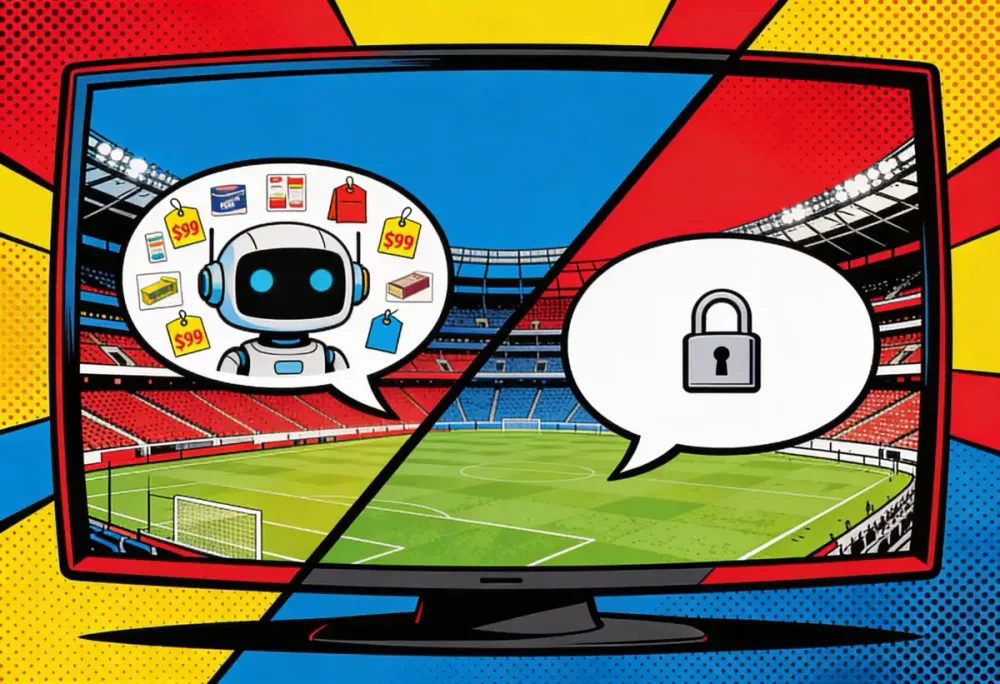
OpenAI began testing advertisements inside ChatGPT on Monday, less than 24 hours after rival Anthropic aired Super Bowl commercials mocking the move, CNBC reported citing a person familiar with the matter. Free and Go-tier users will see "clearly labeled" sponsored products at the bottom of chatbot responses, matched to the conversation they're having. OpenAI expects advertising to account for less than half of its revenue over the long term, the person said, though the company burns roughly $9 billion a year while generating about $13 billion in revenue.
Key Takeaways
• OpenAI began testing ads in free-tier ChatGPT on Monday, matched to user conversations, with health and political topics excluded
• Anthropic aired four Super Bowl LX parody spots mocking AI ads to an estimated 120 million viewers, prompting a public counterattack from Altman
• Both companies released frontier coding models within minutes of each other: GPT-5.3-Codex and Claude Opus 4.6
• OpenAI is closing a $100 billion funding round; Anthropic's own round exceeds $20 billion, with both planning IPOs as early as this year
Anthropic spent millions on four Super Bowl LX spots last night, each depicting a human stand-in for an AI chatbot hijacking personal conversations with absurd product pitches. One showed a therapist-figure recommending a cougar-dating site mid-session. Another had a personal trainer pushing height-boosting insoles. Every spot ended with the same line: "Ads are coming to AI. But not to Claude." An estimated 120 million viewers watched the game, according to Reuters. Anthropic's most-viewed commercial had racked up 390,000 views before kickoff. OpenAI's earnest counterpart, a one-minute ad about a man building with Codex, sat at 26,000.
Sam Altman fired back. He called Anthropic's campaign "so clearly dishonest" in a lengthy post on X last week, then escalated: "One authoritarian company won't get us there on their own. It is a dark path." CMO Kate Rouch piled on, writing that "Anthropic thinks powerful AI should be tightly controlled in small rooms in San Francisco and Davos." President Greg Brockman went further, publicly asking Dario Amodei whether he would "commit to never selling Claude's users' attention or data to advertisers," and noting that Anthropic's own blog post hedges with the phrase "should we need to revisit this approach."
The anger is real. It is also defensive, and expensive to maintain.
The business math behind the ads
Only 5 percent of ChatGPT's 800 million weekly users pay for subscriptions, Ars Technica reported. That works out to roughly 40 million paying customers propping up a company that struck more than $1.4 trillion in infrastructure deals in 2025 alone. Altman himself called advertising a "last resort" in October 2024. Sixteen months. Now it's here.
OpenAI is now chasing a $100 billion funding round, with Microsoft, Nvidia, Amazon, and SoftBank all in talks to participate, sources told CNBC. The first tranche could include Amazon at up to $50 billion. SoftBank, which already contributed $30 billion in a March round totaling $41 billion, is discussing another $30 billion. CFO Sarah Friar and Altman have been circulating charts to investors showing Codex eating into Claude Code's market share, according to a screenshot seen by CNBC.
Anthropic is not yet profitable either, but it looks emboldened rather than cornered. The two companies carry their losses differently. OpenAI relies on consumers for more than 60 percent of revenue, the Observer reported, while Anthropic pulls 85 percent from enterprise clients. OpenAI's cheapest paid tier costs $8 a month. Claude's starts at $17. Altman cast this as proof of populism. "More Texans use ChatGPT for free than total people use Claude in the U.S.," he wrote. "So we have a differently-shaped problem than they do."
What he left out: the ad structure OpenAI described, serving "relevant sponsored product or service based on your current conversation," means the chatbot reads your queries to decide which ads to show. OpenAI says conversations won't be shared with advertisers. Users under 18, or those discussing health, mental health, or politics, won't see ads. Plus and Pro subscribers are exempt. But if you ask free-tier ChatGPT for workout advice, you may now get a sponsored product alongside the answer.
New models, same week
Both companies released frontier coding models last week within minutes of each other. OpenAI shipped GPT-5.3-Codex, which outperforms its predecessor on SWE-Bench Pro and Terminal-Bench 2.0, runs 25 percent faster, and extends the tool's reach beyond code generation into deployment, monitoring, and test management. Anthropic answered with Claude Opus 4.6, which introduced "agent teams," a feature allowing multiple Claude instances to coordinate through a shared Git repository without a central orchestrator.
Both companies made the same claim about their new releases, and it was a strange one. The models, they said, helped build themselves. OpenAI said GPT-5.3-Codex was "instrumental in creating itself," assisting with debugging, deployment management, and test evaluation. Anthropic researcher Nicholas Carlini published a blog post describing how 16 Opus 4.6 instances, working inside separate Docker containers over two weeks, produced a 100,000-line Rust-based C compiler capable of booting a Linux kernel. Cost: about $20,000 in API fees. The compiler passes 99 percent of the GCC torture test suite and compiles PostgreSQL, Redis, and Doom.
Impressive on paper. Less impressive once you read the fine print. Carlini spent weeks building custom test harnesses, context-management pipelines, and feedback systems tailored to the specific ways language models lose coherence. When all 16 agents got stuck on the same Linux kernel bug simultaneously, he had to build an oracle using GCC as a reference to unstick them. "Claude will work autonomously to solve whatever problem I give it," Carlini wrote. "So it's important that the task verifier is nearly perfect, otherwise Claude will solve the wrong problem." The compiler's own assembler and linker remain buggy, and it produces less efficient code than GCC running with optimizations turned off.
Altman told employees on Friday that Codex grew 50 percent in a single week and called its growth "insane." He said the standalone macOS app, launched the previous Monday, had reached 500,000 downloads. "I believe Codex is going to win," he wrote in the internal Slack message seen by CNBC.
There is a catch worth watching. ChatGPT itself still runs on the older GPT-5.2. With Codex now at 5.3, a similar upgrade for the consumer chatbot is expected soon, though OpenAI hasn't announced a date. Altman told employees that "an updated Chat model" was coming later this week. That news triggered a trillion-dollar software stock selloff, Vanity Fair reported, as some investors feared established tech companies would become obsolete if AI models keep improving at this pace.
Join 10,000+ AI professionals
Strategic AI news from San Francisco. No hype, no "AI will change everything" throat clearing. Just what moved, who won, and why it matters. Daily at 6am PST.
No spam. Unsubscribe anytime.
What the ads actually look like
Anthropic's commercials are exaggerations. Nobody at OpenAI is going to interrupt your therapy conversation with cougar-dating pitches. That's the whole point of Altman's objection, and on the specifics, he's right.
But Anthropic didn't invent the anxiety out of thin air. The concern about ads in AI assistants is structural, and it runs deeper than banner placement. These tools handle queries that used to go to doctors, therapists, financial advisors, and search engines. People type things into ChatGPT they wouldn't say out loud in a waiting room. Anthropic spelled this out in a blog post last Tuesday, calling open-ended AI conversations "deeply personal or complex" and comparing the relationship to one "with a trusted adviser." Advertising in that space, even labeled and sitting at the bottom of the page, changes the nature of the product. It turns a tool optimized for your answer into a tool optimized for your attention.
Andrew Stirk, Anthropic's head of brand, told Vanity Fair that the campaign grew out of focus groups and a nationwide YouGov poll. "One of the biggest anxieties people have about AI is its implications on cognitive dependency and misinformation," he said. "People worry about how AI will impact their thinking." Anthropic's chief communications officer, Sasha de Marigny, was more direct. "Consumers have real agency in the outcome of AI's impact," she said. "And we want them to know that there is an alternative to the status quo."
Neither company's ads landed well with test audiences. Both Anthropic's parody spots and OpenAI's earnest Codex commercial drew negative reactions in consumer testing, according to iSpot, an ad-measurement firm. Sean Muller, iSpot's CEO, told Reuters that OpenAI "is still trying to find its way with storytelling and narrative." Sam Singer, president of Singer Associates Public Relations, offered a more pragmatic read: "The dispute between OpenAI and Anthropic makes the Super Bowl more interesting. The compelling battle between two companies with two similar products is going to make people think about Claude or ChatGPT, and that will benefit both parties."
A rivalry that can't afford to stay personal
Dario Amodei worked under Altman at OpenAI before leaving in 2020 over disagreements about safety practices. He co-founded Anthropic the following year with his sister Daniela and a group of other OpenAI alumni. The companies are now valued at $500 billion and $350 billion, respectively. Both plan to go public as early as this year, Vanity Fair reported.
The feud has real commercial consequences. Anthropic has blocked OpenAI from accessing Claude's coding tools. Altman cited this in his X post as evidence that Anthropic wants to "control what people do with AI." Anthropic's Claude Code hit $1 billion in annualized recurring revenue just six months after launch, per the Observer, and the coding-tool rivalry is now the most contested ground between the two companies. OpenAI's internal charts, shown to investors, claim Codex is clawing back share.
Tech overtook food and beverage as the top Super Bowl ad-buying category this year, Vanity Fair reported, a first. Only 17 percent of U.S. adults think AI will have a positive impact over the next 20 years, according to the ad-tracking firm Guideline. Both companies are spending millions to change that number while simultaneously attacking each other's business model in front of 120 million people.
Lulu Cheng Meservey, founder of tech communications firm Rostra, described what Anthropic is doing as cashing in on "underdog privilege." That framing makes more sense when you remember that this particular underdog was valued at $350 billion and is closing a funding round of more than $20 billion.
The Super Bowl spots will fade. The business models won't. OpenAI needs its 760 million free users to stick around once ads start appearing in their conversations. Anthropic needs to prove that "no ads" translates into paying customers, not just goodwill. We'll get a first read within weeks. OpenAI's $100 billion funding round is expected to close by month's end. Anthropic's own round, north of $20 billion, is right behind it. The investors writing those checks will be watching the same number from opposite sides of the bet.
Frequently Asked Questions
Q: Will ChatGPT ads appear for paid subscribers?
A: No. OpenAI confirmed that Plus and Pro subscribers are exempt from ads. Only free and Go-tier users will see sponsored products, labeled and placed at the bottom of chatbot responses.
Q: What did Anthropic's Super Bowl commercials actually show?
A: Four parody spots depicted human stand-ins for AI chatbots hijacking personal conversations with absurd product pitches, like a therapist recommending a dating site mid-session. Each ended with: "Ads are coming to AI. But not to Claude."
Q: How does OpenAI's ad targeting work inside ChatGPT?
A: The system reads the user's current conversation to serve a relevant sponsored product or service. OpenAI says conversations are not shared with advertisers. Users under 18 and those discussing health, mental health, or politics are excluded.
Q: What is GPT-5.3-Codex and how does it compare to Claude Opus 4.6?
A: GPT-5.3-Codex is OpenAI's latest coding model, outperforming its predecessor on SWE-Bench Pro and running 25% faster. Claude Opus 4.6 introduced "agent teams" allowing multiple Claude instances to coordinate through shared Git repositories. Both companies claim the models helped build themselves.
Q: How much revenue does OpenAI generate from subscriptions versus advertising?
A: Only 5% of ChatGPT's 800 million weekly users pay for subscriptions. OpenAI generates about $13 billion in annual revenue, mostly from consumers, while burning roughly $9 billion a year. The company expects advertising to account for less than half of long-term revenue.

Maria Garcia
Bilingual tech journalist slicing through AI noise at implicator.ai. Decodes digital culture with a ruthless Gen Z lens—fast, sharp, relentlessly curious. Bridges Silicon Valley's marble boardrooms, hunting who tech really serves.