IMPLICATOR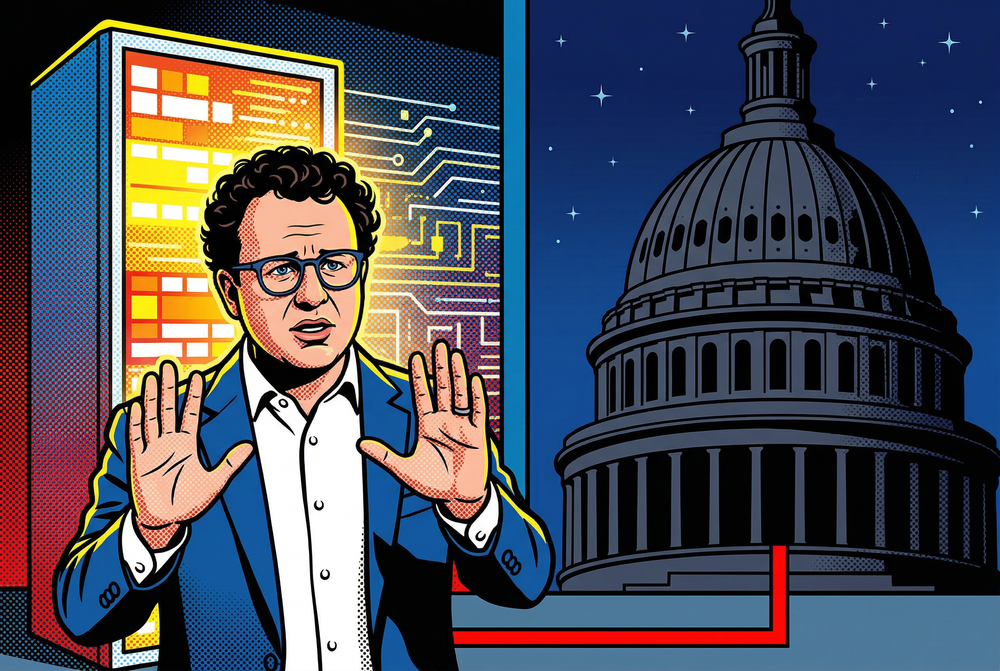
On Thursday, Dario Amodei rejected the Pentagon's "best and final offer" to lift restrictions on military use of his company's AI model Claude. "We cannot in good conscience accede to their request," he wrote. Defense Secretary Pete Hegseth has given Anthropic until Friday at 5:01 p.m. to comply or face blacklisting as a supply chain risk, a classification normally reserved for entities like Huawei.
Call it a "contractor dispute." Better: call it a constitutional vacancy.
Anthropic's two conditions are narrow. No mass surveillance of Americans. No fully autonomous weapons without human oversight. The Pentagon's counter is equally narrow: no conditions at all. "All lawful purposes," the military demands. The phrase sounds reasonable until you notice what it omits. It omits the law that doesn't exist yet.
Responsibility is not a product feature.
That is what this standoff actually exposes. A private company is drawing lines that elected officials should have drawn years ago. Amodei published a 20,000-word essay in January warning that AI could enable "a swarm of billions of AI-controlled drones" or convert "scattered, individually innocuous data into a comprehensive picture of any person's life." He was describing the exact capabilities the Pentagon now demands unrestricted access to. One man with 2,000 employees, doing the work that 535 legislators have refused to begin.
In 1946, the United States faced a version of this question. The military wanted sole custody of nuclear technology after Hiroshima. Scientists objected. Congress stepped in. The Atomic Energy Act stripped the military of its monopoly and handed authority to a civilian commission. The lesson still holds. When a technology can alter the balance between the state and the citizen, generals do not get to write their own permission slip. Neither do contractors.
Contractors do not write constitutions.
The Atomic Energy Act worked because Congress accepted three obligations: define the technology's boundaries, codify civilian oversight that survives changes in administration, and create an enforcement body with real authority. AI demands the same. But nobody on Capitol Hill has defined what "autonomous weapon" means. Nobody has written surveillance prohibitions into statute. The oversight mechanism does not exist, and every Friday that passes without one makes the next contractor negotiation a little more absurd.
AI operates on classified military networks today, and the only governance in place is a contract negotiation between a startup CEO and a defense secretary who labels safety concerns "woke."
Silence is not neutrality.
Anthropic sounds emboldened. It may still lose. The $200 million contract, the classified network access, the standing that comes from being the Pentagon's most capable AI vendor, all of it could vanish by Friday evening. Three competitors, xAI, OpenAI, and Google, are waiting to sign deals without any of Amodei's restrictions. None will say whether their models can be used for surveillance or autonomous weapons.
That should alarm Congress. Senators Warren and Kim have already warned the administration. The Koch-affiliated Abundance Institute called for reform from the opposite end of the spectrum. When the only institution willing to impose limits on military AI is a private company, and the government is threatening to destroy that company for doing so, the absence of legislation is not a gap. It is a choice.
Amodei drew the line. Congress should have drawn it first.
Related opinion
 Implicator.ai
 Implicator.ai
 Implicator.ai

Marcus Schuler
Editor-in-Chief and founder of Implicator.ai. Former ARD correspondent and senior broadcast journalist with 10+ years covering tech. Writes daily briefings on policy and market developments. Based in San Francisco. E-mail: [email protected]