Implicator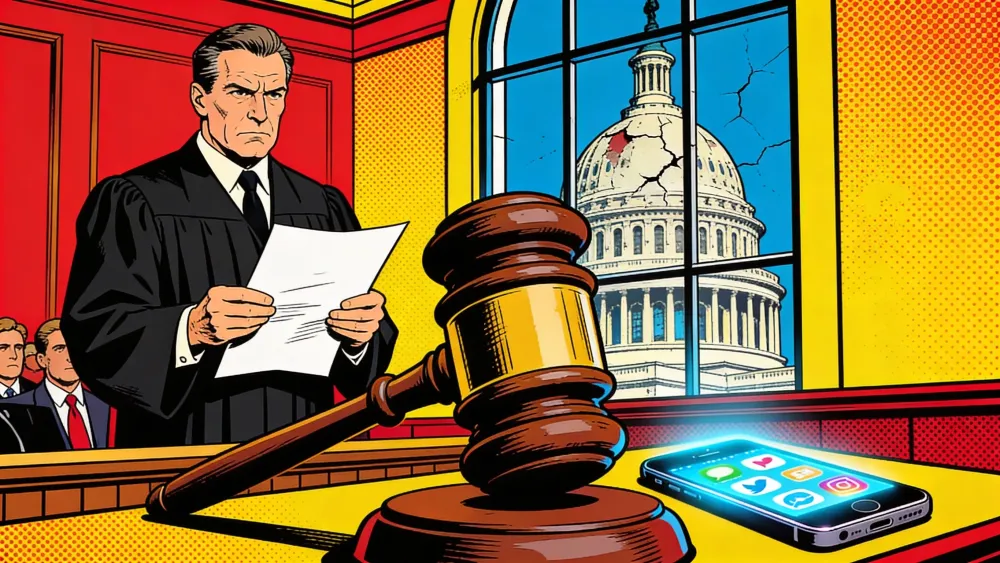
This week, two juries in two states did what the United States Congress has failed to do for thirty years. In Los Angeles, a panel of twelve citizens found Meta and YouTube negligent in designing products that harmed a young woman's mental health, awarding her $6 million in damages. A day earlier in Santa Fe, a New Mexico jury imposed $375 million in civil penalties on Meta for exposing minors to sexual exploitation on its platforms.
Zuckerberg took the stand in Los Angeles. Jurors later said he seemed inconsistent, unprepared, oddly detached from the products at the center of the case. They deliberated eight days. Then they held his company accountable.
Combined penalty: $381 million. Major federal child safety legislation enacted in the same period: zero.
Call it "legislative deliberation." Better: call it abdication.
Hearings are not governance.
This publication has criticized the current administration for its anti-democratic impulses. That criticism stands. But the failure exposed this week predates any single presidency. For thirty years, legislators in Washington have understood the urgency of child safety online. They acknowledged it in speeches, hearings, and campaign promises. They produced no law.
Congress passed Section 230 in 1996 and gave internet companies a liability shield for what their users post. In the thirty years since, the legislative branch has performed concern without producing law. Lawmakers hauled chief executives in front of cameras and introduced dozens of child safety bills. Every one stalled. Last July the Kids Online Safety Act went through the Senate 91 to 3. Not a close vote. The House let it die. Three decades of urgency, and not a single statute on the books.
The record is so barren it reads as confession.
Money is the mechanism.
Why the paralysis? The answer is structural and it is old. Meta's federal lobbying tab in 2025: $26 million. A company record. The broader technology sector pours tens of millions more into campaign contributions each cycle. The money does not buy votes outright. It buys inertia. Bills die in committee. Amendments vanish. Nothing reaches a floor vote, no matter how lopsided the Senate tally. Ninety-one senators said yes. House leadership never scheduled the vote.
Elected officials answer to their donors. The parents who vote come second, if they register at all. The people who are supposed to work for voters work instead for their funders.
This is not cynicism. It is the structure.
The courtroom remembers what the Capitol forgets.
The pattern has a precedent, and it is exact. For four decades, Congress knew that cigarettes killed Americans. The evidence accumulated in Surgeon General reports, epidemiological studies, and damning internal industry documents. Legislators held hearings. They expressed alarm. They did nothing, because tobacco money flowed into campaign accounts with the same bipartisan regularity.
The courts broke the deadlock. In the 1990s, state attorneys general filed suit. Juries heard evidence that executives had suppressed. In 1998, Philip Morris and R.J. Reynolds settled. The bill came to $206 billion, paid out over a quarter century. State attorneys general, not Congress, forced that outcome.
People who had never cashed a lobbying check read the internal documents and decided.
The pattern now repeats. The plaintiffs' lawyers in Los Angeles found a way around Section 230. They argued the platform itself, not what users posted on it, was the defective product. Infinite scroll. Autoplay video. Algorithmic feeds tuned for engagement. The jury said these made the apps dangerous by choice, not by accident. The jury agreed. That theory now forms the basis of thousands of pending lawsuits, with further trials scheduled through the year. Silicon Valley sits in the same chair Big Tobacco occupied a generation ago.
The framers built the backup.
The Constitution anticipated exactly this kind of failure. Hamilton had a word for this. In Federalist No. 78, he called judicial independence "peculiarly essential." Essential for what? For the day the political branches stop doing their jobs. The Seventh Amendment hands that backup power to twelve citizens in a room. Not judges. Not senators. Neighbors.
From this design, three observations follow.
First, the jury is the most direct democratic instrument in the republic. Twelve citizens cannot be lobbied. They cannot receive campaign contributions. They examine evidence under oath and deliver verdicts that no committee chair can table, no filibuster can delay, and no donor can quietly kill.
Second, judicial correction is a symptom, not a cure. When courts must repeatedly do the legislature's work, the system is not functioning as designed. It is running on reserves.
Third, the reserves are finite. Courts handle one case at a time. They do not write national regulations or staff enforcement agencies. A verdict in Santa Fe does not become a rule for Menlo Park. A jury can punish Meta for harming one plaintiff. It cannot protect the millions of American children who will open Instagram tonight.
A verdict on democracy itself.
We should be grateful the courts held. But gratitude is a low bar for a self-governing republic.
Those who seek our votes owe more than theater. They must honor the Constitution not as rhetoric for fundraising emails but as a binding obligation to govern. When attorneys general in more than forty states file suit against the same company for the same harm, and Congress still cannot produce a statute, the dysfunction is no longer incidental.
It is structural. And it is chosen.
The two verdicts this week are not a triumph of the American system. They are a diagnosis of the branch that was supposed to act first. Until legislators answer to voters rather than donors, ordinary citizens in jury boxes will continue to deliver the protections that the democratic process was designed to provide.
A republic that governs only through its courts has not been saved. It has been exposed.

Marcus Schuler
Tech translator with German roots who fled to Silicon Valley chaos. Decodes startup noise from San Francisco. Launched implicator.ai to slice through AI's daily madness—crisp, clear, with Teutonic precision and sarcasm. E-Mail: [email protected]