Implicator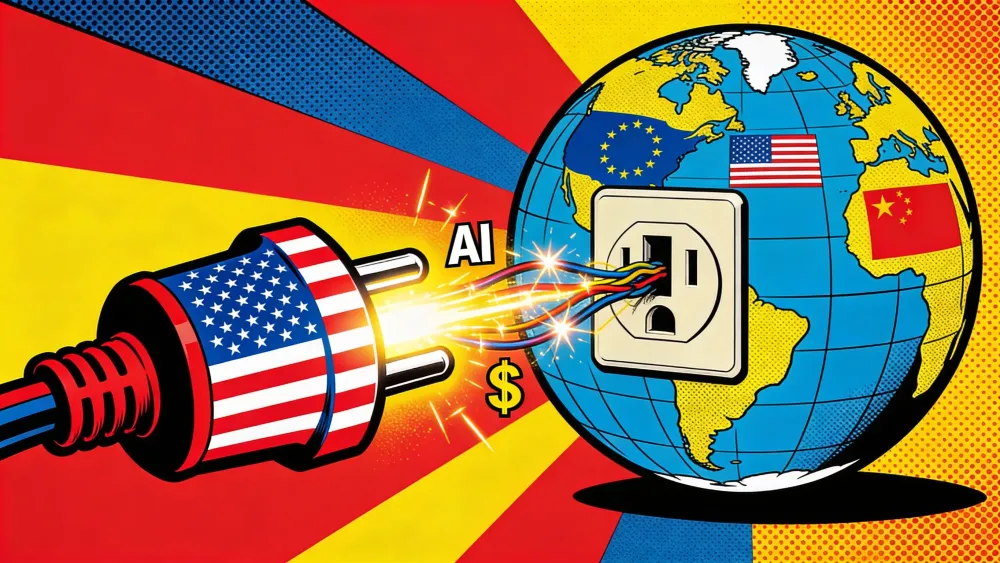
Every earnings call out of Silicon Valley sounds like a victory lap. Foundation model revenue climbs. Cloud AI contracts multiply across Europe, Asia, and the Middle East. Adoption curves look like destiny.
They are also the setup for the most predictable backlash in the history of American power.
Four weeks ago, at Davos, Mark Carney said the quiet part at full volume. "We are in the midst of a rupture, not a transition." Integration, the Canadian prime minister declared, had become "the source of your subordination." Carney is no dissident. He ran the Bank of Canada and then the Bank of England, a technocrat who speaks in yield curves and basis points. When a man of that pedigree calls the American-led order finished, the diagnosis is the event.
He was talking about the dollar. He should have been talking about what comes next.
Generosity is the oldest trap.
Call it "open innovation." Better: call it dependency by design.
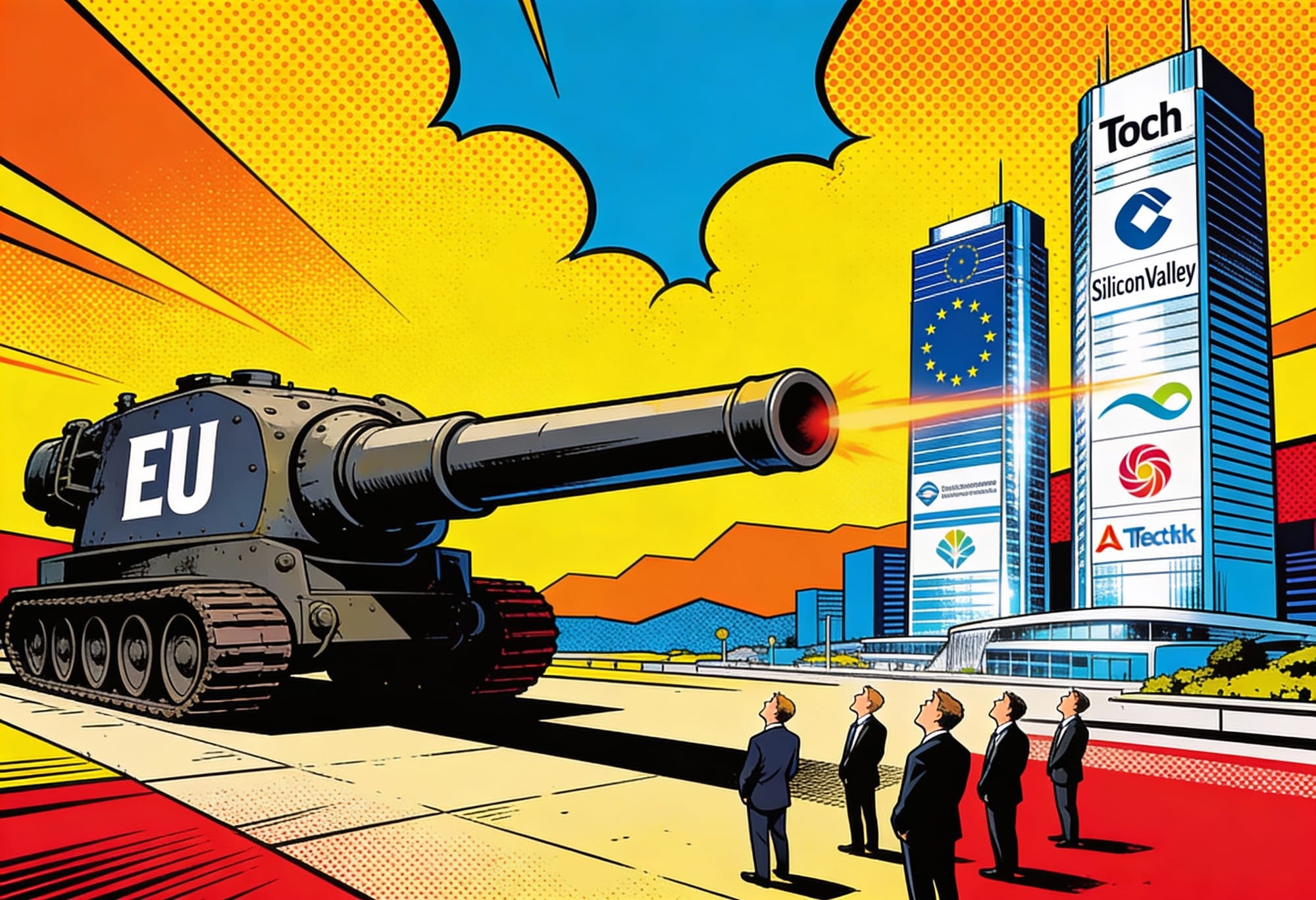
The Trump administration's AI strategy rests on a single bet. Flood the world with American models, relax export controls, let Silicon Valley run, and wait. The assumption is straightforward. Once foreign governments, corporations, and militaries build critical systems on American AI infrastructure, they will have no practical choice but to stay. Too good, too embedded, too expensive to replace.
The playbook is not new. Only the hardware is.
Infrastructure remembers who built it.
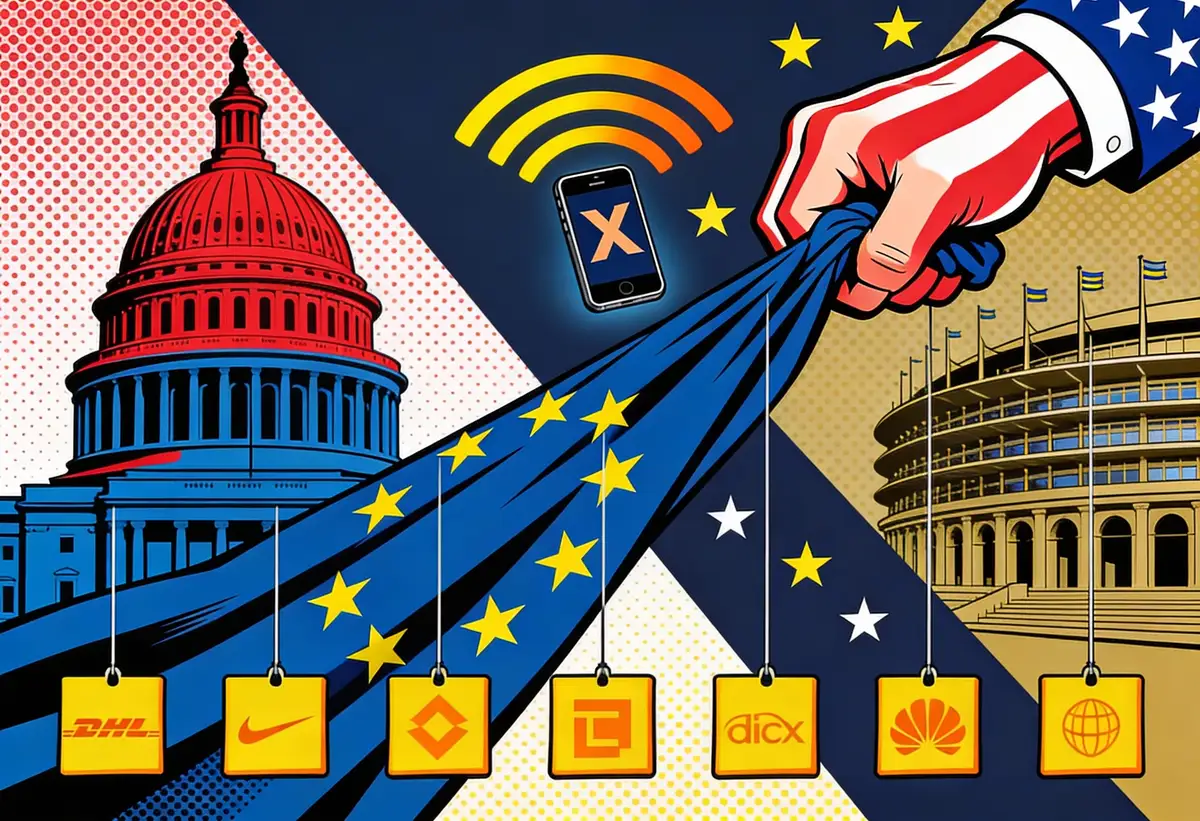
Henry Farrell and Abraham Newman, in Underground Empire: How America Weaponized the World Economy, traced the arc with clinical precision. After September 11, 2001, Washington discovered that the global dollar-clearing system, a neutral financial utility, could function as a weapon. Any international bank that wanted access to U.S. dollars, which meant nearly every bank on earth, was subject to American jurisdiction. Target a bank, and capital fled. Target a country, and it bartered crude oil for grain and crate loads of zippers.
Iran learned this the hard way, cut off from global finance so completely that it could not get paid for its own petroleum.
From Farrell and Newman's framework follow three observations, each uncomfortable.
First: infrastructure that begins as a public good becomes a coercion tool the moment the provider decides to squeeze. The dollar was not designed for punishment. It became punitive because the architecture permitted it and the incentive arrived.
Second: each administration hands the apparatus to the next like a baton. Obama perfected financial sanctions against Iran. Trump turned them on International Criminal Court judges who discovered, overnight, that they could no longer use credit cards or access Google. Nobody planned the trap. Everybody inherited it.
Third: the pattern is platform-shaped. Cory Doctorow calls it enshittification. The early product is generous. The locked-in product extracts. Google did it with search. Facebook did it with the social graph. Washington did it with the dollar.
The sequence never changes: value, dependency, extraction.
Same architecture, different wire.
American AI firms dominate foundation models and cloud inference. They also control the semiconductor supply chain underneath, which is the part that actually matters. When a European ministry, a Japanese manufacturer, or a Canadian defense contractor adopts an American model, it is not purchasing software. It is subscribing to a platform whose updates, data flows, and access terms are governed from San Francisco and regulated from Washington.
Join 10,000+ AI professionals
Strategic AI news from San Francisco. No hype, no "AI will change everything" throat clearing. Just what moved, who won, and why it matters. Daily at 6am PST.
No spam. Unsubscribe anytime.
European leaders have already tasted this arithmetic with Starlink. A satellite network controlled by a single American billionaire, politically volatile and personally untethered, became critical infrastructure for nations that never voted on the arrangement. No sanction was issued. No executive order signed. The dependency simply materialized, and with it a hard lesson. "Open access" is a product setting, not a constitutional guarantee.
If the United States can shut a war-crimes prosecutor out of Google, it can shut a NATO ally out of a model update.
The targets have read the manual.
Here is what distinguishes the AI chapter from the dollar chapter. The world has been briefed.
Carney's Davos address carried no new information. That was the point. It functioned as a coordination signal, a public admission of what allied capitals had rehearsed in private for years. The Canadian prime minister lowered tariffs on Chinese electric vehicles right before his speech. The message to Washington was blunt. If you are unreliable, Beijing is far away and predictably authoritarian, which, for a dependent state, may be preferable to close and erratically coercive.
This is not defection. It is insurance.
Farrell calls these the weapons of the weak. Countries that cannot match American power can hedge, diversify, and build inferior but sovereign alternatives. DeepSeek's open-weight models out of China, the EU's AI Act, India's homegrown inference stack: none match leading American models on benchmarks. All reduce the probability that a single phone call from Washington can cripple a foreign government's critical systems.
The question is not whether American AI is superior. The question is whether "superior" still closes the sale when the seller has spent two decades teaching captive customers what captivity feels like.
Hegemons do not get second tries at trust.
Thucydides recorded what happened when Athens confused dominance with entitlement. The Melian Dialogue is not, as realists prefer, a celebration of power politics. It is a clinical portrait of the hubris that preceded the Sicilian disaster, Spartan occupation, and the end of Athenian influence across the Mediterranean.
The strong did what they could. Then they discovered that "could" had a shelf life.
Picture 2030. A NATO ally, deep inside an American AI stack for defense logistics, votes against Washington at the United Nations. The following week, model access slows. API rate limits tighten. A support ticket goes unanswered. No formal sanction is declared. None needs to be. The architecture does the work quietly, deniably, and at machine speed.
The Trump administration appears to believe that AI supremacy is self-sustaining, that allies will accept dependency because the product is too good to refuse. That is the enshittification thesis stripped of its irony and worn as strategy. Platforms work until users leave. Users leave when the cost of staying exceeds the cost of building something worse but their own.
Canada is already doing the arithmetic. So is Brussels. So is every middle power with a cloud contract and a memory.
Infrastructure is not neutral. It remembers who built it, and it obeys whoever holds the switch.
Frequently Asked Questions
Q: What is weaponized interdependence?
A: A concept from Henry Farrell and Abraham Newman describing how the U.S. turned global financial infrastructure, built as neutral utilities, into tools of coercion. Post-9/11, Washington discovered it could cut countries off from dollar clearing, effectively weaponizing the plumbing of the world economy.
Q: How did the U.S. weaponize the dollar system?
A: Any bank needing U.S. dollar access was subject to American jurisdiction. Washington targeted banks linked to North Korea, then escalated to cutting Iran off from global finance entirely. Iran was forced to barter oil for physical goods. The Trump administration later sanctioned ICC judges, disabling their credit cards and Google access.
Q: What is enshittification and how does it apply to geopolitics?
A: Coined by Cory Doctorow, enshittification describes how platforms start generous, lock users in, then extract value. The op-ed argues American power follows the same arc: the dollar system and AI infrastructure begin as public goods, create dependency, and eventually become tools for coercion and tribute.
Q: Why is Mark Carney's Davos speech considered significant?
A: Carney, a former central banker and consummate establishment figure, publicly declared the American-led order was over. The speech functioned as a coordination signal, giving allied leaders collective permission to admit what they had discussed privately for years. It received a rare standing ovation.
Q: What are countries doing to reduce AI dependency on the U.S.?
A: China is developing open-weight models through DeepSeek. The EU passed its AI Act to regulate and build sovereign capacity. India is investing in homegrown inference infrastructure. Canada lowered tariffs on Chinese EVs to signal willingness to diversify away from Washington.

Marcus Schuler
Tech translator with German roots who fled to Silicon Valley chaos. Decodes startup noise from San Francisco. Launched implicator.ai to slice through AI's daily madness—crisp, clear, with Teutonic precision and sarcasm. E-Mail: [email protected]