IMPLICATOR
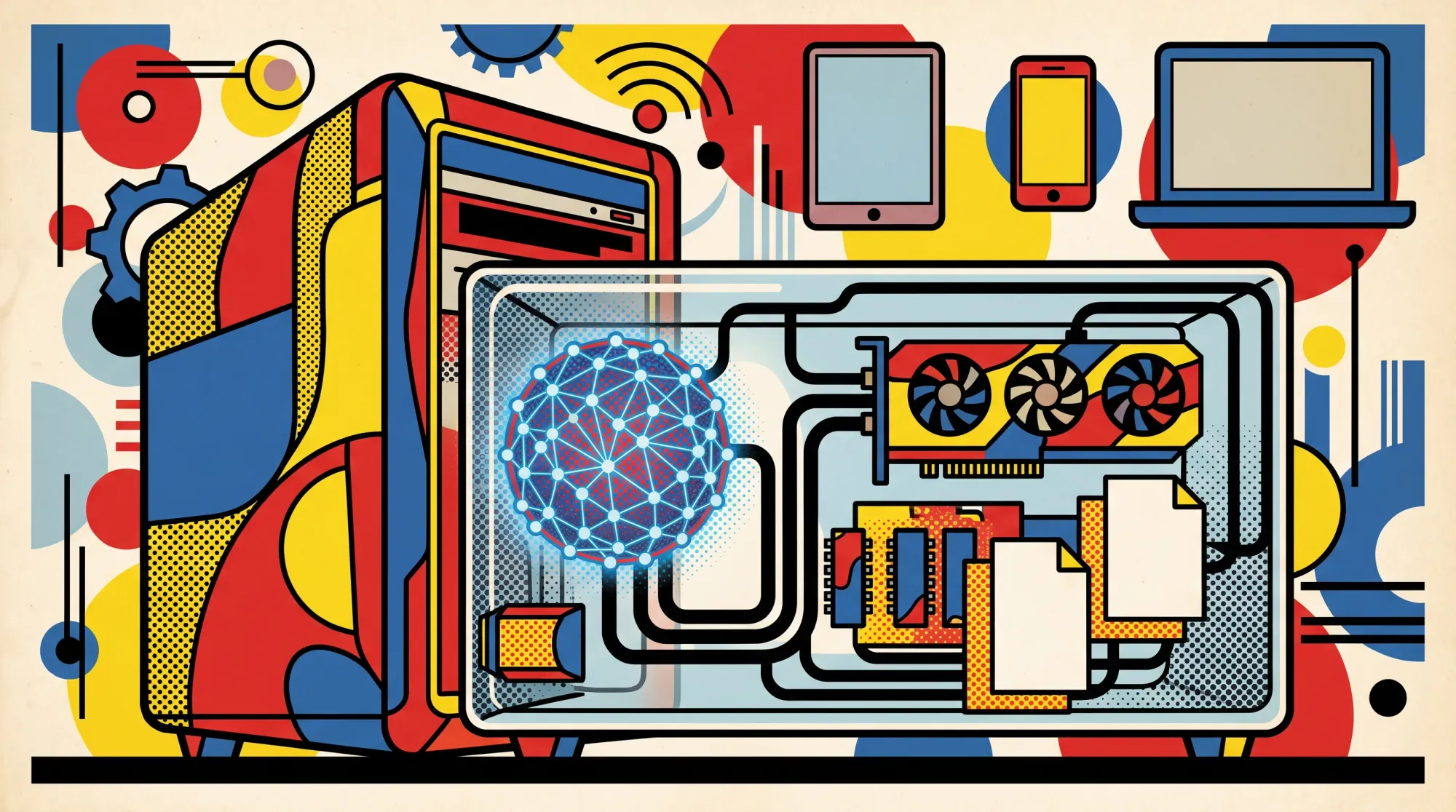
Perplexity launched Portable Computer on Tuesday, moving its Computer agent stack onto Nvidia hardware so files, models and most tool execution can stay on a user's machine. Work completed locally consumes no billing credits, and each step sent to the cloud requires separate approval. The local model judges on the device whether a task needs outside help, and the user then decides whether to approve any cloud transfer.
What Changed
- Perplexity's Portable Computer runs the orchestrator, planner, tool router, scheduler and local search index on the user's own machine, and work completed locally consumes no billing credits.
- It launched on Nvidia's DGX Spark with a choice of Qwen 3.8 27B or PPLX 27B, Perplexity's post-trained version of the same model, with Nemotron 3.5 Lightning due later.
- Sending any step to one of more than 15 cloud models requires the user's separate approval, after a classifier checks the outbound context for personal information.
- Perplexity reports 85.4% for PPLX 27B on its own 53-task benchmark against 77.6% for the Pi harness, but those results have not been independently verified.
AI-generated summary, reviewed by an editor. More on our AI guidelines.
The local stack
Portable Computer runs the orchestrator, planner, tool router, scheduler, durable task queue and local search index on the user's hardware. At launch, it offered Qwen 3.8 27B and PPLX 27B, Perplexity's post-trained version of the same model, first on Nvidia's DGX Spark. Nemotron 3.5 Lightning, an open model with 30 billion parameters, is due later.
The agent can read local files and use Google Drive, Gmail, Slack and GitHub connectors. If it needs current web information or stronger reasoning, it can request help from more than 15 cloud models available at launch. A classifier checks the outbound context for personal information and shows the user what would leave the machine. The remote model returns text guidance without access to local files or tools.
Tool execution runs in an operating-system sandbox that limits processes, file paths and network access. If that sandbox is unavailable, tools are disabled.
Performance and limits
Perplexity designed the harness around a model that advertises a context window of roughly 260,000 tokens but loses performance beyond about 100,000. It keeps the system prompt and tool list small, loads skills only when needed, presents connectors as compact command-line tools and compresses stale context during a task.
Perplexity's launch evaluations put Computer at 82.6% on its 53-task Local Knowledge Work Bench with Qwen 3.8 27B on a DGX Spark, compared with 77.6% for Pi and 74.0% for Hermes using the identical model. PPLX 27B reached 85.4% on the same test.
Every performance figure comes from Perplexity's own evaluations. The results have not been independently verified, and Perplexity has not released the benchmark it says it will open-source.
FREE WEEKDAY MORNING BRIEFING
Don’t miss the next AI story that matters.
The Implicator Morning Briefing filters the AI news cycle to the stories worth your attention and explains their consequences. From San Francisco, every weekday at 4:45 a.m. Pacific, 7:45 a.m. Eastern.
About five minutes. No hype. No spam.
A hybrid run on Terminal Bench 2.1 scored 73.0% at about $0.415 per rollout, up from 59.6% for the fully local setup at effectively zero marginal cost. Claude Opus 5 alone scored 82.4% at about $0.65 per rollout in the same company test.
Know someone who'd find this useful? ✉️ Email it to a friend in one click, or they can subscribe free here.
Enterprise controls
Security practitioners dispute whether approval prompts give companies enough control. Aman Mahapatra, chief strategy officer at Tribeca Softtech, said users may consent to a transfer without giving administrators a deterministic way to bar one. Justin Greis, chief executive of Acceligence, said an enterprise needs the power to prevent the agent from requesting permission.
Perplexity communication manager Beejoli Shah said content inside a local document cannot authorize an escalation or override product controls. Users must first enable cloud escalation, then approve each action separately. The approval covers one transfer and does not carry into later steps or sessions.
Hardware and availability
Portable Computer is available first on Linux to paying subscribers on Perplexity's Pro and Max plans, including the equivalent Enterprise tiers. Windows support is scheduled for September 2026, while macOS is not on the roadmap.
The launch platform is Nvidia's DGX Spark, a GB10 system with 128GB of unified memory. Other Linux machines require an Nvidia RTX GPU with at least 24GB of video memory, roughly an RTX 3090 or newer. Perplexity has not publicly settled whether all qualifying RTX systems are covered from day one, and its launch post describes wider RTX support as still coming. A qualifying card cost at least $1,500 when the product launched, while DGX Spark systems and competing desktop AI boxes cost about $4,000 to $5,000. On Perplexity's undisclosed price for Portable Computer itself, Gartner analyst Nader Henein said high-end laptops can run some of the announced models, "but until we see the price, it's going to be hard to get excited about this."
Frequently Asked Questions
What hardware does Portable Computer require?
The launch platform is Nvidia's DGX Spark, a GB10 system with 128GB of unified memory. Other Linux machines need an Nvidia RTX GPU with at least 24GB of video memory, roughly an RTX 3090 or newer. A qualifying card cost at least $1,500 when the product launched, while DGX Spark systems and competing desktop AI boxes cost about $4,000 to $5,000.
Does running Portable Computer cost anything per task?
Work completed on the device consumes no billing credits. Charges apply only when a step is escalated to a cloud model, and each escalation requires the user's separate approval.
Which models can it run locally?
Qwen 3.8 27B and PPLX 27B, Perplexity's post-trained version of the same model. Nvidia's Nemotron 3.5 Lightning, an open model with 30 billion parameters, is due later.
Who can use it, and on which operating system?
Paying subscribers on Perplexity's Pro and Max plans, including the equivalent Enterprise tiers. It runs on Linux first, with Windows support scheduled for September 2026. macOS is not on the roadmap.
Why do security practitioners question the local-only claim?
Because the boundary is enforced by a permission prompt. Aman Mahapatra said users may consent to a transfer without giving administrators a deterministic way to bar one, and Justin Greis said an enterprise needs the power to prevent the agent from requesting permission at all. Perplexity says escalation must be enabled first and then approved action by action.
AI-generated summary, reviewed by an editor. More on our AI guidelines.

Free AI briefing · Weekdays
The AI stories that matter, sourced and explained.
Join the Morning Briefing. It goes out every weekday at 4:45 a.m. Pacific, with later sends for the East Coast, Berlin and Tokyo.
Free when you sign up: The Paperclip Compendium, our tested guide to running AI agents.
Free. Unsubscribe in one click.

Marcus Schuler
Editor-in-Chief and founder of Implicator.ai. Former ARD correspondent and senior broadcast journalist with 10+ years covering tech. Writes daily briefings on policy and market developments. Based in San Francisco. E-mail: editor@implicator.ai