IMPLICATOR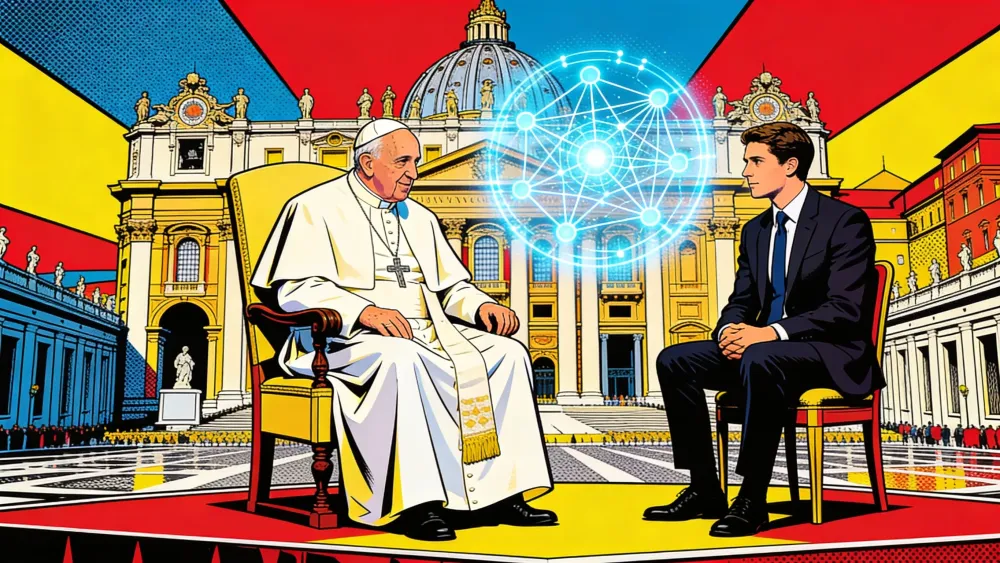
Christopher Olah, who does not believe in God, took a seat among the cardinals in the Vatican's Synod Hall on Monday. Before the presentation began, Fr. Paolo Benanti, the Franciscan friar who advises the Holy See on artificial intelligence, approached Olah, shook his hand and gave him a thumbs-up. Olah is 33. He co-founded Anthropic in 2021, and the roughly 42,300-word document he had come to help unveil, Pope Leo XIV's first encyclical, attacks the concentration of AI power in companies like his.
Olah, seated beside the pope, made the most revealing admission of the morning. The people building this technology, he said, cannot be left to govern it on their own, and he was saying so from the inside. "We need moral voices that the incentives cannot bend," he told the hall. That sentence is the clearest answer to why a non-believer sat in a row of cardinals, clearer than anything in the encyclical itself.
Key Takeaways
- Pope Leo XIV became the first pope to personally present an encyclical, his roughly 42,300-word "Magnifica Humanitas" on artificial intelligence.
- He shared the stage with Christopher Olah, the atheist Anthropic co-founder, while the text attacks AI power concentrated "in fewer hands."
- Olah conceded the labs' incentives can conflict with "doing the right thing" and called for "moral voices that the incentives cannot bend."
- Leo demanded independent oversight, urged AI be "disarmed," and called "just war" theory outdated, setting up a clash with the Trump administration.
AI-generated summary, reviewed by an editor. More on our AI guidelines.
What the front-row seat was for
Popes do not usually present their own encyclicals; they leave that to cardinals or other senior figures. Leo presented this one himself, reported as the first pope to do so, and he gave a speaking slot to an AI executive whose company is suing the U.S. government.
"We haven't usually invited someone from the outside," a senior Vatican official told the National Catholic Reporter before the release. Another was blunt about what the gesture was not: Anthropic's inclusion is "not an endorsement, prize, reward or canonization." The Synod Hall holds about 380 people. The encyclical addresses the Church's 1.4 billion members and, in Leo's phrase, "all people of good will." A non-believer, in a row of cardinals, standing in for an industry.
He had earned the seat. Anthropic spent the past year courting clergy, hosting Christian leaders at its headquarters during March and April to discuss the moral development of its models. It listed three Catholic thinkers, including the Vatican's Bishop Paul Tighe, among the contributors to the constitution that governs Claude, the document staff reportedly call Claude's "soul." Olah said he had spoken with 15 religious leaders about AI before this one.
The concession
Strip away the ceremony, and Olah conceded one of the encyclical's central claims before Leo rose to speak. "Every frontier AI lab, including Anthropic, operates inside a set of incentives and constraints that can sometimes conflict with doing the right thing," he said. He named the stake without softening it: "There is a real possibility that AI will displace human labor at a very large scale."
Silicon Valley moves fast. We tell you what it means.
Strategic AI news from San Francisco. No hype, no "AI will change everything" throat clearing. Just what moved, who won, and why it matters. Daily at 6am PST.
No spam. Unsubscribe anytime.
Leo's text warns that the world's wealth is "increasingly concentrated in fewer hands," and elsewhere that digital power rests with a few private actors. OpenAI and Anthropic are the second- and third-most valuable private companies in the United States, by the AP's count, each valued in the hundreds of billions and both heading toward near-trillion-dollar public offerings; some estimates put Anthropic near $900 billion. The encyclical's critique of concentrated power had a co-founder of one such company reading from the same stage.
The two did not even describe Claude the same way. Citing internal research, Olah said Anthropic's models show "evidence of introspection" and "internal states that functionally mirror joy, satisfaction, fear, grief, and unease." The text he was helping to launch is more categorical: AI systems "do not undergo experiences, do not possess a body, do not feel joy or pain."
The demands he wrote down
Leo's praise for dialogue came with conditions. The encyclical calls for "robust legal frameworks, independent oversight" and a political system "that does not abdicate its responsibility," and it dismisses the industry's preferred form of self-rule directly: "A more moral AI is not enough if that morality is determined by a few." A core part of Anthropic's pitch is exactly that, a more moral AI tuned by a constitution the company wrote for itself. Leo's point, in the same passage, is that oversight has to come from outside the company being overseen.
His harder demands reach past Silicon Valley. Leo called for AI to be "disarmed" and said it is "not permissible" to hand a machine a lethal decision. He declared the Church's centuries-old "just war" theory "now outdated." Leo signed the text on May 15, the 135th anniversary of Rerum Novarum, Leo XIII's 1891 encyclical on industrial labor, and waited ten days to present it himself, into a standoff with Washington: Anthropic is suing the Trump administration, which ordered federal agencies to stop using the company's technology after Anthropic refused unrestricted military use of Claude, and Vice President JD Vance, a Catholic, has said the pope should "be careful when he talks about matters of theology."
So Leo gave the seat beside him to a man whose company is in court against the U.S. government over how its models may be used in war. Days earlier, the pope had created a Vatican commission to study AI's effects, the institutional start of the outside check Olah says the labs cannot supply for themselves.
Frequently Asked Questions
What is "Magnifica Humanitas"?
Pope Leo XIV's first encyclical, a roughly 42,300-word document on safeguarding the human person in the age of artificial intelligence. He signed it May 15, 2026, and presented it May 25, applying Catholic social teaching to AI's effects on labor, war, and human dignity.
Why was an Anthropic co-founder at the Vatican?
Christopher Olah was invited to speak as part of the Vatican's decade-long dialogue with Silicon Valley. A Vatican source called his inclusion "not an endorsement, prize, reward or canonization," but a sign of the Church's seriousness about engaging the industry directly.
What did Olah say?
He said every frontier AI lab "operates inside a set of incentives and constraints that can sometimes conflict with doing the right thing," warned AI could "displace human labor at a very large scale," and urged outside scrutiny: "We need moral voices that the incentives cannot bend."
What does the encyclical demand?
It calls for "robust legal frameworks, independent oversight," rejects company-set ethics as sufficient, urges AI to be "disarmed," bars handing machines lethal decisions, and declares the Church's centuries-old "just war" theory "now outdated."
How does this collide with the Trump administration?
Anthropic is suing the administration, which ordered federal agencies to stop using its technology after Anthropic refused unrestricted military use of Claude. Vice President JD Vance, a Catholic, has said the pope should "be careful when he talks about matters of theology."
AI-generated summary, reviewed by an editor. More on our AI guidelines.
Free AI briefing · Weekdays
The AI stories that matter, sourced and explained.
Join the Morning Briefing. It goes out every weekday at 4:45 a.m. Pacific, with later sends for the East Coast, Berlin and Tokyo.
Free when you sign up: The Paperclip Compendium, our tested guide to running AI agents.
Free. Unsubscribe in one click.

Marcus Schuler
Editor-in-Chief and founder of Implicator.ai. Former ARD correspondent and senior broadcast journalist with 10+ years covering tech. Writes daily briefings on policy and market developments. Based in San Francisco. E-mail: editor@implicator.ai