IMPLICATOR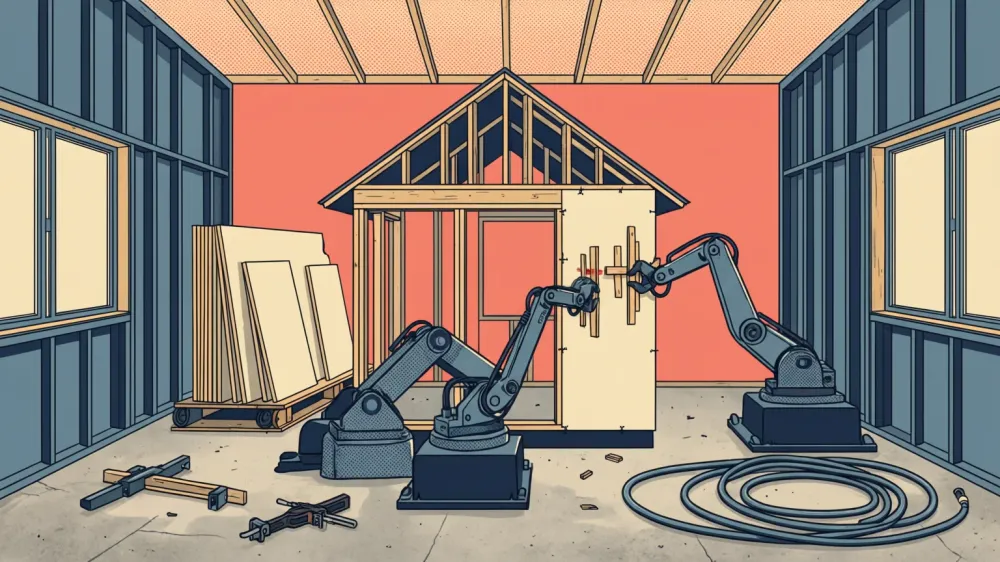
Reframe Systems raised an additional $40 million in venture-backed equity financing to expand its North American microfactory network. Led by Chief Executive Vikas Enti, the company uses small local factories where software coordinates designs and robotic equipment handles repetitive fabrication work. The financing puts new capital behind a model that has delivered few homes so far in a modular sector repeatedly hurt by idle plants, code conflicts and uneven demand.
What Changed
- Reframe Systems raised an additional $40 million to expand its network of homebuilding microfactories.
- The company had completed 10 homes as of Aug. 31, 2026, with eight occupied, and expects 114 more units over the following year.
- Its Billerica plant is designed for up to 500 multifamily units or 250 single-family homes annually with less than $5 million of equipment.
- FAB1 has not begun operations, while earlier factory-housing ventures show the cost of idle plants, code friction and uneven demand.
AI-generated summary, reviewed by an editor. More on our AI guidelines.
The Billerica factory
Energy Impact Partners led the financing announced Aug. 31, 2026, with new co-investors and continued support from existing backers. Reframe plans to use the money to increase deliveries in New England and add factory capacity elsewhere in North America. Enti founded Reframe in 2022 with fellow former Amazon Robotics leaders Felipe Polido and Aaron Small.
Its next site is FAB1 in Billerica, Massachusetts. Reframe has scheduled operations to begin Oct. 5, 2026, fewer than 70 days after it received the keys. The company designed the plant to produce as many as 500 multifamily units or 250 single-family homes a year with less than $5 million of equipment.
The local-factory strategy is meant to keep production near building sites and adjust designs for local codes. It differs from large centralized plants that send completed modules over longer distances. Software converts a digital home design into factory instructions, while robotic systems handle repeated tasks such as wall framing.
Ten completed homes
Reframe had completed 10 homes as of Aug. 31, 2026, and eight were occupied. It expects to deliver another 114 units during the following year, including projects in Massachusetts, New Hampshire and California.
FREE WEEKDAY MORNING BRIEFING
Don’t miss the next AI story that matters.
The Implicator Morning Briefing filters the AI news cycle to the stories worth your attention and explains their consequences. From San Francisco, every weekday at 4:45 a.m. Pacific, 7:45 a.m. Eastern.
About five minutes. No hype. No spam.
At Adams Circle in Devens, Massachusetts, the company was finishing 12 units as of the announcement. A five-story apartment project in Roxbury and a development in Thornton, New Hampshire, were next in the factory queue. In Altadena, California, Jonathan and Marisol Talbot had a wildfire-resilient bungalow and an accessory dwelling unit under construction after the fires.
A federal housing profile documented an Arlington, Massachusetts, accessory dwelling unit completed in 2024. The profile described Reframe's cost and construction-time reductions as company-reported.
FAB1 has not begun operations, which are scheduled for Oct. 5, 2026, making its announced annual capacity forward-looking until then.
A large shortage, a small sector
A July 15, 2026 housing analysis measured a national deficit of 4,743,274 homes in 2024, up 43,438 from 2023. That gap was nearly flat after increasing by 257,000 homes in 2022 and 159,000 in 2023.
Know someone who'd find this useful? ✉️ Email it to a friend in one click, or they can subscribe free here.
Factory building remains a small part of supply. Roughly 100,000 manufactured homes shipped nationwide in 2024, while estimates for modular homes, which follow state and local codes rather than the federal manufactured-housing standard, remained below 20,000.
The factory problem
Earlier factory-housing ventures show how quickly capacity can become a burden. Katerra filed for bankruptcy in June 2021 after receiving $500 million from SoftBank. Veev shut its U.S. operation in November 2023 after constructing 170 units over 15 years.
Factories need steady orders to spread the cost of equipment and labor. Oversized components require special transport, and code changes between jurisdictions can force design changes that reduce repetition. Reframe's smaller sites lower the equipment bill it projects for each factory, but their announced output still depends on consistent demand.
Mark Erlich, author of The Way We Build, described the constraint plainly. “If you have to adjust for design details, at that point, it just becomes prohibitively expensive, and you're much better off to build it on-site,” Erlich said.
Frequently Asked Questions
How much did Reframe Systems raise?
Reframe Systems raised an additional $40 million in venture-backed equity financing. Energy Impact Partners led the financing announced Aug. 31, 2026.
How many homes has Reframe completed?
The company had completed 10 homes as of Aug. 31, 2026, and eight were occupied. It expects to deliver another 114 units during the following year.
What is FAB1?
FAB1 is Reframe's microfactory in Billerica, Massachusetts. The company scheduled operations to begin Oct. 5, 2026, and designed it to produce up to 500 multifamily units or 250 single-family homes annually.
Are Reframe's speed and cost claims independently verified?
The federal housing profile in the source packet describes the cost and construction-time reductions as company-reported. FAB1 has not begun operations.
Why have modular-home factories struggled?
Factories need steady orders to cover equipment and labor. Transport constraints and code differences can reduce repetition, while Katerra's bankruptcy and Veev's closure show the financial risks of unused capacity.
AI-generated summary, reviewed by an editor. More on our AI guidelines.


Free AI briefing · Weekdays
The AI stories that matter, sourced and explained.
Join the Morning Briefing. It goes out every weekday at 4:45 a.m. Pacific, with later sends for the East Coast, Berlin and Tokyo.
Free when you sign up: The Paperclip Compendium, our tested guide to running AI agents.
Free. Unsubscribe in one click.

Marcus Schuler
Editor-in-Chief and founder of Implicator.ai. Former ARD correspondent and senior broadcast journalist with 10+ years covering tech. Writes daily briefings on policy and market developments. Based in San Francisco. E-mail: editor@implicator.ai