 IMPLICATOR

Implicator PRO Briefing / 26 May 2026
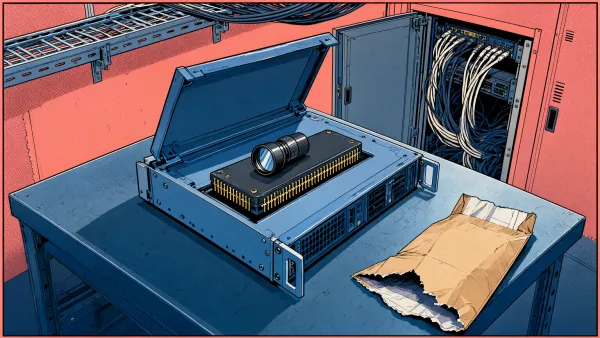
On a shelf, next to the network router, sits a small fanless computer, the kind that costs less than a month of frontier API bills. It does no inference of its own. Its only job is to decide, for every request your tools send, which of a dozen large language models should answer, and to keep the bill and the data under your control. A coding agent's request goes to one model. A long PDF goes to another. A high volume of cheap classification goes to a third that costs a fortieth as much as the first. The box routes, logs, caps the spend, and falls back to a second model when the first one rate-limits.
A box like that costs a few hundred dollars, and it quietly controls how thousands of dollars of model spend get allocated every month. The reason it matters now is that the question most teams still ask, "what is the best model," stopped having a single answer. Trackers like llm-stats now list more than 300 of them, and the leaderboards reorder every few weeks. OpenAI's GPT-5.5, Anthropic's Claude Opus 4.7, and Google's Gemini 3.1 Pro trade the top of the coding and reasoning charts, while a cohort of open-weight Chinese models, DeepSeek V4, Z.ai's GLM-5.1, Moonshot's Kimi K2.6, and Alibaba's Qwen, sit on the value curve at a fraction of the price. None of them wins everything. The model that writes the cleanest prose is not the one you want grading 50,000 support tickets overnight, and the one that grades tickets cheaply is not the one you hand a contract to read.
So the useful question is narrower, and it has two halves. Which model fits this specific task, and how do you move work between models without rewriting your applications every time the leaderboard turns over. The first half is a matching problem, and the charts below answer it. The second half is an infrastructure problem, and an open-source tool called LiteLLM answers it, often running on exactly the kind of cheap box described above. The payoff compounds at the end: the same routing layer that cuts your bill is also what lets you use the strong, cheap Chinese open-weight models without shipping a single prompt to a server in China.
The quick version
- There is no single best model. By May 2026 the lead rotates by task across Claude Opus 4.7, GPT-5.5, and Gemini 3.1 Pro, while open-weight Chinese models lead on value.
- Seven shortlists map the right model to each job, from writing and coding to research, long context, multimodal, and raw value, with working May 2026 prices.
- LiteLLM, MIT-licensed and free for private use, routes one OpenAI-style request to more than 100 providers; virtual keys add budgets, model limits, and spend tracking.
- DeepSeek, GLM, Kimi, and Qwen are open-weight, so they run on US hosts like DeepInfra or on your own hardware, keeping their low cost without sending prompts to China.
AI-generated summary, reviewed by an editor. More on our AI guidelines.
Why one model is no longer the answer
For a year, the simplest AI strategy was also the most defensible: pick the strongest general model and send everything to it. When one lab held a clear lead, that worked. It does not work in May 2026, for three reasons that show up directly on the bill.
The first is price spread. Anthropic lists Claude Opus 4.7 at roughly $5 per million input tokens and $25 per million output tokens, and Haiku 4.5 at about $1 and $5. OpenAI's GPT-5.5 runs near $5 and $30, with its Pro and xhigh modes quoted as high as $30 and $180. DeepSeek's V4 Flash, by contrast, is commonly listed at $0.14 input and $0.28 output. Sending a bulk extraction job to GPT-5.5 Pro instead of DeepSeek V4 Flash is not a rounding error. It is a multiple of several hundred on the same tokens, for routine work where the cheaper model is often good enough once you have tested it.
The second is specialization. The benchmark families now point in different directions. Human-preference arenas favor Claude and Gemini for creative writing; SWE-bench Verified and Terminal-Bench rank OpenAI, Anthropic, Google, and the Chinese coding models in a different order; long-context retrieval, multimodal reasoning, and hallucination rate each have their own leaders. Artificial Analysis has reported that GPT-5.5's highest-effort mode posts strong intelligence scores and a comparatively high hallucination rate, while Claude Opus 4.7 and Gemini 3.1 Pro hold up better on careful interpretation. A single default model means accepting whichever of those tradeoffs your one model happens to embody, on every task, including the ones it is worst at.
Key Takeaways
- Routing beats picking: The cheapest win is sending each task to the model that does it best, not hunting for one model that does everything.
- Indirection is the lever: Map logical model names in a config file and switching providers becomes a one-line edit, not a redeploy.
- Virtual keys are governance: Per-key budgets and model scoping cap a runaway agent and keep real provider credentials off every client.
- Open weights break the China tradeoff: Because DeepSeek and GLM ship open weights, you can run them on US infrastructure and keep the low cost without the data-residency risk.
- US hosting is not absolution: It fixes where data lives, not the censorship or weaker safety baked into the weights, and regulated industries still owe more.
- Gemini 3.1 Pro is the safe probe: It places near the top of nearly every chart and is the cheapest frontier option for testing an unfamiliar task.
The third is volatility. A model that leads one month can be mid-pack the next, and prices move just as fast. DeepSeek ran a 75% promotional discount on V4 Pro through the end of May 2026, dropping it from about $1.74 and $3.48 to roughly $0.435 and $0.87. If your application calls one provider's SDK directly, capturing that kind of swing means touching application code or its environment, and usually a redeploy. If it calls a router, it means editing one line of configuration.
None of this argues for chasing every release. It argues for a structure that lets you place each kind of work with the model that does it best and cheapest, and to change those placements without touching application code. That structure starts with knowing which model is good at what.
I — SHORTLISTS
Match the model to the job
The charts below come from a working session that blended public leaderboards, benchmark evidence, pricing, and practical usefulness as of late May 2026. Treat them as shortlists rather than verdicts. Creative-writing rankings in particular disagree more than coding ones: Arena's human-preference board and EQ-Bench's LLM-judged board both favor Claude, but rarely the same Claude version. Every one of these tables will be wrong in some detail within a month. The categories, though, are stable, and the discipline they encode, route by job, does not expire.
Best for writing and creativity. Softer evidence than coding. Arena's human-vote board currently favors Claude Opus 4.6 and 4.7 and Gemini 3 and 3.1; EQ-Bench puts Claude Opus 4.7 first and GPT-5.5 second.
| # | Model | Best for | Caveat |
|---|---|---|---|
| 1 | Claude Opus 4.7 | Literary prose, voice, essays, nuance | Expensive |
| 2 | Claude Opus 4.6 Thinking | Long-form writing, style control | Arena still ranks it very high |
| 3 | GPT-5.5 | Journalism, structure, argument, editing | Less literary than Claude at times |
| 4 | Gemini 3.1 Pro | Ideation, research-to-draft, long context | Can feel informational rather than elegant |
| 5 | Gemini 3 Pro | Creative drafting, multimodal prep | Strong, not always subtle |
| 6 | Claude Sonnet 4.6 | Everyday writing, emails, polished prose | Cheaper Claude option |
| 7 | Grok 4.20 | Humor, edgy posts, opinionated style | Less reliable for polished journalism |
| 8 | GLM-5.1 | Open-weight creative and value option | Needs more independent writing evaluation |
| 9 | Kimi K2.6 | Creative plus coding and design hybrid work | More agentic than literary |
| 10 | Muse Spark | Experimental fiction and creative drafts | Less proven for journalism |
Best for coding and agentic engineering. The hardest evidence of any category, from SWE-bench Verified, Terminal-Bench, and agent-specific rankings. Claude Opus 4.7 leads LM Council's SWE-bench Verified table; Gemini 3.1 Pro and GPT-5.3 Codex place at or near the top on terminal-style agentic tasks.
| # | Model | Best for | Caveat |
|---|---|---|---|
| 1 | Claude Opus 4.7 | Hard repo repair, refactors, complex debugging | Premium cost |
| 2 | GPT-5.5 | General engineering, code review, agent workflows | Best inside strong tooling |
| 3 | Gemini 3.1 Pro | Terminal tasks, long-context codebases | Very strong for agentic work |
| 4 | GPT-5.3 Codex | Codex workflows, terminal automation | Best inside the OpenAI stack |
| 5 | GPT-5.4 | Balanced coding plus reasoning | Not always top on terminal tasks |
| 6 | Claude Opus 4.6 | Careful code edits, planning, architecture | Still among the strongest |
| 7 | Claude Sonnet 4.6 | Daily coding assistant | Better value than Opus |
| 8 | DeepSeek V4 Pro | Open-weight coding, long context, cost control | Slower than some frontier APIs |
| 9 | GLM-5.1 | Open-weight agentic engineering | Strong for self-hosted workflows |
| 10 | Kimi K2.6 | Coding agents, design-to-code, agent swarms | Newer; needs more third-party testing |
Best for research, analysis, and fact-checking. Here intelligence scores matter less than hallucination behavior, long-context handling, and source discipline. LM Council's hardest reasoning tests put Gemini 3.1 Pro at or near the top; Artificial Analysis has flagged elevated hallucination on GPT-5.5's highest-effort setting.
| # | Model | Best for | Caveat |
|---|---|---|---|
| 1 | Gemini 3.1 Pro | Research synthesis, long documents, hard reasoning | Sometimes verbose |
| 2 | Claude Opus 4.7 | Careful analysis, low-hype interpretation, legal-style reasoning | Expensive |
| 3 | GPT-5.5 | Structured analysis, newsroom workflows, fast synthesis | Check for hallucinated specifics |
| 4 | GPT-5.5 Pro / xhigh | Maximum analytical effort | Cost and hallucination risk |
| 5 | GPT-5.4 Pro | Science and math-heavy research | Strong on GPQA-style reasoning |
| 6 | Claude Opus 4.6 | Deep reading, conservative interpretation | Slightly behind newer Opus |
| 7 | Gemini 3 Pro | Multimodal research, charts, visual reasoning | Superseded by 3.1 Pro on some tasks |
| 8 | Kimi K2 Thinking / K2.6 | Technical research, coding-adjacent analysis | Less established for journalism |
| 9 | GLM-5.1 | Open-weight research and agent workflows | Needs careful verification |
| 10 | Grok 4.20 | Current discourse, fast contrarian framing | Not a first choice for fact-checking |
Best for long-context and document work. Context size is only part of the story; retrieval accuracy and resistance to losing details matter as much. DeepSeek says V4 supports up to 1M-token context across its official services.
| # | Model | Best for | Caveat |
|---|---|---|---|
| 1 | Gemini 3.1 Pro | Very long reports, books, transcripts, PDFs | Strongest general long-context pick |
| 2 | Claude Opus 4.7 | Long-form analysis with nuance | Context excellent, cost high |
| 3 | Claude Sonnet 4.6 | Long docs at lower cost than Opus | Good practical default |
| 4 | DeepSeek V4 Pro | 1M-token open-weight long-context work | Text-only; can be slow |
| 5 | Grok 4.20 | Very large context, exploratory analysis | Reliability varies |
| 6 | GPT-5.4 Codex | Long codebases and repo work | More coding-oriented |
| 7 | GPT-5.5 | Long analytical workflows | Use with retrieval and checking |
| 8 | Qwen 3.5 large-context | Open-weight long-context experimentation | Deployment complexity |
| 9 | Kimi K2.6 | Long agentic coding and design tasks | 256K context; strong agent design |
| 10 | GLM-5.1 | Open-weight long-horizon tasks | 200K context, strong for agents |
Best open-weight and self-hosted models. Open-weight usually means the weights are downloadable while training data and full code stay private. GLM-5.1 ships MIT-licensed weights; Artificial Analysis lists DeepSeek V4 Pro as open weights under MIT with 1.6T total parameters; Kimi K2.6 is described on Hugging Face as an open multimodal agentic model.
| # | Model | Best for | Caveat |
|---|---|---|---|
| 1 | GLM-5.1 | Open-weight agentic engineering | Heavy model; serious infrastructure needed |
| 2 | DeepSeek V4 Pro | Open-weight reasoning, coding, 1M context | Text-only; not lightweight |
| 3 | Kimi K2.6 | Open multimodal coding agents and swarms | New and complex |
| 4 | Qwen3-Coder-Next / Qwen3-Coder | Coding, terminal agents, self-hosted dev | Best for technical users |
| 5 | MiniMax M2.5 / M2.7 | Open coding workflows, cost-sensitive use | Less familiar tooling |
| 6 | GLM-5 | Proven open-weight general and coding model | Older than 5.1 |
| 7 | Qwen 3.5 large models | General open-weight work | Strong but hardware-heavy |
| 8 | Devstral Small 2 | Local coding on smaller hardware | Not frontier-class |
| 9 | Llama 4 Scout / Maverick | Broad local and open tooling | Quality varies by task |
| 10 | Mistral Small / Nemo-class | Cheap local and server tasks | Better for utility than reasoning |
Best multimodal models. Gemini remains strong here because of native image and video reasoning paired with long context. Vals' multimodal index has listed GPT-5.5, Claude Opus 4.7, and Gemini 3.5 Flash among the top models.
| # | Model | Best for | Caveat |
|---|---|---|---|
| 1 | Gemini 3.1 Pro | Images, charts, documents, screenshots, long context | Best general multimodal pick |
| 2 | GPT-5.5 | Multimodal analysis plus writing and reasoning | Strongest all-rounder |
| 3 | Claude Opus 4.7 | Careful image and document interpretation | Less Google-native reach |
| 4 | Gemini 3 Pro | Visual reasoning, charts, screenshots | Slightly behind 3.1 Pro |
| 5 | Gemini 3.5 Flash | Fast, cheaper multimodal tasks | Not as deep as Pro |
| 6 | Claude Sonnet 4.6 | Practical image plus text workflows | Good value |
| 7 | Kimi K2.6 | Multimodal coding and design agents | Strong for UI and design-to-code |
| 8 | GPT-5.4 / GPT-5.4 Pro | Strong multimodal reasoning | Cost depends on tier |
| 9 | Qwen 3.5 vision models | Open-weight multimodal work | More engineering required |
| 10 | Grok 4.20 | Fast visual and social analysis | Less trusted for formal checking |
Best value. Value means different things: cheap raw tokens, best intelligence per dollar, or lowest total cost across an agentic workflow. Public comparisons list Gemini 3.1 Pro as unusually cheap for a frontier model and DeepSeek's flash tier among the cheapest credible options.
| # | Model | Best for | Caveat |
|---|---|---|---|
| 1 | Gemini 3.1 Pro | Best frontier value | Strong quality at relatively low price |
| 2 | DeepSeek V4 Flash | Cheap reasoning and agent tasks | Not always frontier quality |
| 3 | GPT-5.5 medium | High-end quality without max cost | Not the strongest GPT-5.5 setting |
| 4 | DeepSeek V4 Pro | Open-weight frontier value | Slower but powerful |
| 5 | Gemini 3 Flash / 3.5 Flash | Fast multimodal value | Less deep than Pro |
| 6 | Claude Sonnet 4.6 | Practical writing and coding value | Not Opus-level |
| 7 | Kimi K2.6 | Open-weight coding and design value | Tooling matters |
| 8 | GLM-5.1 | Open-weight agentic value | Heavy to run locally |
| 9 | GPT-5.4 Mini | Cheap structured tasks | Not frontier-class |
| 10 | Qwen / Mistral small | Local automation, high-volume tasks | Utility, not deep reasoning |
Read across the seven tables and a pattern shows up that no single chart captures. The same dozen names recur, but their rank swings wildly by job. Claude Opus 4.7 tops writing and coding and disappears from the value table. DeepSeek is absent from the writing top ten, and GLM only scrapes the bottom of it, yet both dominate the open-weight and value lists. Gemini 3.1 Pro is the only model that places near the top of almost every chart, which is itself a routing instruction: when you do not know which model fits, Gemini 3.1 Pro is the safest first probe, and the cheapest of the frontier options to run it on.
II — ENGINES
Know the engines behind the names
A shortlist tells you which model to try. It does not tell you why a model behaves the way it does, or which lane it belongs in when you build a routing rule. For that you need to know who builds these systems and what each company is selling. Six families cover almost every cell in the tables above.
OpenAI made GPT the reference line after ChatGPT launched in November 2022, then split the brand into general reasoning models, cheaper mini and nano tiers, high-effort Pro modes, and the Codex line for software work. That breadth is why OpenAI shows up in nearly every routing map: it sells a model for the hard task, the everyday task, and the cheap high-volume task. The cost structure makes GPT-5.5 a premium default rather than the cheapest endpoint, with the Pro and xhigh modes priced for work where the answer is worth far more than the tokens.
Anthropic was founded in 2021 by former OpenAI staff who argued for a more safety-centered lab, and Claude entered as the careful alternative. The family is unusually legible for routing: Haiku for speed and filtering near $1 and $5, Sonnet 4.6 as the daily production tier at about $3 and $15, and Opus 4.7 and 4.6 as the escalation models at roughly $5 and $25. Claude's public identity is controlled prose, long-document reading, cautious interpretation, and code assistance, which is why Opus sits at the top of both the writing and coding charts and why enterprise buyers reach for it when failures are costly.
Google's Gemini line merged Google Brain, DeepMind, and TPU economics into one stack spanning Vertex AI, Workspace, Android, and the developer APIs. Its advantage is breadth rather than elegance: it processes long inputs, handles multimodal material, and undercuts rivals on price. Gemini 3.1 Pro is commonly quoted near $2 input and $12 output, with longer prompts moving to about $4 and $18, and the Flash and Flash-Lite tiers run far cheaper. For routing, Gemini is the first model to test when the input is long, visual, or already tied to Google Cloud.
Then there is the open-weight cohort, almost all of it Chinese, that fills the value and open-weight tables. DeepSeek, founded in 2023 by High-Flyer quant founder Liang Wenfeng, turned price-performance into a weapon: V4 Pro is a 1.6-trillion-parameter model, optimized to run on Huawei's Ascend chips rather than Nvidia's, with a flash tier near $0.14 and $0.28. Z.ai, formerly Zhipu, built the GLM line out of China's Tsinghua-linked research base; GLM-5 is a 744-billion-parameter mixture-of-experts model with roughly 40 billion active parameters, a 200K context window, and MIT-licensed weights, and GLM-5.1 followed with claims of multi-hour autonomous task execution. Moonshot AI, founded in 2023 by Yang Zhilin, built Kimi around long context before the rest of the market treated million-token windows as normal; Implicator's profile archive notes that Kimi K2.6 had become one of OpenRouter's most-used models, per a May 2026 TechCrunch report. Alibaba's Qwen is the breadth play, widely fine-tuned and hosted across sizes, languages, and modalities, with more than 113,000 derivative models tagged on Hugging Face by mid-2025. MiniMax, out of Shanghai, competes on price and long context through its Lightning Attention design.
For routing, those families sort into lanes by price and role, and the lanes are more durable than any single ranking:
| Routing lane | Job | Representative models (May 2026) | Indicative cost per 1M tokens |
|---|---|---|---|
| Filter / classifier | High-volume tagging, routing, extraction | Claude Haiku 4.5, Gemini 3.1 Flash-Lite, GPT-5.4 Mini, Qwen small | $0.10 to $1 in |
| Daily workhorse | Most production calls, drafts, summaries | Claude Sonnet 4.6, Gemini 3.1 Flash, GPT-5.4 | $0.50 to $3 in |
| Cheap-capable open weight | Coding agents, long context, bulk reasoning | DeepSeek V4, GLM-5.1, Kimi K2.6, Qwen3-Coder | $0.14 to $1.74 in |
| Escalation | Hard reasoning, sensitive writing, complex repos | Claude Opus 4.7, GPT-5.5, Gemini 3.1 Pro | $2 to $30 in |
The lanes are the point. Most production traffic does not need an escalation model, and most teams send it to one anyway because switching is annoying. A router makes the cheap lane the default and reserves the expensive lane for the calls that earn it. The tool that does this, without locking you to any one provider, is LiteLLM.
A router makes the cheap lane the default and reserves the expensive lane for the calls that earn it.
III — ROUTER
The router on the shelf
LiteLLM is best understood as an AI gateway and a compatibility layer, not a model. You send it an OpenAI-style request, and it translates that call to more than 100 providers, OpenAI, Anthropic, Gemini, Bedrock, Azure, Vertex AI, self-hosted endpoints, and the open-weight hosts, then returns the response in OpenAI Chat Completions format regardless of which backend answered. According to LiteLLM's documentation, any client that already works with the OpenAI library works with LiteLLM with no code changes. That single property is why it slots into stacks that were built around one provider but now need many.
Where it came from
LiteLLM started inside BerriAI, a Y Combinator Winter 2023 company founded by Krrish Dholakia and Ishaan Jaffer, and its origin is the exact problem this article opened with. The team had added Azure and Cohere to a chatbot, the Azure calls failed, and the fallback logic across providers turned the code into something hard to debug. They extracted the translation layer, and it became the product. The public GitHub repository was created on July 27, 2023, and by May 22, 2026, it showed 47,956 stars and 8,263 forks, with a $1.6 million seed round from Y Combinator, Gravity Fund, and Pioneer Fund behind it. Thoughtworks' April 2026 Technology Radar describes the trajectory plainly: LiteLLM "started as a thin abstraction layer" and grew into a "full-fledged AI gateway" for retries, failover, load balancing, cost tracking, governance, and access control.
It is free for private use. The core project is open source under the MIT license for everything outside the enterprise directories, which covers the SDK and the self-hosted proxy you would actually run. The enterprise-only features and directories carry separate licensing. LiteLLM's enterprise tier is aimed explicitly at organizations running at scale, which its docs define as 100 or more users or 10 or more production AI use cases, and it adds single sign-on, audit logs, fine-grained access control, and support on top of the open-source gateway. For an individual, a household, a small team, or a homelab, none of that applies. You download it and run it.
Two ways to run it
There are two modes, and the choice between them is the whole adoption decision. The Python SDK is a library you import into application code to call many providers through functions like completion() and embedding(). It suits a single codebase that wants provider flexibility without standing up new infrastructure.
The proxy is the more interesting mode for the box on the shelf. It is a self-hosted, OpenAI-compatible server you point your tools at, and it is where the gateway features live. You can run it on almost anything, a spare mini PC, a small cloud instance, or a container on a homelab node, because the proxy itself does no inference; it forwards requests to providers and waits on their latency, not yours. The configuration is a single YAML file that maps a logical model name your tools will ask for to a real provider model and key:
model_list:
  - model_name: fast-cheap            # the name your tools request
    litellm_params:
      model: deepseek/deepseek-v4-flash
      api_key: os.environ/DEEPSEEK_API_KEY
  - model_name: smart                 # escalation lane
    litellm_params:
      model: anthropic/claude-opus-4-7
      api_key: os.environ/ANTHROPIC_API_KEY
Start it with litellm --config config.yaml, and the proxy listens on a local port. Your application now asks for fast-cheap or smart, and the box decides what that actually means. Changing the model behind a name, when GLM-5.1 undercuts DeepSeek next month, or when an Opus price drop makes escalation cheaper, is a one-line edit and a restart, with no change to any application that calls the proxy. That indirection is the efficiency lever. The model names in your code become routing decisions you control centrally, instead of provider commitments scattered across a dozen repositories.
The model names in your code become routing decisions you control centrally, instead of provider commitments scattered across a dozen repositories.
Virtual keys, in practice
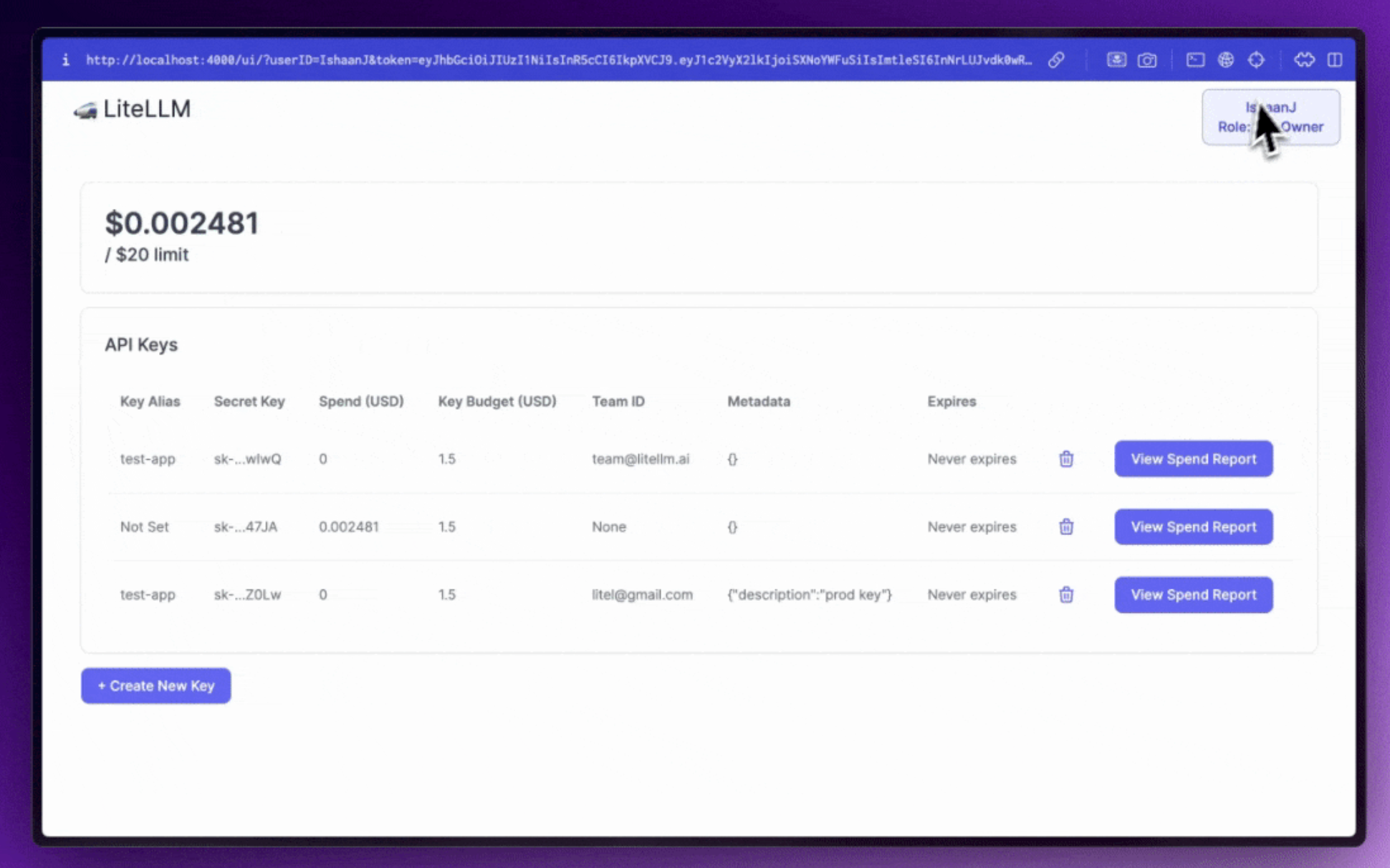
The feature that turns the proxy from a convenience into infrastructure is the virtual key. A virtual key is a LiteLLM-issued credential, beginning with sk-, that stands in front of your real provider keys. Your applications hold the virtual key; only the proxy holds the expensive Anthropic, OpenAI, and Google credentials. Per LiteLLM's documentation, key management requires a PostgreSQL database, a master key set on the proxy, and the /key/generate endpoint to mint new keys. Generating one is a single call:
curl -X POST 'http://localhost:4000/key/generate' \
  -H 'Authorization: Bearer sk-MASTER-KEY' \
  -H 'Content-Type: application/json' \
  -d '{"models": ["fast-cheap", "smart"], "max_budget": 50, "budget_duration": "30d"}'
That returns a key scoped to two models with a $50 budget that resets every 30 days. (For a key that expires outright, LiteLLM uses a separate duration field.) Hand it to a project, a teammate, or a single agent, and you have done four things at once: you have kept your real credentials off the client, capped what that consumer can spend, restricted which models it can reach, and created a per-key spend record you can read later. The walkthrough that accompanies LiteLLM makes the same case in one line: virtual keys control access without exposing real API credentials, and they add usage tracking and spending limits per key or team. For a household sharing one set of provider accounts, or a small business handing AI access to contractors, that is most of the governance story, on free software you host yourself.
What it is good for
Three features explain why teams run LiteLLM, and all three are about money and uptime.
👉 The first is cost containment: spend tracking and budgets per key or user mean a runaway agent hits a ceiling instead of a five-figure invoice.
👉 The second is resilience. LiteLLM's reliability documentation describes fallbacks across model groups when a call fails after its retries, with separate handling for content-policy blocks, context-window overflows, and ordinary errors such as rate limits, so you can encode a rule that a request to smart falls back from Opus to GPT-5.5 to Gemini 3.1 Pro and a single provider outage degrades gracefully.
👉 The third is experimentation: the proxy can mirror live traffic to a second model silently, so you can measure whether a cheaper model is good enough on real prompts before you move production to it.
The honest caveat, and Thoughtworks names it directly, is that a unified call shape does not make providers interchangeable. Models still differ in reasoning, tool use, refusal behavior, and latency, and provider-specific features can pull you back into provider-specific code. LiteLLM's own docs document the tension: by default it raises an error when a model does not support a parameter, and the drop_params setting silently discards the unsupported parameter instead, which keeps requests flowing but can quietly remove a capability your application expected. In practice the gateway is one place to write the common path and to manage the provider differences that still matter, model by model. LiteLLM keeps those differences visible and controllable; the team still owns the tests that prove a model swap is safe, which is part of the broader self-hosted AI tradeoff.
IV — RISK
The China question
Look back at the value and open-weight tables and one fact is hard to miss: the cheapest credible models are almost all Chinese. DeepSeek V4, GLM-5.1, Kimi K2.6, Qwen, and MiniMax sit on the efficiency curve precisely where a cost-conscious router wants to send its high-volume traffic. They are also the models most likely to get a security team to say no, and the reason has nothing to do with their benchmark scores.
The problem is where your prompts go when you call these models on their makers' own Chinese services. DeepSeek's own privacy policy states that "we directly collect, process and store your Personal Data in People's Republic of China," and its terms of service say they are "governed by the laws of the People's Republic of China." Under China's National Intelligence Law, amended in 2018, Chinese organizations "must support, assist, and cooperate with state intelligence work," a duty reinforced by the 2021 Data Security Law and the 2023 revision to the Counter-Espionage Law. A prompt sent to the DeepSeek API, with whatever contract, source tree, or strategy memo it contains, lands on a server inside that legal regime. As an April 2026 American Enterprise Institute analysis put it, users sending those documents to China-hosted endpoints are, in effect, depositing them into a government-accessible database, and many do it without realizing it, because a startup wired DeepSeek into the application they are using.
Governments have treated this as a national-security matter rather than a privacy footnote.
- Italy's data-protection authority ordered an emergency block on January 30, 2025, the first country to act.
- Australia banned DeepSeek from all government devices, with Home Affairs Minister Tony Burke calling it an "unacceptable risk."
- Taiwan and the Czech Republic followed, the Czech cyber agency NÚKIB labeling DeepSeek a "cyber security threat" tied to the National Intelligence Law, and the Netherlands was among the governments that moved to restrict or investigate it.
- South Korea's privacy regulator suspended new downloads in February 2025 after reporting that the personal data of more than a million South Koreans had been transferred to China without consent, restoring access only after changes in April.
- In the United States, the Navy, NASA, and the Department of Commerce blocked it; Texas was the first state to ban it from government devices, in January 2025, and New York followed. The pressure has only grown in 2026: Senators Rick Scott and Tom Cotton introduced the Blocking CCP Spy Tech Act in May, naming DeepSeek among the Hangzhou firms it would force through a national-security review, and the State Department in April ordered a global campaign warning about alleged model theft by Chinese labs.
There are two further problems the data question tends to overshadow, both documented most clearly on DeepSeek. Its models carry their training: DeepSeek's systems refuse to discuss the events of June 4, 1989, and echo Chinese state positions on Taiwan, behavior that travels with the weights wherever they run. And its safety guardrails have tested weaker than the frontier labs': Cisco reported in early 2025 a 100% attack-success rate against DeepSeek R1, which failed to block a single harmful prompt in its test set.
Here is where the routing layer changes the calculation, and where efficiency and safety stop being a tradeoff. The Chinese models in those tables are open-weight. DeepSeek and GLM-5 ship under MIT licenses, Qwen under Apache 2.0, Kimi K2 under a modified MIT whose attribution clause only activates above 100 million monthly users or $20 million in monthly revenue. Open weights mean the model does not have to run in China to run at all. The same DeepSeek V4 and GLM-5.1 you would reach through a Beijing API are hosted, today, on Western infrastructure. DeepInfra runs them in what it describes as secure US-based data centers, with the widest open catalog of the providers. Together AI serves DeepSeek, Qwen, Kimi, and GLM and ranks first on independent output-speed benchmarks. Fireworks, Novita, Groq, and SambaNova offer overlapping open-weight catalogs through OpenAI-compatible endpoints, and AWS Bedrock now lists 18 fully managed open-weight models, including Qwen and MiniMax, with the weights on non-Chinese cloud infrastructure.
Open weights mean the model does not have to run in China to run at all.
For a router, that turns a hard governance question into a configuration choice. Your cheap-capable lane can point its deepseek-v4 alias at a US host like DeepInfra, which says it runs in secure US-based data centers, rather than at api.deepseek.com, and the prompt stays on US infrastructure. Indicative US-hosted prices in May 2026 sit close to the Chinese originals, DeepSeek V4 Pro around $1.74 and $3.48 on DeepInfra, V4 Flash near $0.14 and $0.28, GLM-5.1 around $1.40 and $4.40 on Together, so you capture most of the cost advantage while removing the China-hosted data flow that sits behind most of the bans. If you have the hardware, you can go further and run the weights yourself, which is the only configuration that keeps the data entirely on your own machines.
The residue is worth stating plainly, because US hosting solves one problem and not the others. Running DeepSeek on DeepInfra keeps your prompts out of China; it does not change the model's censorship on Chinese political topics or its weaker safety profile, both of which live in the weights. Licenses can change between model versions, so verify the current terms before you deploy. And regulated industries carry data-residency and supply-chain duties that go beyond where a single inference call runs. For most teams, though, the practical answer is clean: route the high-volume work to a strong cheap open-weight model, run that model on infrastructure you trust, and keep the frontier escalation model for the calls that justify its price.
V — PAYOFF
What efficiency actually buys you
Go back to the box on the shelf. It is not impressive hardware, and that is the point. The capability it provides comes from the decisions it enforces, not from the silicon. Match the model to the job, and most of your traffic moves to models that cost a fraction of the frontier default without doing worse work. Put a router in front of those models, and the matching becomes a line of configuration instead of an engineering project, with budgets, fallbacks, and a single spend ledger thrown in. Point the cheap open-weight lane at a host that guarantees its jurisdiction, and the cheapest models on the market become usable by a security-conscious team, because the prompts stop crossing a border that turns them into someone else's intelligence asset.
The teams that overpay usually have one thing in common: no one owns the routing. Every application hard-codes a single provider, every price change forces a redeploy, and the question of whether a prompt is sitting on a server in Hangzhou never comes up, because there is no layer responsible for asking it. The teams that get it right spend an afternoon centralizing the first routing rules and then stop rebuilding that plumbing for every new model, because the box holds it for them. The leaderboards will turn over again next month, and the month after that, and the routing layer is what lets you follow them for the price of a one-line edit instead of a redeploy.
VI — SIGNALS
What to watch
the lab is reportedly raising at a valuation that climbed from $10 billion toward $45 to $50 billion in weeks, led by China's state-backed Big Fund, while pushing V4 onto Huawei Ascend chips. Watch whether state capital and domestic silicon change its pricing or its willingness to court Western users.
Scott and Cotton's bill would force DeepSeek and five other Hangzhou firms through a national-security review. Its progress signals whether US restrictions move from government devices toward broader commercial limits that could reach hosted-in-China APIs.
DeepInfra, Together, and Fireworks are competing hard on the same Chinese open weights. Watch the gap between their prices and the Chinese originals; if it stays small, the case for ever touching a China-hosted endpoint keeps shrinking.
Thoughtworks already flags the coupling risk as the gateway adds provider-specific features. Watch whether the open-source proxy stays genuinely complete for private users as the company builds out the paid tier.
at 18 models and counting, the hyperscalers are absorbing the open-weight cohort onto their own infrastructure. If that catalog keeps growing, managed open-weight access on trusted clouds becomes the default, and self-hosting becomes a choice rather than a necessity.
Frequently asked questions
Q. What is the best LLM right now?
A. There isn't one. By May 2026 the lead rotates by task between Claude Opus 4.7, GPT-5.5, and Gemini 3.1 Pro, while open-weight Chinese models lead on value. The useful question is which model fits a given job, and how cheaply you can route to it.
Q. What is LiteLLM, and is it free?
A. LiteLLM is an open-source AI gateway that lets one OpenAI-style request reach more than 100 providers. The SDK and self-hosted proxy are MIT-licensed and free for private use; paid enterprise features target organizations with 100 or more users or 10 or more production use cases.
Q. What does a virtual key do?
A. A virtual key is a LiteLLM credential that sits in front of your real provider keys. It caps spend, restricts which models a consumer can call, and records per-key usage, so applications never hold your Anthropic or OpenAI keys directly.
Q. Is it safe to use DeepSeek or other Chinese models?
A. Using the official Chinese API sends prompts to servers in China, under laws that compel data sharing with the state, which is why many governments restricted it. Because the weights are open, you can run the same models on US hosts like DeepInfra, or self-host, and keep data off Chinese servers.
Q. Does US hosting fully fix the China risk?
A. It fixes data residency, not model behavior. A US-hosted DeepSeek still carries the censorship and weaker safety profile baked into its weights, and regulated industries face residency duties beyond where one inference call runs. Verify the license version before deploying.
AI-generated summary, reviewed by an editor. More on our AI guidelines.
Sources & Further Reading
Primary Sources
- LiteLLM — BerriAI, GitHub repository
- LiteLLM Virtual Keys — official documentation
- DeepSeek Privacy Policy — DeepSeek
- LiteLLM company profile — Y Combinator
Research & Analysis
- LiteLLM — Thoughtworks Technology Radar, April 2026
- China's AI Is Spreading Fast — American Enterprise Institute, April 2026
- US State Dept warning on Chinese AI — Reuters, April 2026
- DeepSeek V4 and the US-China AI rivalry — Council on Foreign Relations, April 2026
- GLM-5 and model benchmarks — Artificial Analysis
Further Reading
- Countries banning DeepSeek, explained — Channel News Asia
- DeepInfra — US-based inference infrastructure
- Fastest inference for top open-source models — Together AI

Marcus Schuler
Editor-in-Chief and founder of Implicator.ai. Former ARD correspondent and senior broadcast journalist with 10+ years covering tech. Writes daily briefings on policy and market developments. Based in San Francisco. E-mail: editor@implicator.ai