Implicator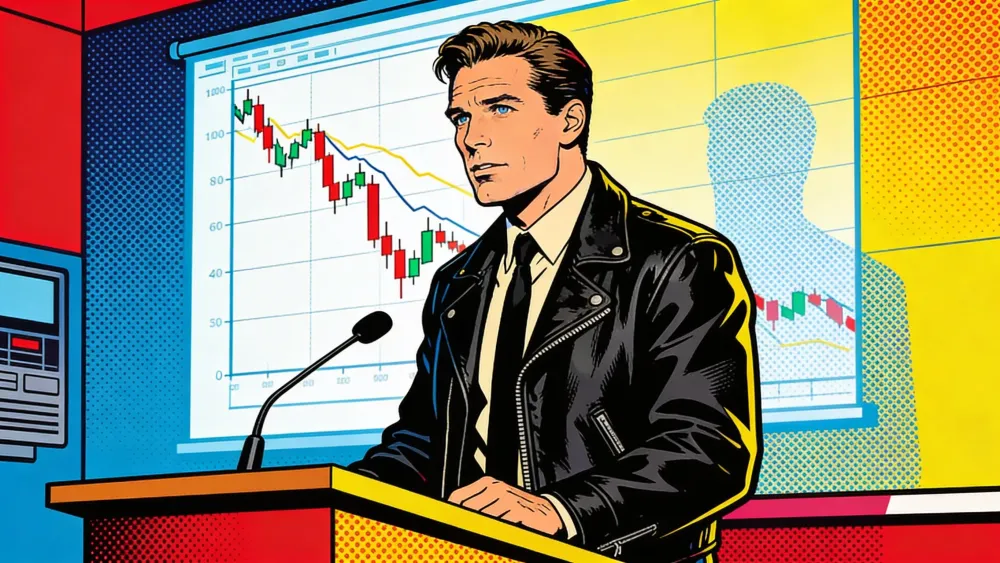
Picture this. Marc Benioff walks into his Wednesday earnings call in a black leather jacket. Not the blazer. Not the Salesforce-blue fleece vest that has become the uniform of enterprise software CEOs who want you to think they're approachable. A leather jacket. Jensen Huang's leather jacket, or close enough to make the reference unmistakable.
He wanted you to see a man who isn't worried. A man who belongs in the same category as the CEO running the most valuable company on earth.
Then Salesforce reported record fourth-quarter revenue of $11.2 billion, beating estimates by $20 million. Earnings crushed expectations at $3.81 per share against a $3.04 consensus. Full-year revenue hit $41.5 billion. Free cash flow reached $14.4 billion, up 16% from the prior year. Remaining performance obligation landed at $72.4 billion. The company announced its fastest revenue growth in two years.
And the stock fell 5%.
That gap between performance and reception tells you everything about where enterprise software stands right now. Salesforce had its best quarter since early 2024. Investors treated it like a terminal diagnosis. Not because the numbers disappointed, but because the numbers have stopped being the question.
The Breakdown
- Salesforce beat Q4 estimates with $11.2B revenue and $3.81 EPS, but stock fell 5% on below-consensus FY27 guidance
- Agentforce ARR reached $800M (up 169%), representing just 1.9% of $41.5B annual revenue
- Benioff staged infomercial-style earnings call, invented "Agentic Work Units" metric, announced $50B buyback
- Salesforce booked $811M gain on Anthropic investment while Anthropic's products reprice the SaaS sector
When the set design matters more than the script
The old Salesforce earnings call was 45 minutes of financial review and analyst Q&A. Wednesday's version was something different. Part podcast. Part infomercial. Part revival meeting. Benioff interviewed three CEOs on camera, testimonial-style, about their devotion to Agentforce. SharkNinja. Wyndham Hotels. SaaStr. He said the word "SaaSpocalypse" at least six times, including the memorable claim that it might be "eaten by the Sasquatch." He introduced a brand-new metric called "Agentic Work Units," counting discrete tasks an AI agent completes rather than tokens processed.
And then the buyback. $50 billion in share repurchases. "Because these are some low prices," Benioff said. With the stock down 28% this year while the S&P 500 gained 1%, the math is hard to argue with.
But step back and look at what this adds up to. A CEO leading a company that just posted record revenue felt compelled to stage a media production, invent a metric, cosplay as Jensen Huang, and commit the largest buyback in company history. All to convince the market his business model isn't dying.
Companies that feel confident don't do this. Confident companies file their numbers, take questions, and hang up. The production was the confession. Salesforce is anxious, and the anxiety is rational, because the question the market keeps asking has nothing to do with this quarter.
It's whether the per-seat subscription model that wiped $285 billion from global software stocks three weeks ago survives the decade.
$800 million is real, and it's 1.9% of revenue
Agentforce gave Benioff his strongest talking point. ARR hit $800 million, which is 169% above where it was a year ago. The company closed 29,000 deals, up 50% from the prior quarter. Combined with Data 360 and the newly acquired Informatica cloud business, total AI-adjacent ARR reached $2.9 billion.
Not small numbers. But set them against the full picture. Agentforce's $800 million represents 1.9% of Salesforce's annual revenue. The other 98.1% still runs on seats.
Salesforce's own CFO confirmed it. Robin Washington said seat counts grew year on year and quarter on quarter. "Seats will continue to be a key component of our growth going forward," she said. That's the hybrid model admission every SaaS company is making right now, and it carries a contradiction you can't paper over with a new metric. You cannot tell Wall Street that agents are the future while insisting that seats are the present, and expect anyone to apply the same revenue multiple to both.
Valoir analyst Rebecca Wettemann put the challenge bluntly. Salesforce needs to show "how customers are moving AI agents into production at scale with governance, observability and trust needed, as well as ROI." Deals closed and tokens consumed won't cut it. Neither will a metric nobody has benchmarks for yet. What investors want is actual outcomes at actual companies. That evidence doesn't exist. Until it does, Agentic Work Units are a press release, not a proof point.
Join 10,000+ AI professionals
Strategic AI news from San Francisco. No hype, no "AI will change everything" throat clearing. Just what moved, who won, and why it matters. Daily at 6am PST.
No spam. Unsubscribe anytime.
The market is pricing the mutation, not the quarter
If you manage a software budget at a Fortune 500 company, you watched Wednesday's call and drew a straightforward conclusion. Salesforce is healthy. Nothing needs to change this fiscal year.
Wall Street drew the opposite conclusion. And Wall Street is pricing the next five years, not this one.
Three weeks ago, a Goldman Sachs basket of U.S. software stocks fell 6% in a single session after Anthropic published a blog post. IBM dropped 13% on Monday after Claude Code gained COBOL modernization features. The pattern repeats. AI companies ship a product, software companies lose market cap. Not because the products replace enterprise software today. Because they compress the pricing power that justified the multiples.
And that pricing power was already bleeding. None of this started three weeks ago. SaaS valuations had been grinding lower since 2021, with EV-to-revenue ratios collapsing from 18x at the pandemic peak all the way down to 5.1x by late last year. Salesforce told a similar story if you looked closely enough. Where did Salesforce's 2025 revenue growth actually come from? Seventy-two percent of it was price hikes on existing customers. Not new logos. Revenue grew. The growth engine sputtered.
Nobody mentioned the most uncomfortable number on the balance sheet. Salesforce booked an $811 million gain on its investment in Anthropic during the quarter, up from $96 million a year ago. Benioff wants more. "We're at about $330 million into Anthropic invested. It's almost 1% of Anthropic," he told analysts. "Believe me, I wish we had invested a lot more." He is making a fortune off the company whose products are redefining his industry, and the earnings call breezed right past it.
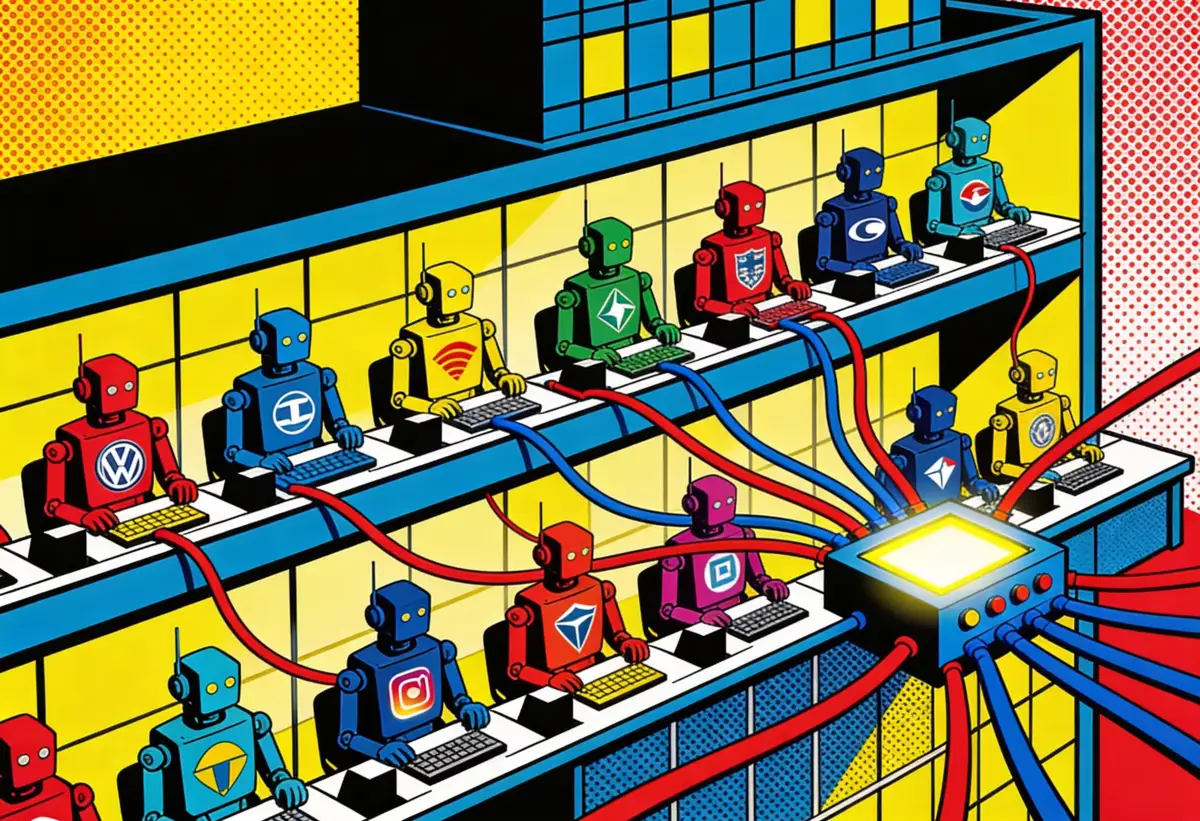
Benioff's response was to frame AI model makers as commoditized infrastructure sitting below Salesforce in the stack. OpenAI's competing architecture, released with its Frontier launch earlier this month, puts it the other way around. SaaS vendors on the bottom, AI platforms on top. Both diagrams are self-serving. Both reveal the same SaaS-Angst from different angles. The argument over who sits on top is really an argument about who gets to set prices. A single earnings call won't settle it, no matter how many customer testimonials you film.
The jacket is the forecast
Benioff will probably be fine. Salesforce sits on $72 billion in remaining performance obligations, has 150,000 core customers, and runs the CRM infrastructure that even its supposed disruptors depend on. Anthropic runs its entire global operation on Salesforce and Slack. He said so on the call, and he's right. That's a moat. Narrow, but real enough to buy time.
Buying time, though, is the best case. That's the uncomfortable truth the leather jacket was meant to obscure. Record free cash flow, fastest growth in two years, five ServiceNow customers poached, AstraZeneca and Novartis won from Veeva. Benioff delivered on every front.
None of it moved the needle.
When the best quarter you've had in two years earns a 5% haircut, the problem isn't the quarter. It's SaaS-Angst. And a leather jacket won't fix it.
Frequently Asked Questions
What are Agentic Work Units?
A new Salesforce metric counting discrete tasks completed by AI agents, like updating a CRM record. Unlike tokens, AWUs measure actual work output. Salesforce logged 2.4 billion AWUs to date. The metric has no industry benchmarks yet, making it difficult for investors to compare against competitors.
Why did Salesforce stock fall after beating estimates?
Full-year FY27 revenue guidance of $45.8-46.2 billion came in slightly below the $46.06 billion consensus. But the bigger driver is structural fear that AI agents will erode per-seat SaaS pricing. Salesforce stock is down 28% year to date while the S&P 500 gained 1%.
How much has Salesforce invested in Anthropic?
About $330 million, representing roughly 1% of Anthropic. The investment generated an $811 million gain in Q4, up from $96 million a year earlier. Benioff said on the call he wishes he had invested more, despite Anthropic's products contributing to SaaS sector repricing.
What is the SaaSpocalypse?
A term coined by Jefferies trader Jeffrey Favuzza during a February 3 selloff that wiped $285 billion from global software stocks. It describes investor fears that AI agents will make per-seat SaaS business models obsolete by automating the work that licensed users perform.
Is Salesforce actually transitioning away from per-seat pricing?
Slowly. CFO Robin Washington confirmed seat counts still grew quarter over quarter. Agentforce runs on consumption-based Flex Credits at $0.10 per action, but at $800M ARR it represents under 2% of revenue. Washington called seats "a key component of growth going forward."


Marcus Schuler
Senior broadcast journalist and former ARD correspondent for Europe's largest public broadcaster. Covering the tech industry from San Francisco for 10+ years. Founded implicator.ai for independent, rigorous AI reporting. E-mail: [email protected]