Implicator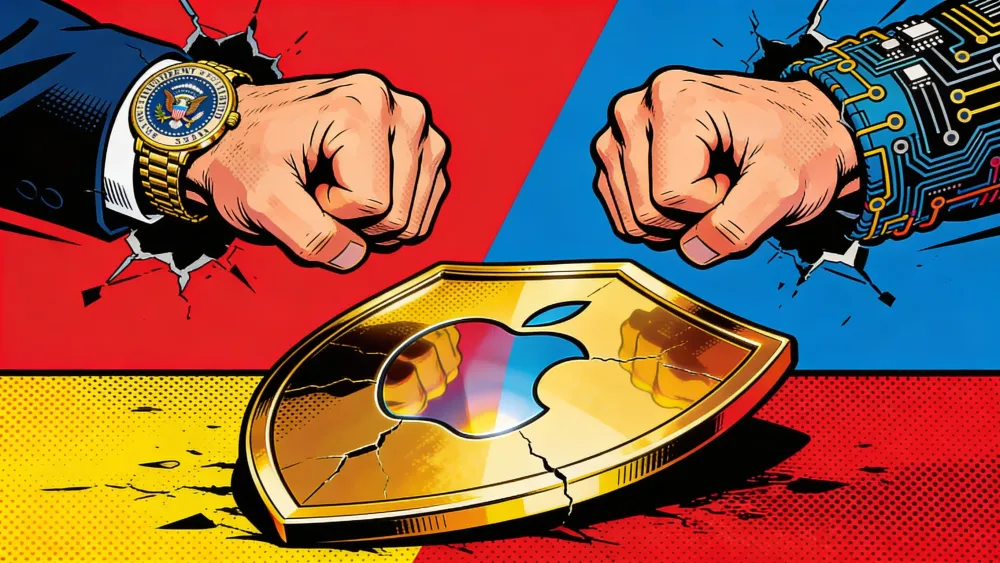
In August, Tim Cook walked into the White House carrying a plaque set on a 24-karat gold base. He stood beside President Trump and pledged that Apple would spend $600 billion in the United States over the next four years. Trump, in return, promised Apple an exemption from his planned electronics tariffs. Vintage Cook diplomacy. Spend enough, smile enough, and nobody shoots at you.
On Wednesday, Apple shed 5% of its market value in a single session. Its worst trading day since April 2025. Two stories landed within hours of each other. Bloomberg reported that internal testing of Apple's revamped Siri was going badly enough to push the update past its spring target. And FTC Chairman Andrew Ferguson sent a warning letter to Cook, accusing Apple News of systematically favoring left-leaning publications. Both FCC Chairman Brendan Carr and the White House press secretary amplified the criticism on social media within the hour.
The gold plaque didn't help. The tariff exemption didn't help. Six months of careful dealmaking evaporated in an afternoon because Apple's two shields, political goodwill and AI credibility, cracked at the same time.
The deal that stopped working
Cook's approach to the Trump administration has been straightforward and, until this week, effective. Keep your head down and write big checks.
The Breakdown
• Apple lost 5% of its market value on Wednesday, its worst trading day since April 2025, after FTC and Siri setbacks hit simultaneously.
• FTC Chairman Ferguson accused Apple News of favoring left-leaning outlets, amplified by the White House within an hour.
• Bloomberg reported that internal Siri testing on Gemini-powered features is failing badly enough to push iOS 26.4 past its spring target.
• Cook's $600 billion spending pledge and tariff exemption failed to shield Apple from political fallout over his Bad Bunny selfie and internal immigration comments.
The $600 billion pledge in August was the centerpiece. It followed a pattern Cook had refined across both Trump terms. During the first, he visited the Oval Office, toured factories, joined advisory councils. While Meta, Google, and Amazon all drew sustained fire from the White House, Apple mostly didn't. Cook grasped something his peers were slower to learn. You don't argue with this administration. You negotiate with it.
That strategy required constant upkeep. Cook attended state dinners. He made sure every Apple announcement included a "jobs in America" number. When other tech CEOs were writing open letters about immigration policy or climate regulation, Cook was writing checks. The approach had a cost, and internal critics at Apple watched their CEO court an administration many of them opposed. But the protection it bought was real.
And it worked. Trump gave Apple a tariff carveout that competitors didn't get. Through the fall and into January, Apple's political shield held even as other companies faced regulatory action.
But transactional relationships carry a specific vulnerability. They hold only as long as both sides keep delivering. The moment one side stumbles, the math changes.
Apple stumbled twice in a single week.
Cook posted a selfie with Bad Bunny after the Super Bowl halftime show, which Apple Music had sponsored. Trump had already called the performance "an affront to the greatness of America." Bad Bunny has been openly critical of the president's immigration crackdown. Then, according to the Financial Times, Cook held an all-hands meeting where he promised staff he would push the administration to change its approach to immigration enforcement. This came after federal agents shot two people during a crackdown in Minneapolis. Hours before that internal meeting, Cook had attended a screening of Melania Trump's Amazon Prime documentary at the White House.
The optics were impossible to manage from either direction. Too cozy with the administration for his own employees. Too defiant for the administration itself.
Trump shared coverage of a Media Research Center report about Apple News bias on Truth Social on Tuesday. By Wednesday, Ferguson's letter was public. Apple's protected status had an expiration date, and Cook had blown past it.
Join 10,000+ AI professionals
Strategic AI news from San Francisco. No hype, no "AI will change everything" throat clearing. Just what moved, who won, and why it matters. Daily at 6am PST.
No spam. Unsubscribe anytime.
The Siri problem runs deeper than a missed deadline
You could treat the Siri delay as a routine product setback. Bloomberg drops a report about internal snags, the stock takes a hit, some PR person emails a statement to reporters. Standard playbook.
Except this time, the timing matters.
Remember WWDC 2024? Apple got on stage and demoed a Siri that could actually do things. Read your screen, remember your habits, act inside other apps. The plan was to ship all of it by spring 2025. None of it shipped. By last March, the company quietly conceded Siri wasn't ready. The public line became "sometime in 2026," vague enough to buy nearly a full calendar year. But engineers inside Cupertino were working to a tighter clock. Their target was iOS 26.4, due this spring.
Bloomberg's Mark Gurman reported Wednesday that iOS 26.4 won't make it either. Siri sometimes fails to process queries at all. Other times it takes so long to respond that users give up. The features were supposed to work as one system, a unified assistant that could see your screen, remember your context, and act inside apps. Shipping them piecemeal across multiple updates defeats the purpose. It would be like announcing a new iPhone and delivering the display in March and the camera six months later.
CNBC asked for comment. Apple gave them five words. "Still on track to launch in 2026." Five words, no denial, no acknowledgment of what Bloomberg had laid out. The statement was built to be technically true and nothing else, because Apple never pinned itself to anything more specific than "this year." Read it again. Defensive doesn't quite cover it. That's what a company sounds like when it knows the full answer would be worse than silence.
And here Apple's second shield, its AI credibility, starts to buckle. These are the first Siri features running on Google's Gemini models, the product of a partnership Apple announced in January. Apple made a specific bet. Hand the AI foundation work to Google. Close the gap with OpenAI faster than Cupertino could on its own. Ship the first Gemini features late and buggy, though, and the whole strategy starts looking like a mistake. Not just one update. The whole bet.
Wall Street was already on edge. UBS downgraded the US tech sector to neutral this week, citing heavy capital spending and what it called "software uncertainty." Apple's Siri stumble handed investors a concrete example of that uncertainty the same day it landed.
When both shields fail at once
Consider what Cook was counting on. Political goodwill would keep Washington quiet. A credible AI roadmap would keep Wall Street patient. He needed both running at once.
The FTC letter alone probably wouldn't have triggered a 5% stock drop. Ferguson's warning leans on the Media Research Center study, which analyzed 620 stories featured by Apple News in January and found zero from outlets AllSides rates as right-leaning. That number sounds damning until you notice the study classified the Wall Street Journal, which appeared 54 times in Apple News that month, as "center." The methodology invites skepticism. Alex Abdo runs litigation at Columbia's Knight First Amendment Institute. He called the letter part of a "concerted jawboning campaign." A former Biden-era FTC official called it "frivolous."
And the Siri delay alone probably wouldn't have done it either. Apple never gave a public spring date. The 2026 promise technically holds.
But both arriving on the same Wednesday told a story no PR team could control. A company that had spent decades building the most careful corporate diplomacy in tech lost control of its political and product narratives in a single afternoon. Investors don't do subtlety. They read pattern.
The pattern was specific. Apple hadn't just had a bad news day. It had revealed that the two things propping up its premium valuation, Cook's political access and the promise of an AI-powered Siri, were both weaker than the market had priced in. Take those away. You're left with a hardware company trading at a tech multiple in the same week UBS told clients to sell tech.
What they saw was a company without a buffer. No political cushion to absorb the FTC pressure. No impressive AI demo to distract from the political noise. Just a CEO who had built his reputation on being the most cautious operator in Silicon Valley, suddenly exposed on two fronts.
What Cook can't buy back
The FTC letter doesn't carry enforcement power on its own. Ferguson said so himself, writing that "the FTC is not the speech police." No investigation. No lawsuit. And there's a reason he probably won't file one. A federal judge already threw cold water on a similar FTC probe last summer, the one aimed at Media Matters, calling it a likely First Amendment violation. NewsGuard sued over the same issue last week. Every time Ferguson tries this approach, the legal ground shifts a little further out from under him.
But the letter doesn't need enforcement teeth to matter. It marks Apple as a target. Companies that get named in Washington tend to stay named. And with the FTC down to just two commissioners out of five, the agency can't pursue many formal actions anyway. What it can do, what Ferguson just demonstrated, is send a signal. Apple no longer gets a free pass.
On the Siri front, the first beta of iOS 26.4 is expected later this month. That build will be the real test. Engineers in Cupertino know what's riding on it. If meaningful Siri features appear, the Bloomberg report becomes background noise. If they don't, expect another round of downgrades and harder questions about whether Apple's Gemini partnership was a real solution or a late admission that Cupertino couldn't build its own AI fast enough.
Cook has weathered worse. The man ran Apple through a trade war and a pandemic. He survived the DOJ antitrust case. The $600 billion shield cracked on Wednesday. But Apple beat earnings estimates last month, and the company still commands a $3 trillion valuation. Apple survives a bad week. That was never in doubt. Cook's playbook for the Trump era is a different problem. The whole approach depended on the spending buying protection and the quiet holding. On Wednesday, neither did. If you follow Apple closely, it was the first day that stopped being theoretical.
Frequently Asked Questions
Q: Why did Apple's stock drop 5% on Wednesday?
A: Two stories hit within hours. Bloomberg reported Siri's AI overhaul was failing internal tests, and the FTC sent a warning letter accusing Apple News of political bias. Neither alone would likely have caused a 5% drop, but the combination exposed weaknesses in both Cook's political strategy and Apple's AI credibility.
Q: What is the FTC accusing Apple of?
A: FTC Chairman Andrew Ferguson sent a letter claiming Apple News systematically favors left-leaning publications. The accusation relies on a Media Research Center study of 620 stories from January. However, the study classified the Wall Street Journal as 'center,' and legal experts have called the letter 'frivolous' and part of a 'jawboning campaign.'
Q: What went wrong with the Siri update?
A: Apple demoed an AI-powered Siri at WWDC 2024 that could read screens, remember context, and act inside apps. It missed its 2025 launch, then its internal spring 2026 target. Bloomberg reports Siri sometimes fails to process queries or responds too slowly. The features run on Google's Gemini models under a partnership announced in January.
Q: Could the FTC actually take legal action against Apple News?
A: Unlikely in the near term. Ferguson himself wrote the FTC is 'not the speech police.' The agency is down to two of five commissioners, limiting formal action. A federal judge blocked a similar FTC probe into Media Matters last summer, and NewsGuard sued over the same issue last week.
Q: What happens next for Apple's Siri plans?
A: The first iOS 26.4 beta is expected later this month. That build is the real test. If meaningful Siri features work, the Bloomberg report fades. If they don't, expect Wall Street downgrades and harder questions about whether Apple's Gemini partnership was a real solution or an admission it couldn't build its own AI.

Marcus Schuler
Tech translator with German roots who fled to Silicon Valley chaos. Decodes startup noise from San Francisco. Launched implicator.ai to slice through AI's daily madness—crisp, clear, with Teutonic precision and sarcasm. E-Mail: [email protected]