IMPLICATOR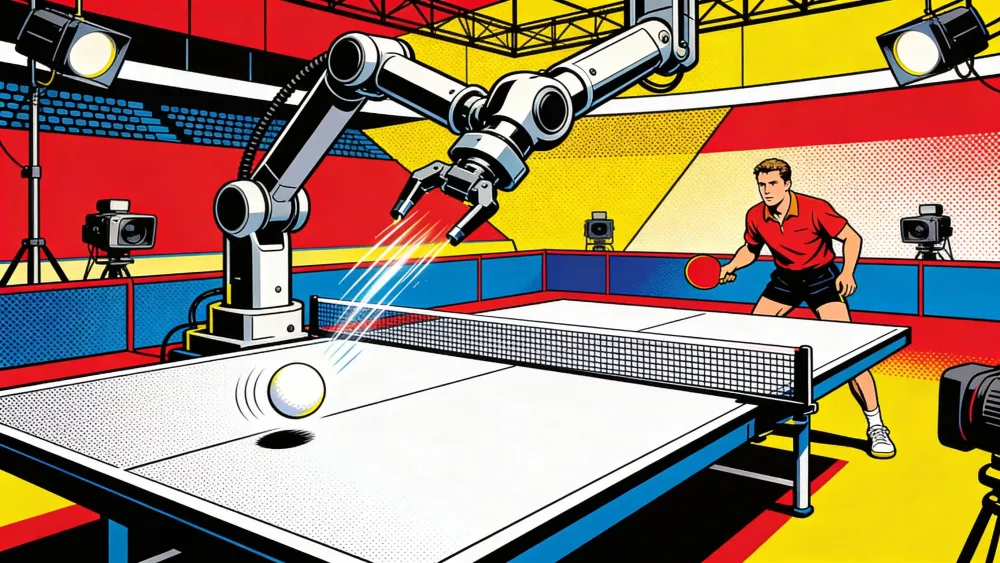
Sony AI's Ace robot has become the first peer-reviewed autonomous table-tennis system shown beating elite human players under close-to-official competition rules, according to a Nature paper published April 22 and Reuters reporting on the project. In April 2025 matches in Tokyo, Ace beat three of five elite players, lost both matches against professional players, and took one game out of seven from those professionals. Sony says later versions improved enough to beat professional players in December 2025 and March 2026, a claim Sony AI repeated around the Nature release.
That makes Ace real news. It also makes the easy version of the story too neat. The point is not that a robot now owns table tennis, or that general-purpose humanoids just moved closer by a year. The point is narrower and more useful: Sony built a wind tunnel for physical AI, then proved that a full-stack machine can beat highly trained humans inside it. If you want to know where embodied AI is actually advancing, watch the court around the robot, not just the paddle.
Key Takeaways
- Ace beat three of five elite players in peer-reviewed matches, while April 2025 professional matches were losses.
- Sony says later versions beat professionals, but those wins still need full public match data.
- The breakthrough is a sensor-rich court, spin estimation, RL control, and custom high-speed hardware.
- Ace points to constrained physical AI, not general-purpose robot deployment.
AI-generated summary, reviewed by an editor. More on our AI guidelines.
The court was the machine
Ace looks like a player, but it wins like an instrumented system. The robot uses nine synchronized cameras to locate the ball in three dimensions at 200 hertz, with 3.0 millimeters of average error and 10.2 milliseconds of average latency, according to the Nature paper. Three gaze-control systems then track the ball's logo with event-based vision sensors, mirrors, and tunable lenses to estimate spin at roughly 400 to 700 hertz.
That matters because table tennis is a hidden-state game. At high level, the ball is brutal: more than 20 meters per second, sometimes under half a second between shots, and spin that can touch 1,000 radians per second. A normal camera feed sees a blur. A player reads the opponent's wrist, torso, face, pressure, and habit. Ace reads the ball itself, with the court acting as its nervous system.
This is where corporate pride and scientific anxiety meet. Sony can claim a breakthrough because Ace did not merely rally with a cooperative human. It played umpired matches with standard balls, standard tables, licensed officials, and human opponents free to attack. Yet the achievement depends on an arena humans do not get. Ace's eyes sit around the court. That does not cheapen the result. It defines it.
The scoreline needs a split screen
The clean peer-reviewed number is three out of five against elite players. The professional number in the paper is harsher: zero matches out of two, with one game won out of seven. Sony's later professional wins may be real, and Reuters and AP both carried the company's post-review claim. The Guardian reported continued improvement after the Nature submission. Still, those later matches do not yet carry the same public data tables, shot distributions, and method detail as the Nature evaluation.
That distinction should shape the headline you carry away. Ace is not proven professional-dominant. It is proven elite-competitive, with Sony-reported professional wins after further tuning. The difference matters because robotics markets run on impatience. Investors want a clean line from sports victory to factory value. Engineers know the line bends through sensors, calibration, safety cases, cost, and repeatability.
The useful calculation is simple. Ace needed 12 external optical systems to beat three elite players in the published test. That is not a flaw. It is the price of making a physical benchmark honest enough to count. The wind tunnel does not look like the open road, but it tells you whether the aircraft can fly.
Spin is the real frontier
The showy part of Ace is the racket moving faster than a human can parse. The better clue is spin. The Nature paper says Ace returned shots up to 14 meters per second consistently, sustained more than a 75 percent return rate up to 450 radians per second of spin, and returned human shots measured as high as 19.6 meters per second and 867 radians per second.
That is why the result lands beyond a lab demo. Earlier table-tennis robots could look impressive while avoiding the hardest part of the sport. Skilled players do not just hit hard. They hide spin, vary rhythm, set up third-ball attacks, and punish bland returns. Ace's event-camera stack let it see one of the variables that usually stays tactical.
Humans still found seams. Rui Takenaka told Reuters that complex-spin serves often came back complex, while simpler knuckle serves produced simpler returns he could attack. The Guardian reported that Ace also struggled earlier with slow, low-spin balls before improvements. That is not a minor footnote. It shows the gap between sensorimotor skill and match intelligence.
Physical AI, without the demo fog
Strategic AI news from San Francisco. No hype, no "AI will change everything" throat clearing. Just what moved, who won, and why it matters. Daily at 6am PST.
No spam. Unsubscribe anytime.
Physical AI is getting a better test
Ace belongs in a line that starts long before this week. Researchers have been trying to solve robot ping-pong since John Billingsley's 1983 project made it a benchmark. Google DeepMind's 2024 table-tennis robot reached amateur-level competitive play, reporting a 45 percent win rate across 29 matches and stronger performance against intermediate players. Sony moved the ladder up by combining event-based spin sensing, simulation-trained control, a custom eight-degree-of-freedom platform, and official-style matches against stronger humans.
That stack is the lesson. Ace's controller queries a reinforcement-learning policy every 32 milliseconds, then turns those outputs into a one-kilohertz trajectory with optimization and safety fallbacks. It did not win because one model got big enough. It won because the system gave the model the right state, fast enough, then bounded what the robot could safely do with it.
If you build software, that may feel oddly old-fashioned. More data, bigger models, better prompts, new wrapper. Physical AI does not grant that shortcut. A missing spin estimate cannot be fixed after the ball is past the racket. A delayed actuator turns insight into a missed point. A safety fallback is not paperwork when a robot arm is swinging near a human athlete.
The market will overread the rally
Sony and others will point from Ace toward manufacturing, service robotics, sports training, entertainment, and safety-sensitive physical domains. Some of that is fair. Fast state estimation, real-time control, simulation-to-real training, and safe fallback motion all matter outside table tennis. A factory robot handling moving parts or a training machine reacting to an athlete could borrow pieces of this stack.
The leap to general robots is weaker. Jan Peters, a robotics professor who has worked on table-tennis robots, told the Guardian that table tennis does not solve object manipulation and that useful public robotics still requires engineering. AP also noted the fairness issue around Ace's external cameras and sensor-rich court.
That is the sober version investors may dislike and researchers may respect. Ace is a new kind of proof, not a product map. It proves that a tightly designed physical-AI system can cross an expert-human threshold in a fast sport. Laundry, warehouse bins, hospital assistance, city sidewalks. Those are different jobs, and Ace does not prove it can do them.
The next match is repeatability
The next evidence should be boring in the best way. Start with the December 2025 and March 2026 match package, not another highlight reel. Name opponents and rankings. Show full scores, serve order, shot speeds, spin buckets, return rates, rule exceptions, umpire credentials, and repeated matches after humans study the robot. Then vary the cameras and lighting to see how much performance depends on the wind tunnel.
That is where Ace can become more than a launch-day clip. The machine has already created pride inside Sony and envy across robotics labs. It should also create discipline. The harder match is not against a surprised elite player seeing a strange opponent for the first time. It is against scouting, replication, smaller sensor budgets, and transfer outside the court.
Ace did not make robots generally athletic. It made physical AI harder to dismiss.
Frequently Asked Questions
Did Sony's Ace beat professional table-tennis players?
In the peer-reviewed April 2025 Nature evaluation, no. Ace lost both professional matches and won one game out of seven. Sony says later versions beat professional players in December 2025 and March 2026, but those later wins are company-reported and need fuller public match data.
What made Ace technically different from earlier table-tennis robots?
Ace combines nine synchronized cameras, three event-camera gaze-control systems for spin, a reinforcement-learning rally policy, one-kilohertz trajectory execution, safety fallbacks, and a custom eight-degree-of-freedom robot platform. The result came from the full stack, not one model.
Why does spin matter so much in this result?
Spin changes the ball's flight, table bounce, and racket bounce. Skilled players use it to hide intent and create attacks. Ace's event-camera setup estimates spin fast enough to return high-spin shots that earlier robots often simplified away or missed.
Does Ace prove general-purpose robots are close?
No. Ace is a strong benchmark result in a structured, sensor-rich court. Homes, hospitals, warehouses, and streets have messier objects, goals, and safety problems. The transferable lesson is fast perception and control in constrained settings.
What should Sony publish next?
The key next step is full data for the December 2025 and March 2026 professional wins: opponent names, rankings, scores, serve order, telemetry, rule details, umpire credentials, and rematches after human players study the robot.
AI-generated summary, reviewed by an editor. More on our AI guidelines.
Free AI briefing · Weekdays
The AI stories that matter, sourced and explained.
Join the Morning Briefing. It goes out every weekday at 4:45 a.m. Pacific, with later sends for the East Coast, Berlin and Tokyo.
Free when you sign up: The Paperclip Compendium, our tested guide to running AI agents.
Free. Unsubscribe in one click.

Marcus Schuler
Editor-in-Chief and founder of Implicator.ai. Former ARD correspondent and senior broadcast journalist with 10+ years covering tech. Writes daily briefings on policy and market developments. Based in San Francisco. E-mail: editor@implicator.ai